
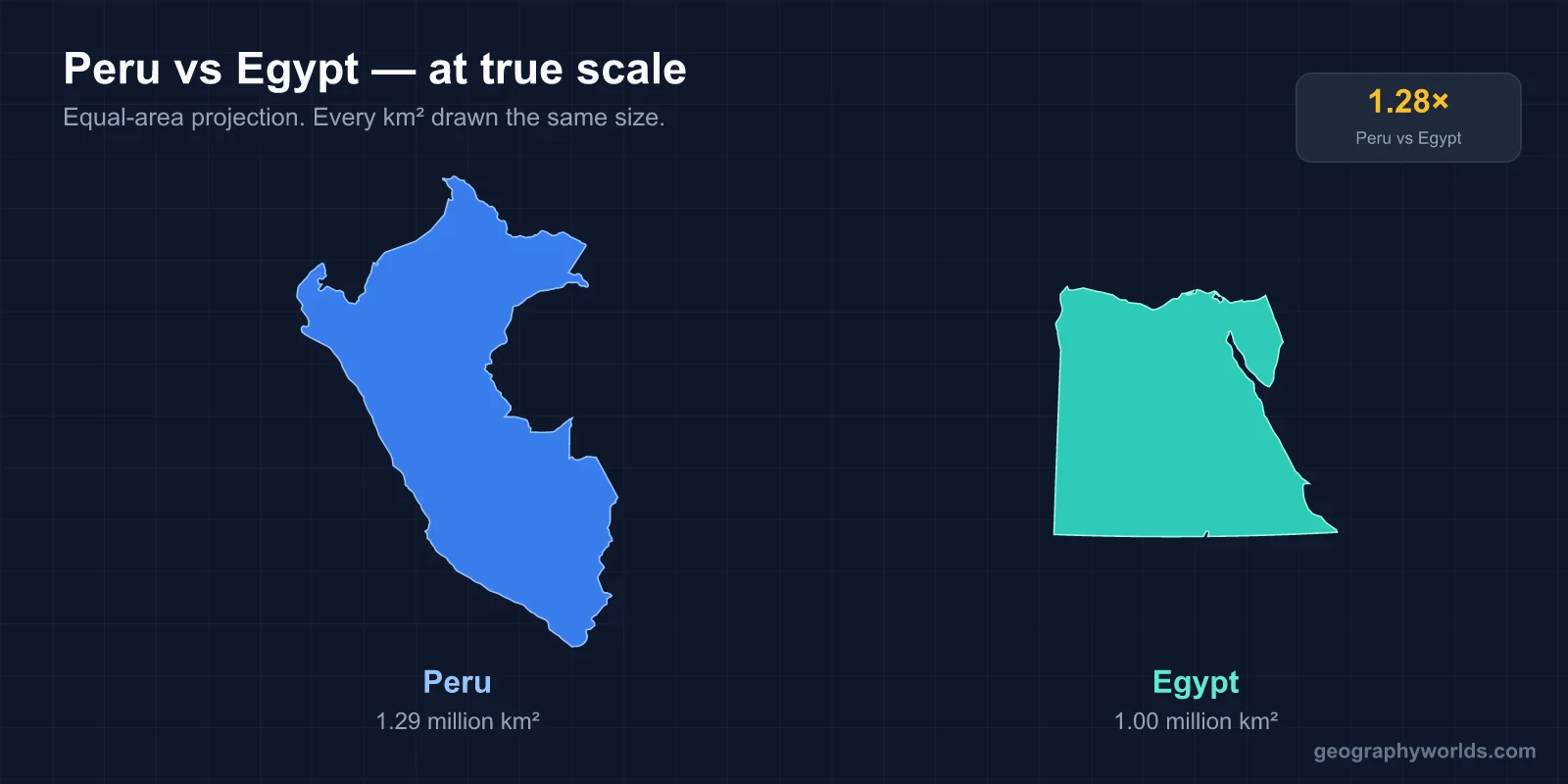
Yes. Peru is larger than Egypt. Peru covers 1,285,216 km², while Egypt covers 1,001,450 km². Peru is about 1.28 times the size of Egypt — larger by 283,766 km², about the size of Italy. But Egypt has more than 3× the population of Peru (110 million vs 34 million Peruvians).
The Short Answer
Peru is the 19th-largest country in the world and the 3rd-largest in South America (after Brazil and Argentina). Egypt is the 30th-largest globally and the 13th-largest in Africa. Both are major regional powers with deep historical legacies — Peru as home to the Inca Empire and earlier civilizations, Egypt as home to one of the world's oldest continuous civilizations.
Both countries are characterized by major rivers (Amazon and tributaries in Peru, Nile in Egypt) that shape their geographies and human settlements. But the climatic, cultural, and historical contexts are fundamentally different.

The Real Numbers
- Peru total area: 1,285,216 km² (496,225 sq mi)
- Egypt total area: 1,001,450 km² (386,662 sq mi)
- Difference: 283,766 km² — about the size of Italy
- Ratio: Peru is about 1.28× the size of Egypt
Population
Egypt has more than 3× more people:
- Egypt population: ~110,000,000
- Peru population: ~34,000,000
- Egypt density: ~110 people per km²
- Peru density: ~26 people per km²
Egypt has 3.2× more people than Peru. Egypt's density is 4.2× higher. But this masks important differences: Egypt's 110 million are concentrated in just 5% of the country (along the Nile), while Peru's 34 million are spread across coastal cities (Lima dominates), the Andean highlands, and Amazonian lowlands.
Geography
Peru has remarkable geographic diversity:
- Coastal Desert: Narrow strip along the Pacific, home to Lima and most cities
- Andes Mountains: Central highlands, including Huascarán (6,768 m) — Peru's highest peak
- Amazon Basin: 60% of Peru's territory but only 12% of population — Iquitos is the largest city not accessible by road in the world
- Lake Titicaca: The highest navigable lake in the world (3,812 m)
- Macchu Picchu and Inca sites: In the Andean highlands
Egypt is dominated by desert:
- Nile Valley and Delta: Inhabited green strip from south to north
- Western Desert: Part of the Sahara
- Eastern Desert: Between Nile and Red Sea
- Sinai Peninsula: Between Africa and Asia
- Mediterranean and Red Sea coasts
Climate
Peru has three main climate zones due to its varied geography. The coast is mostly desert (Lima receives just 7 mm of rain annually — one of the driest cities in the world). The Andes have alpine and tropical climates depending on elevation. The Amazon basin is tropical wet — humid year-round with heavy rainfall.
Egypt is essentially hot desert throughout. Summer temperatures regularly exceed 40°C. Winters are mild. Rainfall is minimal — less than 25 mm annually in most of the country.
Economy
Both have similar GDP totals:
- Egypt GDP: ~$398 billion
- Peru GDP: ~$268 billion
- Egypt per capita GDP: ~$3,600
- Peru per capita GDP: ~$7,900
Egypt's economy is about 48% larger than Peru's in absolute terms, but Peru is about 2.2× richer per capita. Egypt has a more diverse economy — tourism, Suez Canal, manufacturing, agriculture. Peru is heavily dependent on mining (copper, gold, silver, zinc), agriculture, fishing (one of the world's largest anchovy fisheries), and increasingly tourism.
Historical Civilizations
Both countries are home to some of the most impressive ancient civilizations. Peru's territory housed the Norte Chico civilization (3000 BC), the Chavín, Moche, Nazca, Wari, and finally the Inca Empire (15th-16th century) — the largest pre-Columbian empire in the Americas. Machu Picchu is the most famous Inca site.
Egypt had one of the world's oldest continuous civilizations — over 5,000 years of recorded history. The pyramids of Giza (built about 4,500 years ago), hieroglyphic writing, and 30 dynasties of pharaohs left a legacy that continues to influence modern civilization. Egypt's ancient sites at Giza, Luxor, Karnak, and Abu Simbel attract millions of tourists annually.
Tourism
Both countries attract significant tourism for their archaeological heritage. Peru receives about 4.7 million international tourists annually, with Machu Picchu being the top attraction. Cusco, the Sacred Valley, Lake Titicaca, the Amazon, and the Nazca Lines are other major destinations.
Egypt receives about 13 million international tourists annually. The Pyramids of Giza, Luxor's temples, Aswan, and Red Sea resorts (Sharm El Sheikh, Hurghada) are top destinations. Tourism contributes about 12% of Egyptian GDP.
Key Facts
- Peru is about 1.28× the size of Egypt.
- Egypt has 3.2× more people than Peru.
- Peru is 2.2× richer per capita than Egypt.
- Both have ancient civilizations that produced famous archaeological sites.
- Peru has 3 climate zones (desert, Andes, Amazon); Egypt is essentially desert.
Fun Facts
- Peru's Inca Trail is a famous 4-day hike to Machu Picchu — one of the world's most popular treks.
- Egypt has more than 100 pyramids, but the Great Pyramid of Giza is the most famous.
- Peru is the world's largest producer of quinoa.
- Egypt produces about 20% of the world's cotton.
- Both countries have UNESCO World Heritage Sites that are among the most visited in the world.
Languages
Peru's official languages are Spanish, Quechua, and Aymara. Spanish is the most widely spoken (about 84% of Peruvians). Quechua (the Inca language) is spoken by about 13% as a first language and is recognized as a national language. Aymara is spoken near Lake Titicaca. Peru is one of the most linguistically diverse countries in the Americas.
Egypt's official language is Arabic, specifically Modern Standard Arabic for official purposes and Egyptian Arabic for everyday use. Egyptian Arabic is widely understood across the Arab world due to Egypt's dominant film and TV industry. Coptic (the descendant of ancient Egyptian) survives only in the Coptic Christian Church liturgy.
Music and Arts
Peru has a rich musical heritage blending indigenous (Andean pan flutes, charangos), African (Afro-Peruvian rhythms), and Spanish influences. Famous Peruvian artists include Eva Ayllón, Susana Baca, and pop groups across various genres. Literature: Nobel laureate Mario Vargas Llosa is Peruvian.
Egypt has been the cultural and entertainment capital of the Arab world for nearly a century. Egyptian films, TV dramas, and music dominate Arabic-language media. Famous Egyptian singers include Umm Kulthum, Mohammed Abdel Wahab, and Amr Diab. Egyptian literature is also globally influential — Naguib Mahfouz won the Nobel Prize in Literature in 1988.
Cuisine
Peruvian cuisine has been recognized as one of the world's most sophisticated and diverse — combining indigenous Andean traditions, Spanish colonial influences, African, Chinese (Peruvian-Chinese chifa cuisine is a distinctive fusion), and Japanese (Nikkei cuisine) influences. Famous dishes include ceviche (Peru's national dish), pollo a la brasa, lomo saltado, and aji de gallina. Peruvian chef Gastón Acurio has been a global culinary ambassador.
Egyptian cuisine is hearty and grain-based — koshary (the unofficial national dish made of rice, lentils, pasta, and tomato sauce), ful medames (slow-cooked fava beans), molokhia (a green leafy soup), and various stuffed vegetables. Egyptian cuisine has Mediterranean, Arab, and ancient Egyptian influences.
Sports
Both countries are passionate about football (soccer). Egypt has won the Africa Cup of Nations a record 7 times. The Egyptian league features clubs like Al Ahly and Zamalek — two of Africa's most successful football clubs. Peru's football tradition includes World Cup appearances and players like Teófilo Cubillas (one of football's great strikers in the 1970s) and modern stars like Paolo Guerrero. Both countries' football fans are notably passionate about their national teams.
Economic Resources
Peru is one of the world's top mining countries — the world's 2nd-largest producer of copper, silver, and zinc. Mining contributes a significant portion of Peru's economy and exports. The country also has substantial fisheries (Peru is the world's largest anchovy fishery), agriculture, and growing tourism. Lima is increasingly a regional financial center.
Egypt's economy is driven by Suez Canal revenues (about $9 billion in 2023), tourism, manufacturing, agriculture (Nile delta), oil and gas, and remittances from Egyptians working abroad. The country has been working to expand its industrial base and reduce dependence on a few sectors. Cairo serves as a regional commercial hub. Both countries also benefit significantly from their archaeological heritage tourism, which provides ongoing economic returns from their ancient civilizations.
The Bottom Line
Peru is bigger than Egypt by area (28% larger), but Egypt has 3× more people and a larger total economy. Per capita, Peru is richer. Both countries have profound historical significance through their ancient civilizations and continue to draw millions of tourists annually. They represent different scales of geographic and demographic settlement, but share characteristics of major regional cultural powers with deep heritage.
Quiz Ancient Civilizations!
Test your knowledge of Peru, Egypt, and the ancient world.
Play Geography Games →