
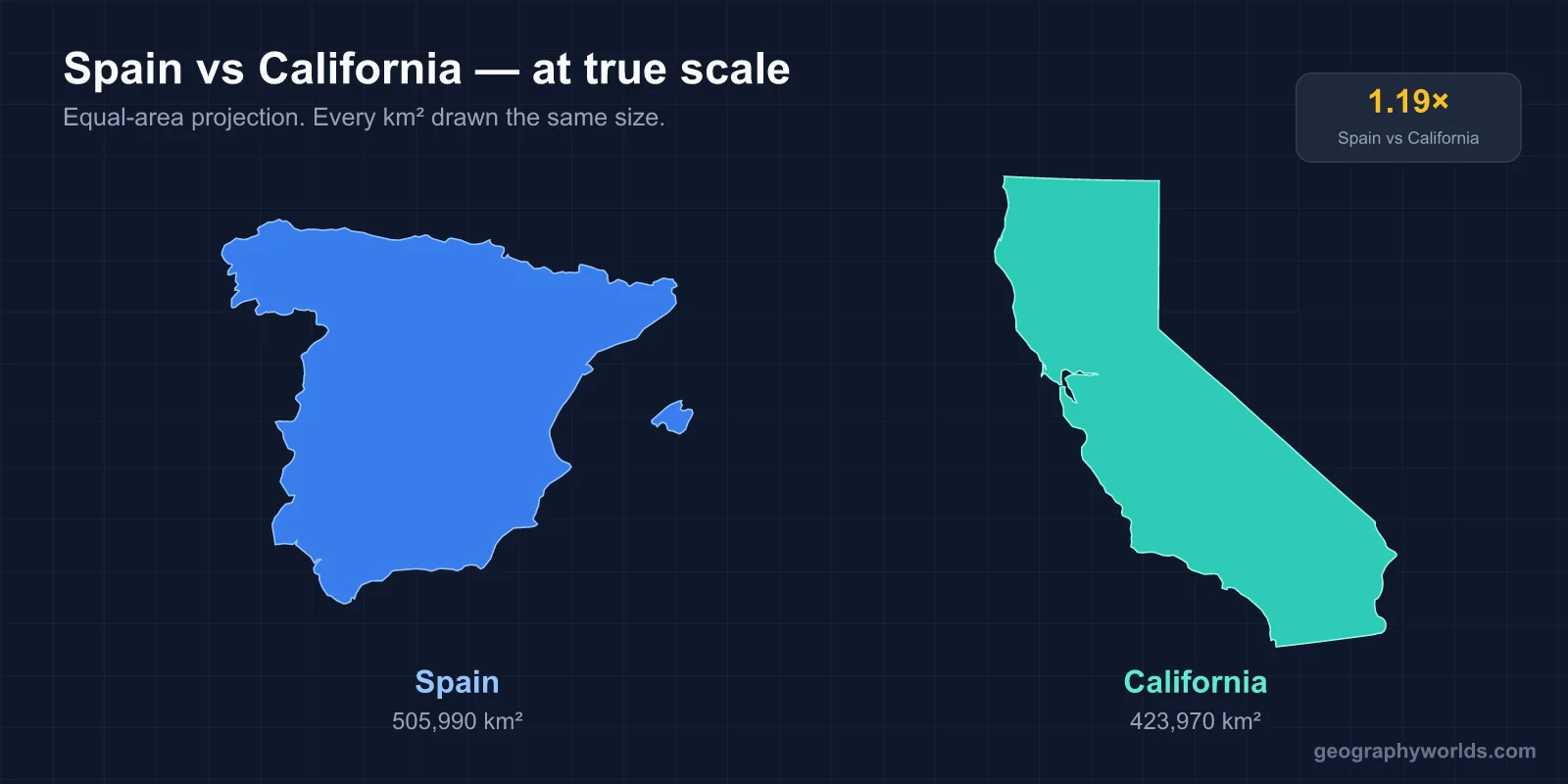
Spain is one of Europe's largest countries by area; California is by far the most populous US state and one of the largest by area. The two share Mediterranean-type climates, large agricultural sectors, and rich cultural histories. So how do they compare in size? Spain has the edge — but not by a huge margin.
The Short Answer
Yes, Spain is bigger than California. Spain covers 505,990 km². California covers 423,970 km². Spain is approximately 19% larger than California.
Side-by-Side Numbers
- Spain area: 505,990 km² (195,360 sq mi)
- California area: 423,970 km² (163,696 sq mi)
- Difference: Spain is ~82,000 km² larger
- Ratio: Spain is ~1.19× the size of California
- Spain population: ~48 million
- California population: ~39 million
Spain
Spain occupies most of the Iberian Peninsula in southwestern Europe, plus the Balearic Islands in the Mediterranean, the Canary Islands in the Atlantic off northwest Africa, and the small North African enclaves of Ceuta and Melilla. It borders Portugal to the west, France and Andorra to the northeast, the Mediterranean Sea, and the Atlantic Ocean. Spain is the 4th largest country in Europe and the 51st largest in the world.
Madrid is the capital and largest city (about 3.3 million in the city, 6.7 million in the metro area). Other major cities include Barcelona, Valencia, Seville, Zaragoza, and Málaga. Spain is divided into 17 autonomous communities with varying degrees of independence, including Catalonia, the Basque Country, Galicia, and others with strong regional identities. The country is famous for its diverse landscapes — from the Pyrenees in the north to the desert-like Almería in the southeast.
California
California is the most populous US state with about 39 million people, and the 3rd largest by area after Alaska and Texas. It borders Oregon to the north, Nevada and Arizona to the east, Mexico to the south, and the Pacific Ocean to the west. California has been a US state since 1850, joining as the 31st state shortly after the Gold Rush of 1849 brought hundreds of thousands of settlers to the territory.
California's geography is extraordinarily varied. The Sierra Nevada mountains run along the eastern edge (with Mount Whitney, the highest peak in the contiguous US at 4,421 m). The Central Valley dominates the middle of the state — one of the most productive agricultural regions on Earth. The Coast Ranges separate the valley from the Pacific. Death Valley, in eastern California, is the hottest and lowest place in North America (−86 m below sea level). The state has every climate type from arctic-alpine in the high Sierras to subtropical desert in the southeast.
Population
Spain has about 48 million people; California has about 39 million. Spain has slightly more people in a slightly larger area. Population density is similar — about 95 per km² in Spain and 92 per km² in California. Both Spain and California have most of their population concentrated in coastal regions and major cities.
Economy
California has the larger economy. California's GDP is about $3.8 trillion — if it were a country, it would be the 5th largest economy in the world, larger than India's. Spain's GDP is about $1.6 trillion, making it the 4th largest in the EU and 15th largest globally. California's economy is dominated by technology (Silicon Valley), entertainment (Hollywood), agriculture (largest agricultural state in the US), and tourism. Spain's economy is more diversified across tourism (one of the world's top destinations), automotive manufacturing, agriculture (olive oil, wine, fruit), banking, and renewable energy.
Climate
Both share Mediterranean climate zones in much of their territory. Coastal Spain (particularly the Mediterranean coast from Catalonia south through the Costa del Sol) has hot, dry summers and mild, wet winters — classic Mediterranean climate. Coastal California (from the Bay Area down to San Diego) has very similar conditions, hence the close fit between Spanish wine, olive, and citrus agriculture and California's. Inland California (Central Valley) is hotter and drier than coastal areas; inland Spain (the Meseta plateau) is similar. Northern Spain (the Atlantic coast) is wet and cool, while northern California (around the Redwoods) is similarly wet and cool. Both regions face drought and wildfire challenges driven by climate change.
Geography Details
Spain has about 4,964 km of coastline; California has about 1,350 km. The Pyrenees Mountains separate Spain from France in the north, with peaks over 3,400 m. The Sierra Nevada mountains in California reach 4,421 m at Mount Whitney. Both have major agricultural valleys — Spain's Andalusian plain (Guadalquivir Valley), Castile-La Mancha, and the Ebro Valley; California's Central Valley. Both have desert regions — the Tabernas Desert in Almería, Spain (the only true desert in Europe); the Mojave and Colorado Deserts in southeastern California.
History
Spain has one of the longest documented histories in Europe. The Iberian Peninsula has been continuously inhabited for tens of thousands of years. The Phoenicians, Greeks, Carthaginians, Romans, Visigoths, Moors, and finally the Castilians and Aragonese have all shaped the region. Under Charles V and Philip II, Spain became the world's largest empire (16th century), spanning the Americas, the Philippines, and parts of Europe and Africa. Modern Spain became a democracy in 1975 after the death of dictator Francisco Franco, joined the EU in 1986, and has been a major European power since.
California has been inhabited for at least 13,000 years by hundreds of distinct Indigenous tribes — more than any other US state. Spanish missionaries established the first European settlements in the late 1700s. California was briefly part of independent Mexico (1821–1848) before being ceded to the US after the Mexican-American War. The Gold Rush of 1849 brought rapid population growth, leading to statehood in 1850. The 20th century saw California become an economic and cultural powerhouse — Hollywood from the 1920s, Silicon Valley from the 1960s, and continuous innovation in technology, entertainment, and agriculture.
Cultural Connections
Spain and California have unusually deep cultural connections. Spanish missions in California (21 missions built between 1769 and 1833) gave the state place names from San Francisco to San Diego to Los Angeles to Santa Barbara. Spanish architecture, especially mission revival and Spanish colonial styles, defines large portions of California cities. Mexican American culture in California (about 40% of California residents are Hispanic, mostly of Mexican descent) creates ongoing connections to the broader Spanish-speaking world. California cuisine, agriculture (citrus, olives, grapes, wine), and even surf culture share deep DNA with Spanish counterparts.
Tourism
Spain is one of the world's top tourism destinations, ranking 2nd globally after France with about 85 million international visitors per year. Top destinations include Madrid, Barcelona, Seville, Granada, the Balearic and Canary Islands, the Costa del Sol, and the Camino de Santiago pilgrimage. California receives about 28 million international tourists per year plus hundreds of millions of domestic visitors. Major attractions include Los Angeles (Hollywood, Disneyland), San Francisco (Golden Gate, Alcatraz), Yosemite National Park, Disneyland, Napa Valley wine country, Lake Tahoe, the Redwoods, and the Pacific Coast Highway.
Wine and Agriculture
Both are major wine and food producers, and the parallel runs deep. Spain has more land under vineyard than any other country in the world (over 1 million hectares), though it ranks third in total wine production. Famous wine regions include Rioja, Ribera del Duero, Priorat, Rías Baixas (for Albariño), and Jerez (for sherry). California produces nearly 90% of US wine, with Napa, Sonoma, Paso Robles, the Santa Ynez Valley, and the Central Coast being the major regions. Both produce excellent olive oil — Spain is the world's largest producer; California is the leading US producer. Both have significant citrus, almond, and fruit industries. The Mediterranean climate that makes both regions so productive is increasingly under threat from prolonged droughts.
Key Facts
- Spain is about 19% larger than California by area.
- Spain has 23% more people than California.
- California has the larger economy (~$3.8T vs ~$1.6T).
- Both have classic Mediterranean climate zones.
- California place names reflect deep Spanish colonial history.
Fun Facts
- If California were a country, it would be the 5th largest economy in the world.
- Spain is the world's largest producer of olive oil.
- Mount Whitney (CA) is taller than any peak in Spain.
- About 40% of Californians are Hispanic, the largest share of any US state.
- Spain has 4 official languages: Spanish, Catalan, Galician, Basque.
The Bottom Line
Spain is larger than California — by about 19%. They're both regions of remarkable geographic, demographic, and cultural depth, and they share more in common than people often realize — Mediterranean climates, agricultural wealth, Spanish-language heritage, and global cultural influence well beyond their physical size. Both will continue to shape Europe and North America respectively in the decades ahead.
Quiz Spain and California!
Test your knowledge of Spain, California, and Mediterranean geography.
Play Geography Games →