
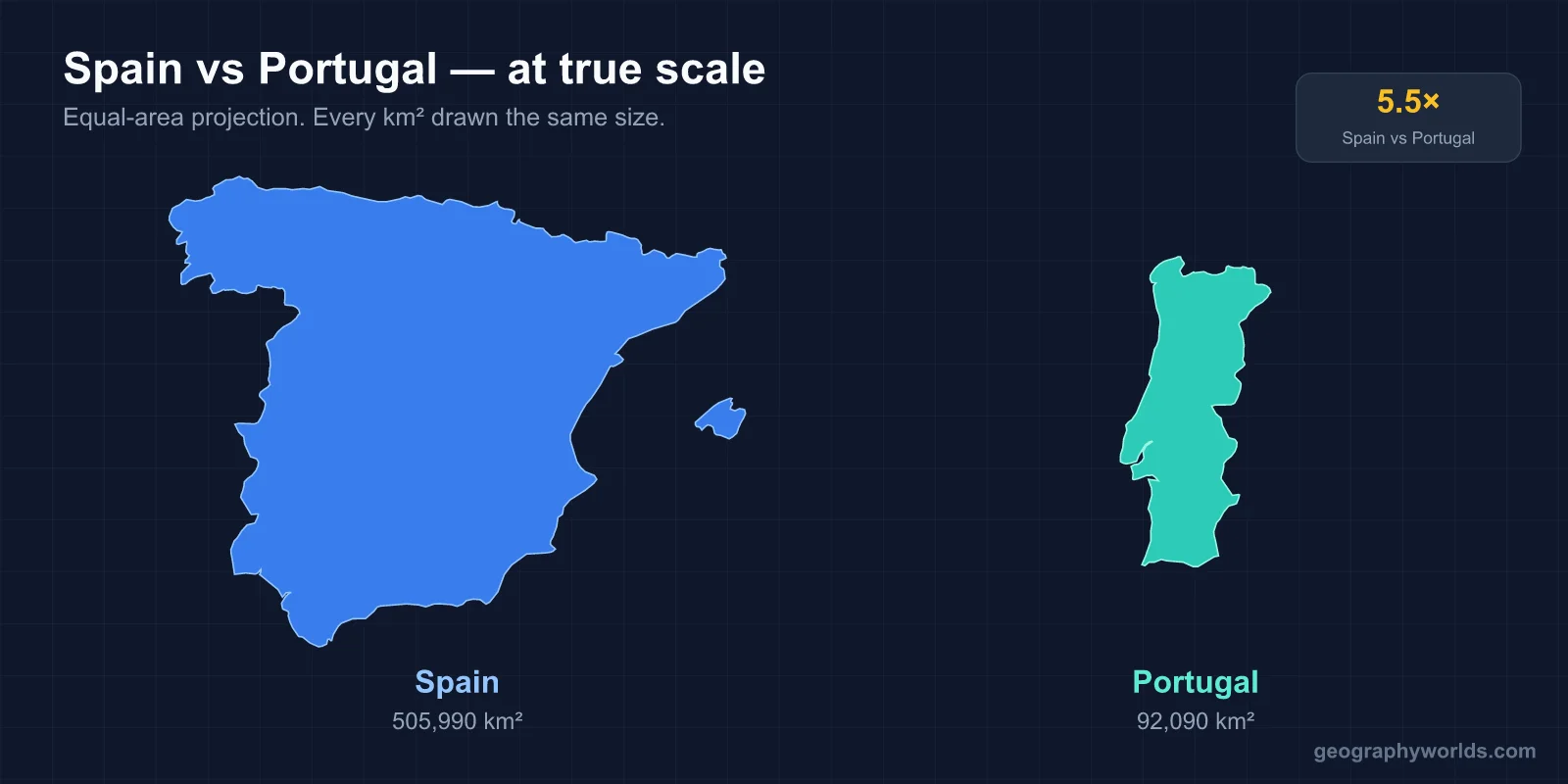
Yes. Spain is much larger than Portugal. Spain covers 505,990 km², while Portugal covers 92,090 km². Spain is about 5.5 times the size of Portugal — large enough to fit almost six Portugals inside its borders. Spain also has about 4.5× more people, making it dramatically bigger by every measure.
The Short Answer
Spain and Portugal share the Iberian Peninsula in southwestern Europe, but Spain dominates the peninsula by a wide margin. Spain occupies about 85% of the peninsula's 583,000 km² total area, while Portugal occupies about 15%. The size disparity is one of the largest between any two bordering countries in Europe.
Despite the size gap, both countries are major European cultural powers with deep colonial histories. Spanish is the world's second-most-spoken native language (after Mandarin); Portuguese is the 9th-most-spoken. Both languages spread globally during the Age of Exploration — Spanish to most of the Americas, Portuguese to Brazil and parts of Africa and Asia.

The Real Numbers
- Spain total area: 505,990 km² (195,365 sq mi)
- Portugal total area: 92,090 km² (35,556 sq mi)
- Difference: 413,900 km² — about 4.5× the size of Portugal itself
- Ratio: Spain is about 5.5× the size of Portugal
Spain is the 52nd largest country in the world and the 4th largest in Europe (after Russia, Ukraine, and France). Portugal is the 110th largest country in the world. The two countries are in completely different size categories globally despite sharing a border.
The Iberian Peninsula
The Iberian Peninsula is the southwestern peninsula of Europe, bounded by the Atlantic Ocean to the west, the Bay of Biscay to the north, the Mediterranean Sea to the east, and the Strait of Gibraltar to the south. The peninsula covers about 583,000 km². It's separated from the rest of Europe by the Pyrenees mountains, which run east-west along the Spain-France border.
Spain occupies the central and eastern parts of the peninsula plus the northern Pyrenean foothills. Portugal occupies a narrow strip along the western Atlantic coast — only about 218 km wide at its widest point. The Atlantic-facing Portuguese coastline runs about 1,793 km from north to south.
Population
Spain has substantially more people than Portugal:
- Spain population: ~48,800,000
- Portugal population: ~10,300,000
- Spain density: ~96 people per km²
- Portugal density: ~112 people per km²
Spain has about 4.7× more people than Portugal. Interestingly, Portugal has slightly higher population density — its smaller area is more uniformly populated, while Spain has vast empty interior plateaus (the Meseta Central) with few people. Both countries have been losing population in recent years due to low birth rates and emigration of young people seeking work elsewhere in Europe.
Geography
Spain has remarkable geographic diversity. The central Meseta plateau averages 600-700 m elevation. The Pyrenees in the north (peaks over 3,400 m) form the border with France. The Sierra Nevada in the south reaches 3,478 m at Mulhacén. Spain has Mediterranean coastline (Costa Brava, Costa del Sol, Balearic Islands), Atlantic coast (Galicia, Asturias, Cantabria), and dry interior (Castile, Aragon, Extremadura). Major rivers include the Tagus, Douro, Ebro, and Guadalquivir.
Portugal is mostly hilly to mountainous, with a long Atlantic coastline. The country's highest peak is Pico in the Azores (2,351 m), but on the mainland the highest is Torre in Serra da Estrela (1,993 m). Portugal's landscape is dominated by river valleys (Douro, Tagus, Mondego) and rolling hills. The coast is famous for its beaches, cliffs, and old fishing villages.
Climate
Spain has more climate variation than Portugal. Northern Spain (Galicia, Asturias) is oceanic — cool, wet, green. Central Spain has a continental climate with cold winters and hot summers. Southern Spain (Andalusia) is Mediterranean — hot dry summers, mild winters. The Spanish Mediterranean coast and Balearic Islands have one of the most pleasant climates in Europe.
Portugal has a Mediterranean climate moderated by Atlantic influence. Summers are warm to hot but with cooler maritime breezes. Winters are mild and wet, especially in the north. Portugal's climate is more uniform across the country than Spain's — there's less variation between regions because the country is smaller and entirely Atlantic-facing.
Economy
Spain has the larger economy of the two:
- Spain GDP: ~$1.62 trillion
- Portugal GDP: ~$269 billion
- Spain per capita GDP: ~$33,000
- Portugal per capita GDP: ~$26,000
Spain's economy is about 6× larger than Portugal's in absolute terms. Per capita, Spain is about 27% richer on average. Spain is the 4th-largest economy in the EU (after Germany, France, Italy). Portugal ranks around 13th in the EU. Both economies are heavily dependent on tourism — Spain receives over 85 million international tourists annually (2nd in the world after France), Portugal receives about 27 million.
Languages
Spain has 4 co-official languages: Castilian Spanish (the national language), Catalan, Galician, and Basque. There are also recognized regional languages like Aranese (Occitan) in Aran Valley. About 9% of Spaniards speak Catalan as a first language; 5% speak Galician; 1% speak Basque.
Portugal's official language is Portuguese. Mirandese is a co-official regional language in a small area of northeastern Portugal (Miranda do Douro region), spoken by about 7,000-10,000 people. Otherwise Portugal is more linguistically uniform than Spain.
Colonial Empires
Both countries built massive colonial empires starting in the late 15th century. The Treaty of Tordesillas in 1494 divided the non-European world between them — Spain got most of the Americas (except Brazil), the Philippines, and parts of North Africa; Portugal got Brazil, much of West and East Africa coastal trading posts, Goa, Macau, and parts of Indonesia.
By the 19th century, both empires had largely dissolved. Spain lost most of its American colonies in the 1810s-1820s (Mexico, Argentina, Colombia, etc.) and the rest in 1898 (Cuba, Puerto Rico, Philippines, Guam). Portugal lost Brazil in 1822 but retained its African colonies (Angola, Mozambique, Cape Verde, Guinea-Bissau, São Tomé and Príncipe) until the 1970s.
Today both countries are democratic EU members, but the colonial legacy is still visible — Spanish is the official language of 21 countries and a co-official language in many more; Portuguese is the official language of 9 countries (Brazil, Angola, Mozambique, etc.) with about 260 million speakers worldwide.
Sports
Both countries are major football (soccer) powers. Spain's La Liga is one of the world's top football leagues, with FC Barcelona and Real Madrid being two of the most famous clubs globally. Spain won the FIFA World Cup in 2010 and three consecutive UEFA European Championships (2008, 2012). Portugal's Primeira Liga features Porto, Benfica, and Sporting CP. Portugal won the UEFA European Championship in 2016 and produced Cristiano Ronaldo, one of the most famous footballers in history.
Tourism
Both countries are major tourist destinations relative to their size. Spain receives about 85 million international tourists annually — second only to France worldwide. Visitors come for the beaches (Costa del Sol, Costa Brava, Balearic Islands), historic cities (Madrid, Barcelona, Seville, Granada), and cultural attractions (Sagrada Família, Alhambra, Prado Museum). Tourism contributes about 12% of Spain's GDP.
Portugal receives about 27 million international tourists annually — large for a country of 10 million. Visitors flock to Lisbon, Porto, the Algarve coast (southern beaches), Madeira and the Azores (Atlantic islands), and the Douro Valley wine region. Tourism is about 14% of Portuguese GDP — proportionally even more important than for Spain. Portugal has been one of the fastest-growing European tourism destinations in the past decade.
Key Facts
- Spain is about 5.5× the size of Portugal.
- Spain has 4.7× more people than Portugal.
- Both countries share the Iberian Peninsula in southwestern Europe.
- Spain's GDP is about 6× larger than Portugal's.
- Both countries have major colonial legacies — Spanish in the Americas, Portuguese in Brazil and Africa.
Fun Facts
- The Spain-Portugal border is one of the oldest in Europe — largely unchanged since 1297.
- Portugal is older as a continuous nation-state than most European countries — established in 1143 (882 years old).
- Spain has 11 cities with over 250,000 people; Portugal has only 2 (Lisbon and Porto).
- Portuguese is the most-spoken language in the Southern Hemisphere, mainly because of Brazil.
- The Tagus River starts in Spain (Spanish: Tajo) and flows through Lisbon (Portuguese: Tejo) before reaching the Atlantic — one river, two names, two countries.
The Bottom Line
Spain is much bigger than Portugal by every measure that matters — area, population, economy, and global presence. Spain occupies about 85% of the Iberian Peninsula; Portugal occupies the rest. Despite this, both countries punch well above their weight culturally, due to their colonial histories and the global reach of Spanish and Portuguese languages.
The two countries have parallel but separate histories — Catholic monarchies, colonial empires, 20th-century dictatorships (Franco in Spain, Salazar in Portugal), modern EU democracies. They're close neighbors with deep ties, but very different scales of geographic and demographic weight.
Quiz European Geography!
Test your knowledge of Iberia and other European regions.
Play Geography Games →