
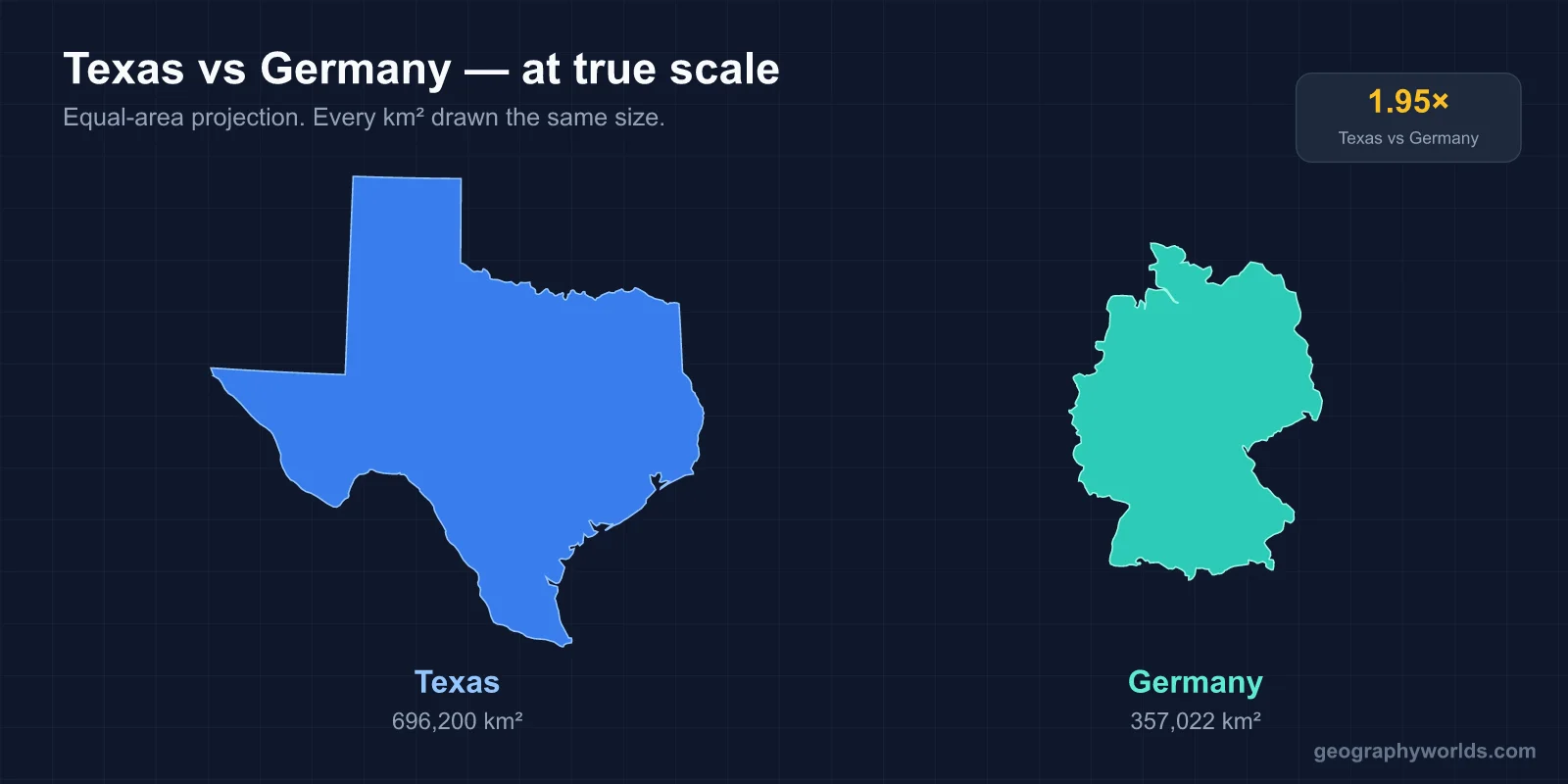
Yes. Texas is significantly larger than Germany. Texas covers 696,200 km² (268,597 sq mi), while Germany covers 357,022 km² (137,847 sq mi). Texas is about 1.95 times the size of Germany — almost exactly twice as large. But Germany has more than 2.7 times Texas's population, making it far more densely settled.
The Short Answer
Texas is roughly the size of two Germanies stacked together — with a sliver of Belgium left over for good measure. That's a big size advantage for Texas. But Germany packs over 83 million people into its smaller area, while Texas spreads 30 million people across nearly twice the land. The result: Germany feels dense, walkable, transit-rich, and intensely built up; Texas feels sprawling, car-dependent, and full of open horizon.
If you took the population of Germany and dropped it into Texas, Texas would suddenly have nearly 84 million people — making it the second-most-populated state (still behind California, briefly) and one of the densest places in North America. Texas's relative emptiness is mostly a function of how it was settled, not its land potential.

The Real Numbers
- Texas total area: 696,200 km² (268,597 sq mi)
- Germany total area: 357,022 km² (137,847 sq mi)
- Difference: 339,178 km² — roughly the size of Finland
- Ratio: Texas is about 1.95× the size of Germany
Globally, Texas would rank around 40th by area if it were a country. Germany ranks 63rd. Both are mid-sized by world standards, but Texas is comfortably in the larger half. The gap between them (Finland-sized) is itself larger than most countries.
Population: Germany Wins Big
While Texas has more land, Germany has many more people:
- Germany population: ~83,800,000
- Texas population: ~30,500,000
- Germany density: ~235 people per km²
- Texas density: ~44 people per km²
Germany has roughly 2.75× more people than Texas, packed into 51% less land. Germany's population density is about 5.3× higher than Texas's. Germany feels intensely populated by US standards — German cities are old, dense, and connected by some of the world's best rail and roads. Texas feels intensely empty by European standards, especially in West Texas and the Panhandle.
Economy: Germany Is the European Powerhouse
Germany is Europe's largest economy. Texas is the second-largest state economy in the US. Comparing them:
- Germany GDP: ~$4.5 trillion
- Texas GDP: ~$2.4 trillion
- Germany GDP per capita: ~$54,000
- Texas GDP per capita: ~$79,000
Germany's total economy is about 88% larger than Texas's. But on a per-person basis, Texas leads Germany by about $25,000 per capita — a substantial gap. The two economies are structured differently. Germany is industrial powerhouse with strong manufacturing (Volkswagen, BMW, Mercedes, Siemens, BASF), engineering, and exports. Texas is more diversified: oil and gas, tech (Austin), aerospace (Houston), agriculture, and services.
Cities
Germany's cities are smaller individually than Texas's megacities. Berlin (~3.7 million) is the largest German city, followed by Hamburg (~1.9 million), Munich (~1.5 million), Cologne (~1.1 million), and Frankfurt (~750,000). These are dense, mostly compact urban areas with old historical cores and modern districts.
Texas has Houston metro (~7.3 million), Dallas-Fort Worth metro (~7.9 million), San Antonio metro (~2.6 million), and Austin metro (~2.4 million). Each Texan metro is larger than the largest German city by metro population. But German cities feel different — denser, more walkable, less car-dependent. Texas cities are typically sprawling suburban networks with car-centric urban planning.
Climate and Landscape
Germany has a temperate climate — oceanic in the northwest (mild winters, cool summers, frequent rain) and continental in the east (colder winters, warmer summers). Germany's landscape ranges from the Alps in the south (peaks up to 2,962 m at Zugspitze) to the North Sea coast, with the Rhine Valley and Black Forest in between. About 30% of Germany is forested.
Texas has more extreme climate variation — humid subtropical in the east, semi-arid in the central region, arid desert in the west. Summer temperatures regularly exceed 38°C across most of the state. Texas has the Guadalupe Mountains (peak: 2,667 m), the Gulf Coast (367 miles of coastline), the Hill Country, and the Chihuahuan Desert. Forests cover about 25% of Texas, concentrated in the Piney Woods of East Texas.
Transportation
Germany has one of the world's most developed rail networks. The Deutsche Bahn ICE high-speed rail connects most major cities at speeds up to 300 km/h. Local S-Bahn and U-Bahn networks make most German cities navigable without a car. The Autobahn highway system is famous for its unlimited-speed sections.
Texas has almost no passenger rail — Amtrak operates limited routes, but most Texans drive everywhere. The state has more total highway miles than any other US state (about 313,000 miles of state-maintained roads). Texas highways are wide and well-built, but cities like Houston have notorious traffic that consumes hours of residents' lives. The car-dependence is a defining feature of Texan life that has no real equivalent in Germany.
History and Federalism
Germany became a unified country in 1871, was divided after World War II (1949-1990), and reunified after the fall of the Berlin Wall. Modern Germany is a federal republic with 16 states (Länder), each with significant autonomy in education, police, and cultural affairs.
Texas became an independent country in 1836, joined the US in 1845, seceded during the Civil War (1861-1865), and was readmitted after Reconstruction. Texas is one of 50 US states with similar levels of federal autonomy. The federal-state relationship in both countries is similar in spirit — significant local autonomy under a national government — but the historical contexts are very different.
Languages
Germany speaks German (with regional dialects like Bavarian, Swabian, and Low German still spoken). About 65% of Germans speak some English as a second language, especially younger and urban populations. Turkish is the largest minority language (about 3% of the population).
Texas's primary language is English, but Spanish is widely spoken — about 28% of Texans speak Spanish at home. Other languages include Vietnamese, Chinese, and German (yes — the Hill Country has German-speaking communities dating to 19th-century immigration). Fredericksburg, Texas still holds Oktoberfest and has German-language signs in some shops.
Federal Structure Comparison
Germany has 16 states (Länder), each with elected parliaments and significant local autonomy. The largest German states by area are Bavaria (70,550 km²), Lower Saxony (47,615 km²), and Baden-Württemberg (35,751 km²). Bavaria alone is bigger than Belgium, but only about 10% the size of Texas. So a single Texan county can sometimes be larger than a small German state.
Texas has 254 counties — the most of any US state. The largest by area, Brewster County (16,058 km²), is bigger than several German states (Saarland, for instance, is just 2,569 km²). Loving County (1,749 km²) has fewer than 100 residents — a level of emptiness that doesn't exist anywhere in Germany, where even rural districts have meaningful population. The administrative geography of both places reflects their very different settlement histories.
Key Facts
- Texas is about 1.95× the size of Germany.
- Germany has 2.75× more people than Texas.
- Germany's population density is 5.3× higher than Texas's.
- Germany's total GDP is about 88% larger than Texas's.
- Texas has higher per-capita GDP ($79K vs Germany's $54K).
Fun Facts
- The Texas Hill Country has German-speaking communities founded in the 1840s — Fredericksburg, New Braunfels, and others.
- If Texas were in Europe, it would be the second-largest country after Ukraine.
- Texas has more wind energy capacity than any country in Europe except Germany.
- Both Texas and Germany have famous beer cultures — Shiner Bock is Texan; Oktoberfest is global.
- King Ranch in Texas (3,340 km²) is larger than the German state of Saarland.
The Bottom Line
Texas is about twice the size of Germany by land area. Germany has nearly three times more people and a substantially larger economy in absolute terms. Texas wins on per-capita wealth and physical space; Germany wins on population, infrastructure density, and total economic output. Both are powerhouses by their respective standards — Germany as Europe's economic engine, Texas as one of the world's largest sub-national economies.
The Texas-Germany comparison is a good reminder that "bigger" depends entirely on what you measure. Texas dominates Germany by square kilometers. Germany dominates Texas by people, by GDP, and by industrial output. Neither makes the other smaller; they're just operating at different geographic and demographic scales. Spending time in both reveals the contrast immediately: in Germany, almost every square kilometer feels used — towns, fields, forests, factories. In Texas, hundreds of kilometers can pass between meaningful settlements. Same continents apart, same orders of magnitude in scale.
Test European Geography!
Quiz yourself on Germany and other European countries.
Play Geography Games →