
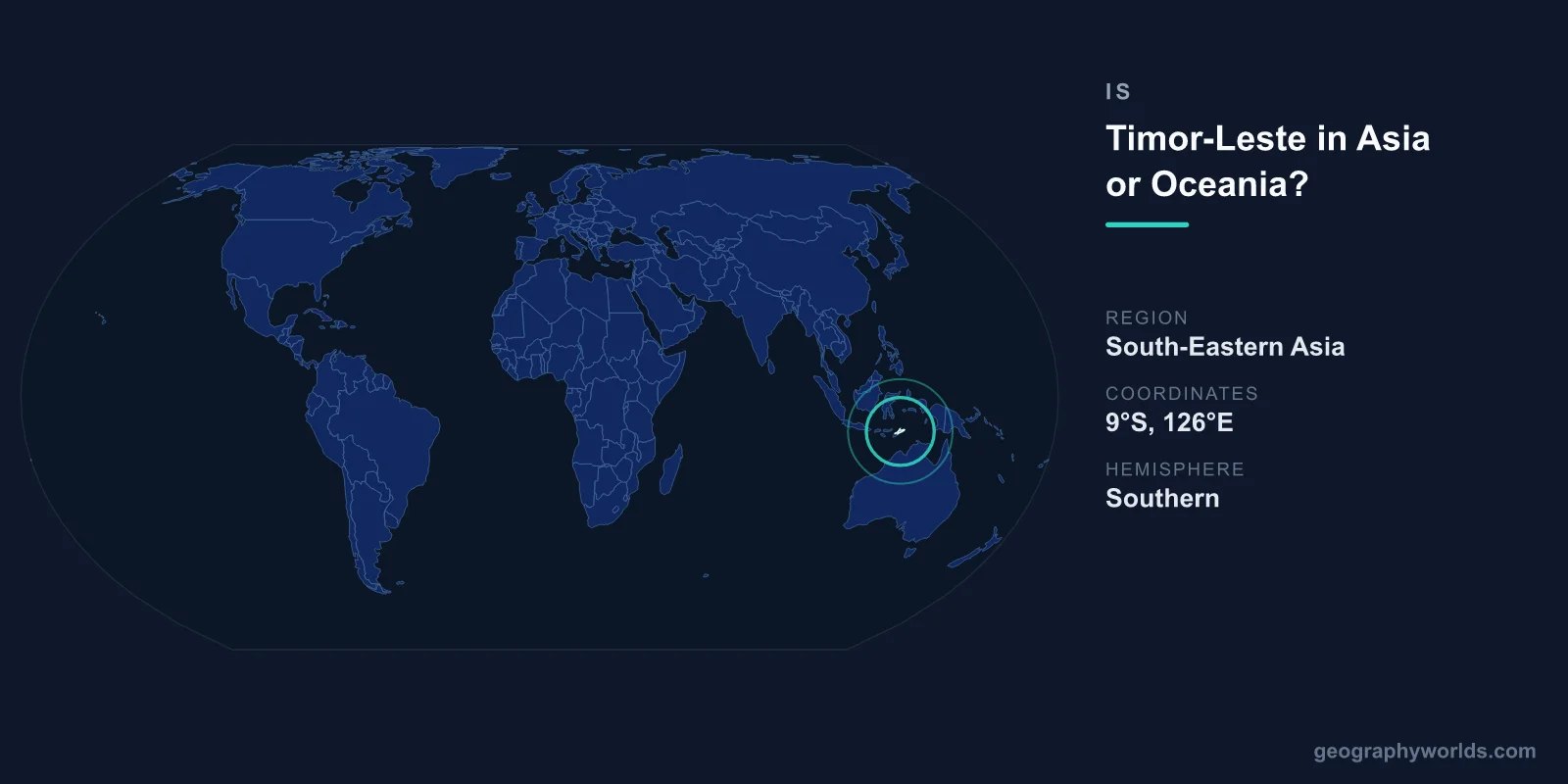
Timor-Leste (East Timor) is in Asia — it is classified as part of Southeast Asia, despite sitting right at the edge of the region where Asia meets Oceania. The confusion is understandable. Timor-Leste lies near a long-debated continental frontier, shares some cultural threads with its Melanesian neighbours, and is closer to northern Australia than to most of mainland Asia. But by every standard geographic, political, and diplomatic convention, this young half-island nation belongs to Asia.
Where Exactly Is Timor-Leste?
Timor-Leste occupies the eastern half of the island of Timor, the largest and easternmost of the Lesser Sunda Islands in the Indonesian archipelago. Its capital, Dili, sits on the northern coast facing the Banda Sea, while the southern shore looks out across the Timor Sea toward Australia. The country also includes the Oecusse exclave — a pocket of territory cut off from the main landmass and surrounded by Indonesian West Timor — plus the islands of Ataúro and Jaco.
In total, Timor-Leste covers roughly 14,874 km², making it one of the smaller countries in Asia by area, comparable in size to a mid-sized European region. Its land border, shared entirely with Indonesia, runs through the middle of Timor island and around the Oecusse enclave. The nearest large neighbour to the south is Australia, about 640 km away across the Timor Sea — close enough that the two countries have negotiated major maritime boundary and oil-and-gas agreements.
Why People Think It Might Be in Oceania
Several genuine factors blur the line. Timor sits south of the Wallace Line, the famous biogeographic boundary identified by naturalist Alfred Russel Wallace, and falls within Wallacea — a transitional zone where Asian and Australasian plants and animals mingle. Ecologically, the island has more in common with Australia than with the Asian mainland, which makes some assume it belongs to Oceania.
Culturally, too, there are Pacific echoes. Many of Timor-Leste's indigenous peoples have linguistic and ancestral ties to Papuan and Melanesian groups, and several local languages belong to non-Austronesian families found further east toward New Guinea. Add the country's proximity to Australia and its participation in some Pacific regional forums, and it is easy to see why Oceania comes to mind. Yet these are overlaps, not a reclassification — Timor-Leste remains firmly on the Asian side of the ledger.
The Case for Asia
The strongest evidence is political and institutional. Timor-Leste identifies as a Southeast Asian state and has spent years pursuing membership in ASEAN (the Association of Southeast Asian Nations), receiving agreement in principle to join as the bloc's eleventh member. ASEAN groups it with neighbours such as Indonesia, Malaysia, and the Philippines — never with Pacific Island nations.
Its modern history is also distinctly Asian. Timor was colonised by Portugal for roughly four centuries, leaving Portuguese as a co-official language alongside the indigenous Tetum. After Portugal withdrew, Indonesia annexed the territory in 1975, and Timor-Leste only secured full independence in 2002 following a long and costly struggle. Its closest political, trade, and migration ties run to Indonesia and the wider Southeast Asian region, reinforcing its Asian classification.
Geography and Landscape
For such a small country, Timor-Leste is strikingly rugged. A spine of steep mountains runs the length of the island, peaking at Mount Ramelau (Tatamailau) at about 2,963 metres — the highest point in the nation and a popular pilgrimage climb. The terrain shapes the climate: a wet northern coast, a drier interior, and dramatic monsoon seasons that influence farming and travel.
The population is around 1.3 million, with a large share living in or near Dili. Subsistence agriculture and coffee exports support much of the country, while offshore petroleum reserves in the Timor Sea have long been a cornerstone of national revenue. Its position in the maritime crossroads between Asia and Oceania has historically made Timor a meeting point for traders, sailors, and cultures from both worlds.
A Quick Note on the Name
The country's name itself reflects its layered history. "Timor" comes from the Malay and Indonesian word timur, meaning "east," while "Leste" is Portuguese for "east." Put together, Timor-Leste literally translates to something like "East East" — a nod to its location at the eastern end of the Lesser Sunda Islands and to the two languages that shaped its identity.
If you want to explore more about this nation's culture, history, and travel highlights, see our timor-leste country guide.
Frequently Asked Questions
Is East Timor the same as Timor-Leste?
Yes. "East Timor" is the common English name, while "Timor-Leste" is the official name combining the Malay and Portuguese words for "east." They refer to the same country.
What continent is Timor-Leste on?
Timor-Leste is on the continent of Asia, specifically within the Southeast Asia subregion. It is grouped with neighbours like Indonesia rather than with Pacific or Oceanian nations.
Is Timor-Leste part of Indonesia?
No. Indonesia annexed and occupied Timor-Leste from 1975 until the territory voted for independence, becoming a fully sovereign nation in 2002. The two countries now share the island of Timor and a land border.
Why is Timor-Leste sometimes linked to Oceania?
It sits south of the Wallace Line in the Wallacea transition zone, lies close to Australia, and shares some Melanesian cultural roots. These geographic and cultural overlaps are why people associate it with Oceania, even though it is classified as Asian.
