
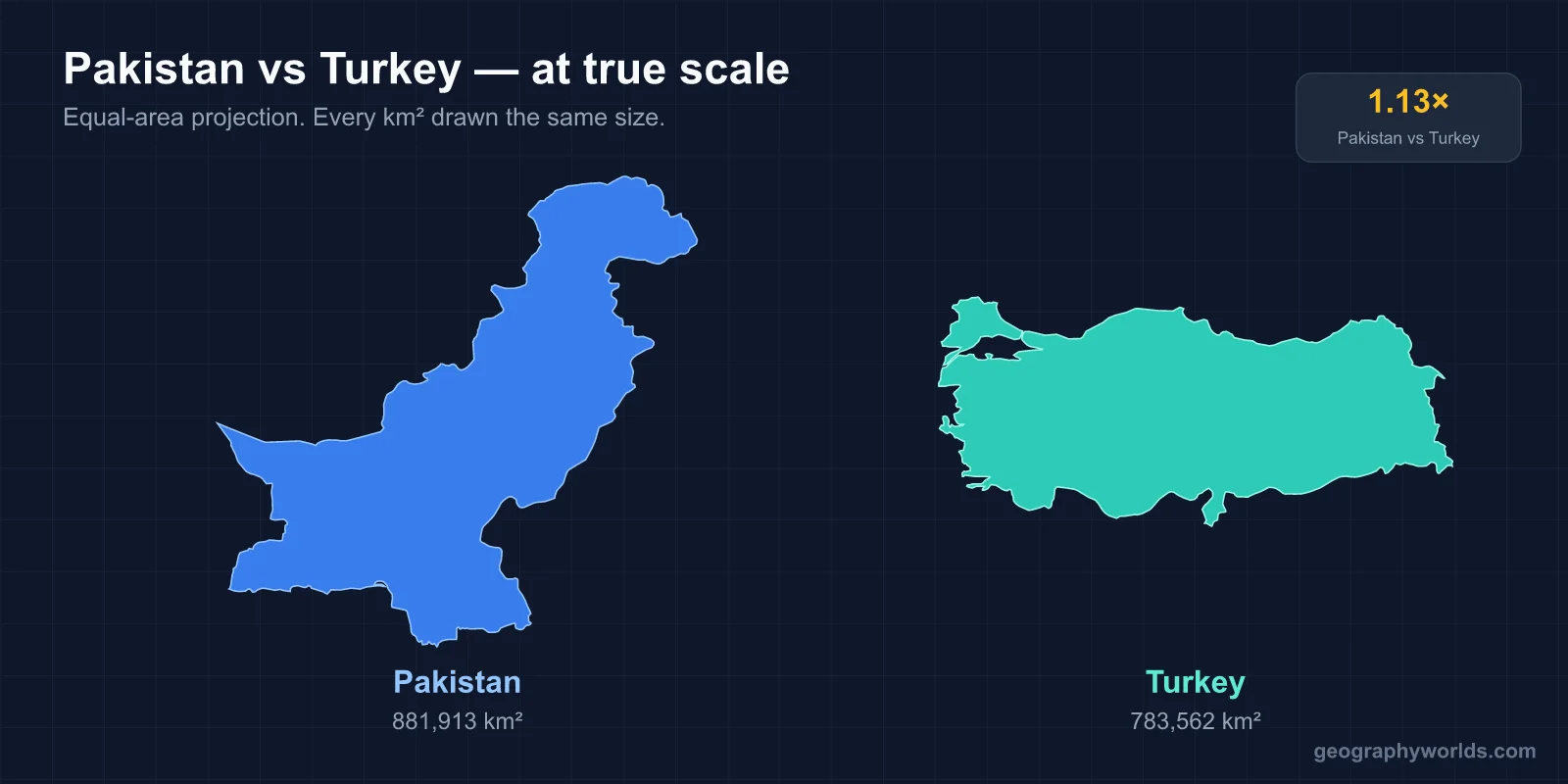
Turkey and Pakistan often appear in the same conversations: both are large Muslim-majority countries strategically positioned at the intersection of major regions, both have over 100 million people in their broader spheres of influence, and both are increasingly significant in global geopolitics. But which is physically bigger? The answer surprises a lot of people.
The Short Answer
No, Pakistan is bigger than Turkey. Pakistan covers 881,913 km². Turkey covers 783,562 km². Pakistan is approximately 12.6% larger than Turkey. The two are similar in size, but Pakistan is the larger of the two.
Side-by-Side Numbers
- Turkey area: 783,562 km² (302,535 sq mi)
- Pakistan area: 881,913 km² (340,509 sq mi)
- Difference: Pakistan is ~98,000 km² larger
- Ratio: Pakistan is ~1.13× the size of Turkey
- Turkey population: ~85 million
- Pakistan population: ~241 million
Turkey
Turkey is a transcontinental country straddling Europe and Asia, with most of its land area (about 97%) in Anatolia (Asia Minor) and a smaller portion in southeastern Europe (East Thrace). It borders eight countries: Greece, Bulgaria, Georgia, Armenia, Azerbaijan (Nakhchivan exclave), Iran, Iraq, and Syria. The Bosphorus and Dardanelles straits give Turkey control of one of the world's most strategically important shipping routes between the Black Sea and the Mediterranean.
Turkey's geography is dominated by mountainous terrain. The Anatolian Plateau is bordered by the Pontic Mountains in the north and the Taurus Mountains in the south. Mount Ararat (5,137 m), in eastern Turkey, is the country's highest peak and a national symbol (Noah's Ark is traditionally said to have come to rest there). Istanbul, with about 16 million residents, is the largest city, while Ankara (5.7 million) is the capital.
Pakistan
Pakistan is in South Asia, bordered by India to the east, Afghanistan to the northwest, Iran to the southwest, and China to the north. It has a coastline along the Arabian Sea. The country is the 5th most populous in the world and home to over 240 million people. It came into existence in 1947 when British India was partitioned into India and Pakistan, with East Pakistan becoming Bangladesh in 1971 after a war of independence.
Pakistan's geography is varied. The Indus River, flowing the length of the country, is the agricultural and historical heart — the Indus Valley Civilization (3300–1300 BCE) was one of the world's earliest urban civilizations. The Punjab and Sindh plains contain most of the population and farmland. The Hindu Kush, Karakoram, and Himalayan ranges in the north contain K2 (8,611 m), the world's second-highest mountain. The Thar Desert occupies the southeast.
Population Density
The two countries diverge dramatically in population. Pakistan has about 241 million people, making it the world's 5th most populous country. Turkey has about 85 million. Despite Pakistan being only 13% larger by area, it has roughly 2.8× more people. This makes Pakistan one of the most densely populated large countries (273 people per km²) while Turkey is moderately populated (109 per km²).
Economy
Turkey has a more developed economy. GDP is around $1.1 trillion (PPP about $3.3 trillion), with strong industries in automotive manufacturing (Ford and Toyota have large operations), textiles, consumer electronics, tourism, agriculture, and construction. Turkish GDP per capita is around $13,000 nominal. Pakistan's GDP is approximately $375 billion (PPP around $1.6 trillion), with major industries in textiles (the largest export), agriculture (cotton, wheat, rice, sugarcane), and increasingly information technology. Pakistan's GDP per capita is much lower at around $1,500 nominal.
History
Turkey's history is rich and ancient. Anatolia was home to the Hittite Empire (~1600 BCE), Phrygia, Lydia, Persian provinces, classical Greek city-states, the Roman and Byzantine Empires, the Seljuk Turks (from 1071), and the Ottoman Empire (1299–1922). Modern Turkey was founded by Mustafa Kemal Atatürk in 1923 as a secular republic from the ashes of the Ottoman Empire. Istanbul (formerly Constantinople and before that Byzantium) was the capital of three successive empires.
Pakistan, as a modern state, is much younger. The land it occupies has a much longer history — the Indus Valley Civilization predates ancient Egypt and Mesopotamia in some respects. The region was part of the Persian Empire, conquered by Alexander the Great, ruled by the Mauryan Empire, the Kushan Empire, various Hindu and Buddhist kingdoms, the Delhi Sultanate, the Mughals, the Sikh Empire, and the British Raj before becoming an independent Muslim-majority state in 1947.
Religion and Culture
Both countries are overwhelmingly Muslim. Turkey is roughly 99% Muslim, with the majority being Sunni and a significant Alevi minority. The country has been officially secular since Atatürk's reforms, though Islam has reemerged in public life under recent governments. Pakistan is about 96% Muslim, with the majority being Sunni and a Shia minority of roughly 10–15%. Pakistan is officially the Islamic Republic of Pakistan, with Islam as the state religion.
Climate
Turkey's climate varies significantly. Coastal regions on the Mediterranean and Aegean have warm, dry summers and mild, wet winters. The Black Sea coast is wetter and more temperate. The interior Anatolian Plateau has a continental climate with hot summers and cold, snowy winters. Pakistan's climate is generally hot and dry, with extreme temperatures in summer (often above 45°C in the Punjab and Sindh). The monsoon brings rain to the eastern and southern parts in July–September. The northern mountains have alpine and high-altitude climates with significant snowfall.
Strategic Importance
Both countries occupy critical geographic positions. Turkey controls the Bosphorus and Dardanelles, choke points for Russian access to the Mediterranean. It is a NATO member, a candidate for EU membership (in slow-motion accession since 1999), and a critical bridge between Europe, the Middle East, and Central Asia. Pakistan sits at the confluence of South Asia, Central Asia, and the Middle East. It has nuclear weapons, the world's 6th largest military by personnel, deep ties to China (the China-Pakistan Economic Corridor is a flagship of China's Belt and Road Initiative), and a complex relationship with the US, India, Afghanistan, and Iran.
Tourism
Turkey is one of the world's top tourism destinations, receiving roughly 50 million international visitors per year (peak figures before the pandemic, recovering since). Visitors come for Istanbul's Hagia Sophia, Topkapi Palace, and Grand Bazaar; the otherworldly landscapes of Cappadocia with its hot-air balloons; the ancient ruins of Ephesus and Troy; the beach resorts of the Turkish Riviera; and the surreal travertine pools of Pamukkale. Pakistan's tourism is far smaller — only about 1 million international visitors per year — but its potential is enormous. The country offers the Karakoram Highway through some of the world's most dramatic mountain scenery, ancient Buddhist and Mughal sites including Taxila and Lahore Fort, the Margalla Hills outside Islamabad, and the seacoast at Karachi.
Diaspora
Both countries have large global diasporas that shape culture and remittance flows. The Turkish diaspora is largest in Germany (about 3 million people of Turkish descent), with significant communities in France, the Netherlands, Belgium, Austria, and the UK. Pakistan's diaspora is even more globally spread — roughly 9 million Pakistanis live abroad, with major communities in the Gulf states (Saudi Arabia, UAE), the UK, the US, Canada, Australia, and Germany. Pakistani remittances are the country's second-largest source of foreign exchange after textile exports.
Sport
Sport is a major shared cultural force. Football (soccer) dominates both countries. Turkey's top clubs — Galatasaray, Fenerbahçe, and Beşiktaş — are all based in Istanbul and have passionate global followings. The Turkish national team's greatest moment was reaching the semifinals of the 2002 World Cup. Pakistan, by contrast, is a cricket nation — the Pakistan men's cricket team has won the ICC World Cup (1992) and T20 World Cup (2009), and players like Imran Khan, Wasim Akram, Shahid Afridi, and Babar Azam are national icons. Pakistan also produces some of the world's best squash players historically (Jahangir Khan, Jansher Khan).
Key Facts
- Pakistan is about 13% larger than Turkey by area.
- Pakistan has 2.8× more people than Turkey.
- Both are majority-Muslim countries with deep historical legacies.
- Turkey is officially secular; Pakistan is officially Islamic.
- Both occupy strategically critical positions in their regions.
Fun Facts
- Mount Ararat in Turkey is the traditional resting place of Noah's Ark.
- K2 in Pakistan is the world's second-highest mountain at 8,611 m.
- Both countries border 8+ countries each.
- Turkey has 19 UNESCO World Heritage Sites; Pakistan has 6.
- Pakistan has nuclear weapons; Turkey does not.
The Bottom Line
Pakistan is larger than Turkey — about 13% larger by area. But the more dramatic difference is in population: Pakistan has nearly three times the people. Both nations are strategic, regionally critical, and rich in history. Both face significant economic and political challenges, but both will play an outsized role in regional and global affairs throughout the 21st century.
Quiz Asia Geography!
Test your knowledge of Turkey, Pakistan, and the great nations of Asia.
Play Geography Games →