
Introduction
Few country pairings are tied together as tightly by people as Italy 🇮🇹 and Argentina 🇦🇷. Generations of Italian emigrants settled in Argentina, leaving a mark on its surnames, food, and accent that you can still hear in Buenos Aires today. Yet geographically the two could hardly be more different, and that contrast is what makes them such an interesting pair to put side by side.
This comparison walks through how Italy and Argentina differ across area, population, capitals, language, climate, and the landmarks each is famous for. Whether you are studying, planning a trip, or just curious, here are the numbers that matter.
Size & Geography
| Feature | Italy 🇮🇹 | Argentina 🇦🇷 |
|---|---|---|
| Area | 301,340 km² | 2,780,400 km² |
| Continent | Europe | South America |
| Region | Southern Europe | South America |
| Land Borders | France, Switzerland, Austria, Slovenia, San Marino, Vatican City | Chile, Bolivia, Paraguay, Brazil, Uruguay |
| Landscape | boot-shaped peninsula; Alps in north, Apennines central spine | Pampas plains, Andes mountains, Patagonian steppe, subtropical north |
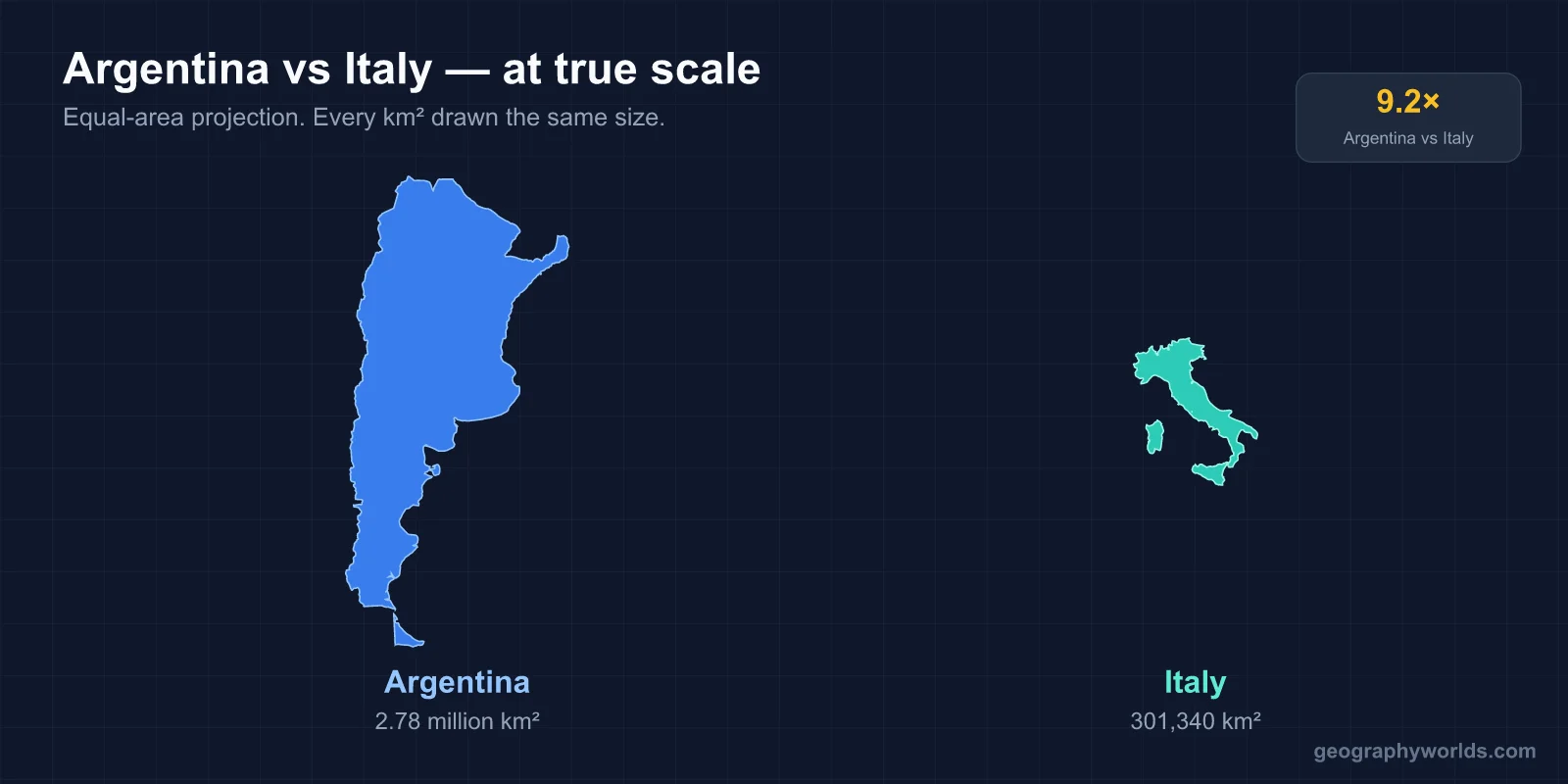
The size gap here is dramatic: Argentina covers 2,780,400 km², roughly 9.2 times the 301,340 km² that Italy occupies. Italy is a long, narrow peninsula shaped like a boot, with the Alps sealing off the north and the Apennines running down its center like a spine. Argentina stretches across an entire continent's worth of terrain, from the flat, fertile Pampas to the towering Andes along its western edge, the windswept Patagonian steppe in the south, and a humid subtropical zone up north. It is worth noting that Italy borders two of the world's smallest states, San Marino and Vatican City, both of which sit entirely within its territory.
Population & Demographics
| Metric | Italy 🇮🇹 | Argentina 🇦🇷 |
|---|---|---|
| Population | 58.9 million | 46.0 million |
| Population Density | 195.5 per km² | 16.5 per km² |
This is where the comparison flips. Despite being a fraction of Argentina's size, Italy is home to more people: 58.9 million against 46.0 million, about 1.3 times as many. Pack those numbers into the available land and the difference becomes stark. Italy carries 195.5 people per km², while Argentina averages just 16.5, a gap of roughly 179 people per km². Much of Argentina's interior, especially Patagonia, is sparsely settled, with the population heavily concentrated around Buenos Aires.
Capital Cities
Rome is the capital of Italy, and Buenos Aires the capital of Argentina. Rome lies in Europe, Buenos Aires on the South American coast across the Atlantic, but the cultural thread between them runs deep given how many Buenos Aires families trace their roots back to Italy.
Language, Currency & Culture
| Aspect | Italy 🇮🇹 | Argentina 🇦🇷 |
|---|---|---|
| Languages | Italian (official) | Spanish (official) |
| Currency | Euro (EUR) | Argentine Peso (ARS) |
Italy's official language is Italian; Argentina's is Spanish. Both are Romance languages descended from Latin, which is part of why Italian immigrants adapted to Argentine life so readily. On money, Italy uses the Euro as a member of the eurozone, while Argentina keeps its own Argentine Peso.
Climate & Natural Features
| Aspect | Italy 🇮🇹 | Argentina 🇦🇷 |
|---|---|---|
| Climate | Mediterranean in south, alpine in far north | mostly temperate; arid in southeast; subantarctic in southwest |
| Key Features | Alps, Amalfi Coast, Mount Vesuvius, Dolomites, Po Valley | Andes, Patagonia, Iguazu Falls, Tierra del Fuego, Pampas |
| Economy | manufacturing, fashion, tourism, agriculture, automotive | agriculture (beef, soy), mining, automotive, IT |
Italy's climate is broadly Mediterranean in the south and alpine in the far north, which gives the country sun-soaked coastlines alongside ski-worthy mountains. Its signature landscapes range from the Alps and the Dolomites to the Amalfi Coast, Mount Vesuvius, and the agricultural Po Valley. Argentina runs mostly temperate, turning arid in the southeast and subantarctic in the far southwest as it edges toward Antarctica. Its standout features are the Andes, the wilds of Patagonia, the thundering Iguazu Falls, Tierra del Fuego at the continent's tip, and the cattle country of the Pampas. Fittingly, Argentina's economy leans on agriculture, with beef and soy at the core, alongside mining, automotive, and a growing IT sector, while Italy's strengths lie in manufacturing, fashion, tourism, agriculture, and automotive.
What Makes Each Country Unique
Italy is a cradle of Western culture, from the Roman Colosseum to the masterpieces of the Renaissance, and of course pasta and pizza. It holds more UNESCO World Heritage Sites than any other country on Earth, 59 in total, a reflection of just how much history is packed into that boot-shaped peninsula.
Argentina answers with tango, the ritual of asado and its famous beef, the vastness of Patagonia, the spectacle of Iguazu Falls, and football icons like Maradona and Messi. One natural curiosity stands out: the Perito Moreno glacier is among the few in the world still advancing, creeping forward roughly 2 meters a day.
Key Differences at a Glance
- Area: Italy (301,340 km²) vs Argentina (2,780,400 km²) — Argentina is 9.2x larger
- Population: Italy (58.9 million) vs Argentina (46.0 million) — Italy is 1.3x more populous
- Capitals: Rome vs Buenos Aires
- Currency: Euro (EUR) vs Argentine Peso (ARS)
- Continents: Europe vs South America
- Density: Italy is more densely populated (difference of ~179.0 people per km²)
- Languages: Italian (official) vs Spanish (official)
Verdict
Italy and Argentina are bound by migration and culture yet split by geography in almost every way. Argentina is the giant on the map, 9.2 times larger, but Italy still edges it on population, 1.3 times more people in a far smaller space. It is a neat reminder that land area and population rarely line up.
Italy's identity is shaped by its Mediterranean-to-alpine climate and landmarks like the Alps, with an economy built on manufacturing and design. Argentina's character comes from its sweeping temperate-to-subantarctic landscapes and icons like the Andes, powered by an agricultural engine of beef and soy. One leans on craftsmanship and heritage, the other on natural abundance and scale.
Both nations enrich the world's geographic story in their own way. Whether you are heading to either one, brushing up on world geography, or simply feeding your curiosity, seeing them side by side makes the planet feel a little more knowable.
Test Your Knowledge!
Think you know your countries? Try our interactive geography quiz!
Play Geography Games →