

The library is one of the most enduring building types in human civilization, spanning from the clay tablet archives of ancient Mesopotamia to the cloud-connected digital hubs of the 21st century. Throughout this history, libraries have served as more than storage facilities for written knowledge — they have been symbols of power, demonstrations of civic ambition, and some of the most architecturally innovative buildings of their eras.
Introduction
Library architecture faces a unique design challenge: creating spaces that simultaneously preserve fragile materials, provide comfortable environments for study and contemplation, express the importance of knowledge in society, and adapt to rapidly changing information technologies. The greatest libraries solve all of these problems while also achieving beauty — which is why the world's finest library interiors rank among the most sublime spaces architecture has produced.
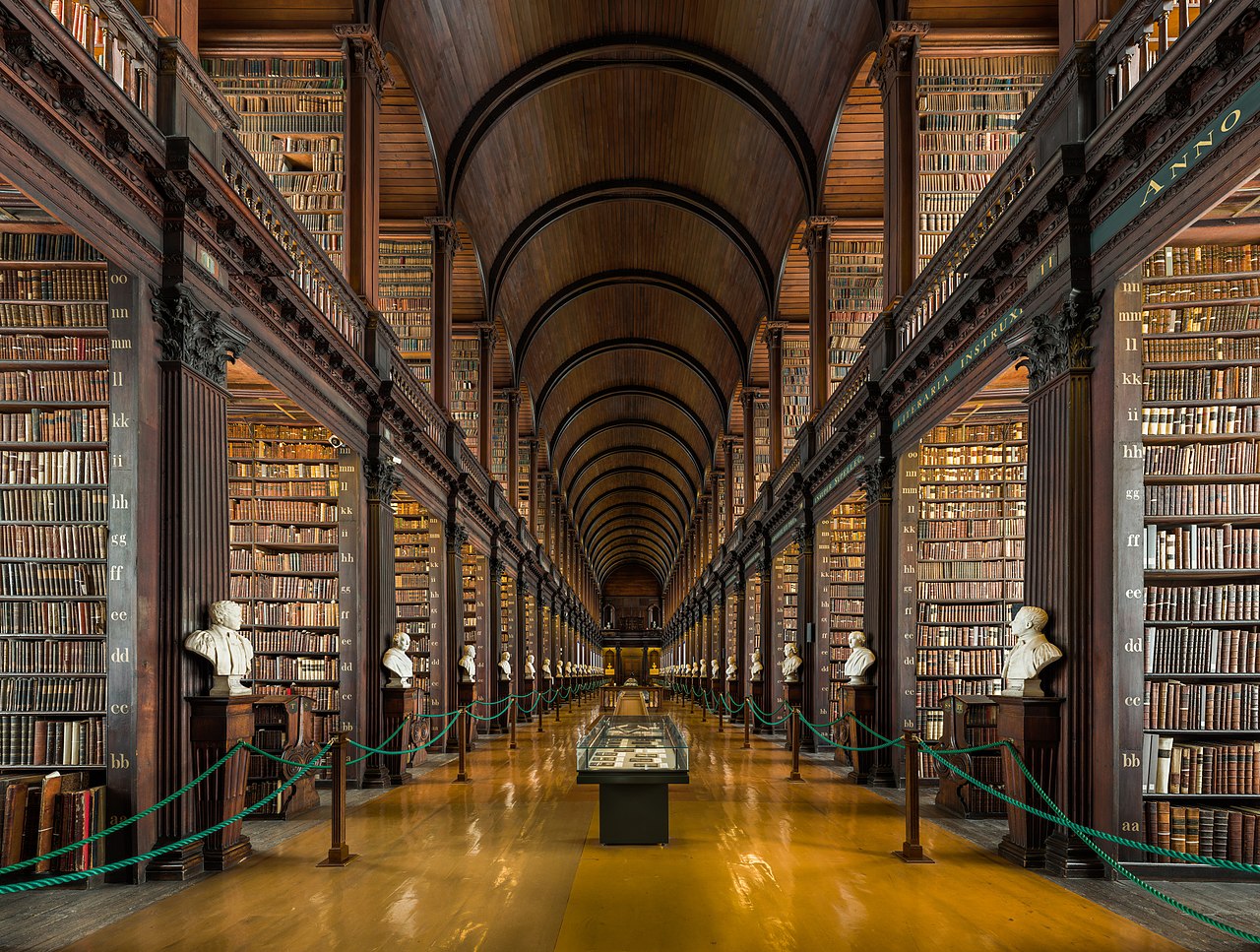
Baroque & Renaissance Library Halls
- Notable Examples: Admont Abbey (Austria), Strahov (Prague), Trinity College (Dublin)
- Style: Painted ceilings, gilded columns, walnut shelving
- The Long Room: Trinity College Dublin — 65 meters, 200,000 oldest books
- Admont Abbey: World's largest monastic library (70 meters long)
The great Baroque and Renaissance library halls of Europe are among the most visually overwhelming interiors ever created. The Long Room of Trinity College Dublin, completed in 1732, stretches 65 meters with a barrel-vaulted ceiling rising above two stories of dark oak shelving housing 200,000 of the library's oldest books. Its solemn grandeur — marble busts of philosophers and writers lining the central aisle — has made it one of the most photographed library interiors in the world.
The Admont Abbey Library in Austria, completed in 1776, is the world's largest monastic library. Its 70-meter hall, illuminated by 48 windows, features ceiling frescoes by Bartolomeo Altomonte depicting the stages of human knowledge from natural science to divine revelation. The Strahov Library in Prague contains two magnificent halls: the Theological Hall (1679), with its painted barrel vault, and the Philosophical Hall (1794), with a ceiling fresco depicting the progress of humanity toward wisdom. These libraries were designed to demonstrate that knowledge leads to God — architecture as theology.
National Libraries & Civic Monuments
- Library of Congress: Washington DC — world's largest library (170+ million items)
- British Library: London — 170+ million items
- Bibliothèque nationale de France: Paris — Dominique Perrault's four glass towers (1996)
- National Library of China: Beijing — 31 million items, largest in Asia
National libraries are among the most ambitious civic buildings of the modern era. The Library of Congress in Washington, DC, with over 170 million items, is the largest library in the world. Its original building, the Thomas Jefferson Building (1897), is one of the most ornate structures in the United States, its Great Hall featuring marble columns, mosaic floors, and painted murals depicting the evolution of civilization — a Beaux-Arts temple to American cultural ambition.
The Bibliothèque nationale de France, designed by Dominique Perrault and opened in 1996, took a radically different approach: four L-shaped glass towers resembling open books rise at the corners of a sunken garden, with the main reading rooms located below ground level around the garden. The design was controversial — critics argued that glass towers would expose books to damaging sunlight (movable wooden shutters were added) — but the building has become one of the defining architectural works of late 20th-century Paris.
Contemporary Library Icons
- Tianjin Binhai: MVRDV, 2017 — cascading terraced bookshelves
- Seattle Central: OMA/Rem Koolhaas, 2004 — angular glass form
- Oodi Helsinki: ALA Architects, 2018 — Finland's "living room"
- Calgary Central: Snøhetta, 2018 — arched timber and glass
The Tianjin Binhai Library in China, designed by MVRDV and completed in 2017, became an instant architectural sensation with its vast atrium of terraced white bookshelves cascading from floor to ceiling around a luminous spherical auditorium. The effect is of standing inside an enormous eye, with the sphere as the pupil and the shelves as an iris of knowledge. While many of the visible "books" on the upper levels are actually printed aluminum panels, the spatial drama of the interior has made it one of the most photographed libraries in the world.
Oodi Helsinki Central Library, designed by ALA Architects and opened in 2018, represents the library as civic living room. The building features three levels: a ground floor of public gathering spaces and cinemas, a middle floor of makerspaces, recording studios, and 3D printers, and a top floor of quiet reading spaces beneath a flowing timber ceiling. The concept is that the library is no longer primarily about books but about providing equal access to tools, technology, and social space — a democratic ideal expressed in architecture.
Libraries in the Islamic World
- Historical: House of Wisdom (Baghdad, 9th century)
- Al-Qarawiyyin: Fez, Morocco — founded 859 CE (oldest continuously operating)
- Modern: Qatar National Library (OMA, 2018)
- Design Feature: Geometric patterns, natural light, cooling courtyards
The Islamic world has a library tradition predating Europe's by centuries. The House of Wisdom in Baghdad, established in the 9th century during the Abbasid Caliphate, was the greatest center of learning in the medieval world, translating Greek, Persian, and Indian texts into Arabic and advancing mathematics, astronomy, medicine, and philosophy. The library at Al-Qarawiyyin in Fez, Morocco, founded in 859 CE, is the oldest continuously operating library in the world.
The Qatar National Library in Doha, designed by OMA and opened in 2018, reinterprets this tradition for the 21st century. The building's interior is a single vast terraced space where the floor itself folds upward to create bookshelves, eliminating the traditional separation between reading areas and book storage. A heritage collection of rare Islamic manuscripts is housed in a sunken central gallery visible through a glass floor, placing the tradition of Islamic scholarship literally at the foundation of the contemporary library.
The Future of Library Architecture
- Trend: From book storage to community hubs
- Digital Impact: Physical books declining, digital access increasing
- New Functions: Makerspaces, recording studios, co-working, social services
- Design Response: Flexible spaces, technology integration, third-place design
Library architecture is undergoing its most fundamental transformation since the invention of the printing press. As digital access replaces physical books for much of the population, libraries are being reimagined as "third places" — neither home nor work, but civic spaces where communities gather, learn, create, and connect. New libraries increasingly contain makerspaces with 3D printers and laser cutters, music recording studios, podcast rooms, seed libraries, language-learning labs, and social service offices alongside traditional book collections.
Architecturally, this transformation demands flexibility — spaces that can be reconfigured as needs change, rather than the fixed shelving layouts of traditional libraries. The concept of the library as a democratic equalizer — providing free access to tools, technology, and space that individuals cannot afford — drives a design approach centered on openness, accessibility, and civic generosity. The most successful new libraries, like Oodi in Helsinki and Calgary's New Central Library, achieve this through architecture that is warm, welcoming, and deliberately non-institutional.
Key Facts
- The Library of Congress holds over 170 million items — the world's largest collection.
- Al-Qarawiyyin Library in Fez, founded in 859 CE, is the oldest continuously operating library.
- Trinity College Dublin's Long Room stretches 65 meters and houses 200,000 of its oldest books.
- The Tianjin Binhai Library's atrium features cascading terraced shelves around a spherical auditorium.
- Modern libraries are being reimagined as community hubs with makerspaces, studios, and social services.
Fun Facts
- Many of the "books" visible on the upper shelves of the Tianjin Binhai Library are actually printed aluminum panels.
- The Admont Abbey Library in Austria was nearly destroyed by a fire in 1865 that consumed much of the monastery, but the library hall survived intact.
- Oodi Helsinki Central Library contains 3D printers, laser cutters, and recording studios alongside its book collection.
- The Library of Congress adds approximately 12,000 items to its collection every working day.
Final Thoughts
Library architecture traces an arc from the clay tablets of Mesopotamia to the digital makerspaces of Helsinki — a journey that reflects every stage of humanity's relationship with knowledge. The greatest libraries have always been more than warehouses for books: they are civic statements about the value of learning, the importance of equal access to information, and the belief that knowledge deserves beautiful spaces. As the digital revolution transforms what libraries contain, their architectural mission — to create spaces that inspire curiosity and serve all members of society — remains as vital as ever.
Test Your Knowledge!
Think you know your architecture and cities? Try our interactive quiz!
Play Geography Games →