

Baseball, called béisbol or simply pelota, is the national sport of Cuba and by far its most popular game, played since the 1860s and organised today in the state-run National Series, whose biggest ground is Havana’s 55,000-seat Estadio Latinoamericano. Cuba won three Olympic baseball gold medals and 25 amateur world titles, while boxing, women’s volleyball and athletics give the island its other sporting heroes. The best way to understand the game’s hold is to follow it around the island, from the field in Matanzas where the first organised match was played in 1874 to the provincial stadiums that still fill for the Havana–Santiago rivalry.
Palmar de Junco, Matanzas: The Field Where Cuban Baseball Began
Baseball arrived in Cuba in the 1860s with two groups of people: Cuban students coming home from colleges in the United States and American sailors on shore leave in Cuban ports. The player most often credited with spreading it is Nemesio Guillot, who studied with his brother Ernesto at Spring Hill College in Mobile, Alabama. Back in Havana, the brothers founded the Habana Base Ball Club in 1868.
The timing put the game in the middle of politics. The first Cuban War of Independence began that same year, and in 1869 the Spanish authorities banned baseball. Officials worried that Cubans were choosing the new game over the bullfights that colonial subjects were expected to attend, and the game became bound up with Cuban nationalism as a replacement for Spain’s colonial pastimes. One early Cuban player, Esteban Bellán, stayed in the United States and in 1871 became the first Latin American to play in what many historians count as a major league, with the Troy Haymakers.
The first organised game on Cuban soil was played on 27 December 1874 at the Palmar de Junco, a field once owned by the del Junco family in the Pueblo Nuevo district of Matanzas. Club Habana beat Club Matanzas 51–9, with Bellán hitting two home runs for the winners. The ground still stands on Calzada de Esteban, between Monserrate and San Ignacio streets. Four years later the professional Cuban League was founded with three teams, Almendares, Havana and Matanzas. Its first game, on 29 December 1878, ended Havana 21, Almendares 20, and Havana went unbeaten to win the first title under Bellán as captain.

Estadio Latinoamericano, Havana: The Colossus of Cerro
By the early twentieth century the Cuban League had become one of the strongest winter leagues anywhere. It admitted black players from 1900, and the best players of the North American Negro leagues spent their winters playing on integrated teams in Cuba. Cubans such as pitcher José Méndez and outfielder Cristóbal Torriente were so good that both were elected to the National Baseball Hall of Fame in Cooperstown in 2006. Martín Dihigo (1906–1971), nicknamed “the Immortal”, played in the Negro leagues and Latin American winter leagues from 1923 to 1945 and excelled at all nine positions.
The game needed a stage to match, and in 1946 it got one in the Cerro district of Havana. The Gran Estadio de La Habana opened on 26 October 1946 before 31,000 fans, the largest crowd yet at a Cuban sporting event, to watch Almendares beat Cienfuegos 9–1. Known as El Coloso del Cerro, it was enlarged in 1971 to about 55,000 seats and is known today as Estadio Latinoamericano. It is the second-largest baseball stadium in the world by capacity, a spacious pitchers’ park where the prevailing wind blows in from the outfield. Fidel Castro, who had pitched for the University of Havana in the 1940s, watched games there, and in 1959 the stadium’s minor-league tenant, the Havana Sugar Kings, won the Junior World Series, the championship of the top level of the American minor leagues, with Castro backing the club financially.
The stadium has hosted several diplomatic moments. In 1999 the Cuba national team played an exhibition series there against the Baltimore Orioles, and on 22 March 2016 President Barack Obama and President Raúl Castro watched Cuba play the Tampa Bay Rays from the stands. Its everyday tenant is Industriales, Havana’s team in the National Series. Founded in 1961 and first seen at the Latinoamericano on 10 February 1963, Industriales has won more National Series titles than any other team, 12 in all, including four in a row from 1963 to 1966.
Santiago de Cuba, Santa Clara and Pinar del Río: The Provincial Strongholds
The Cuban Revolution changed where and how the game was played. In March 1961 the government abolished professional baseball, ending the Cuban League that had run since 1878, and replaced it with a nominally amateur National Series under the new National Institute of Sport, Physical Education and Recreation (INDER). The series grew from four teams in 1961–62 to a peak of 18 from the late 1970s to the early 1990s, with teams representing every province. To carry the game across the island, the state built a new generation of concrete stadiums in provincial cities during the 1960s.
The fiercest rival to Havana lives at the other end of the island. Estadio Guillermón Moncada in Santiago de Cuba opened on 24 February 1964, seats about 25,000 and is named after a general of the independence wars who was born in the city. Its team, the Avispas (Wasps), have won eight National Series titles, including a hat-trick of titles between 1999 and 2001, a run remembered as the Aplanadora Santiaguera, the Santiago Steamroller. Games between Santiago and Industriales are called the Superclásico and are often compared with Yankees against Red Sox.
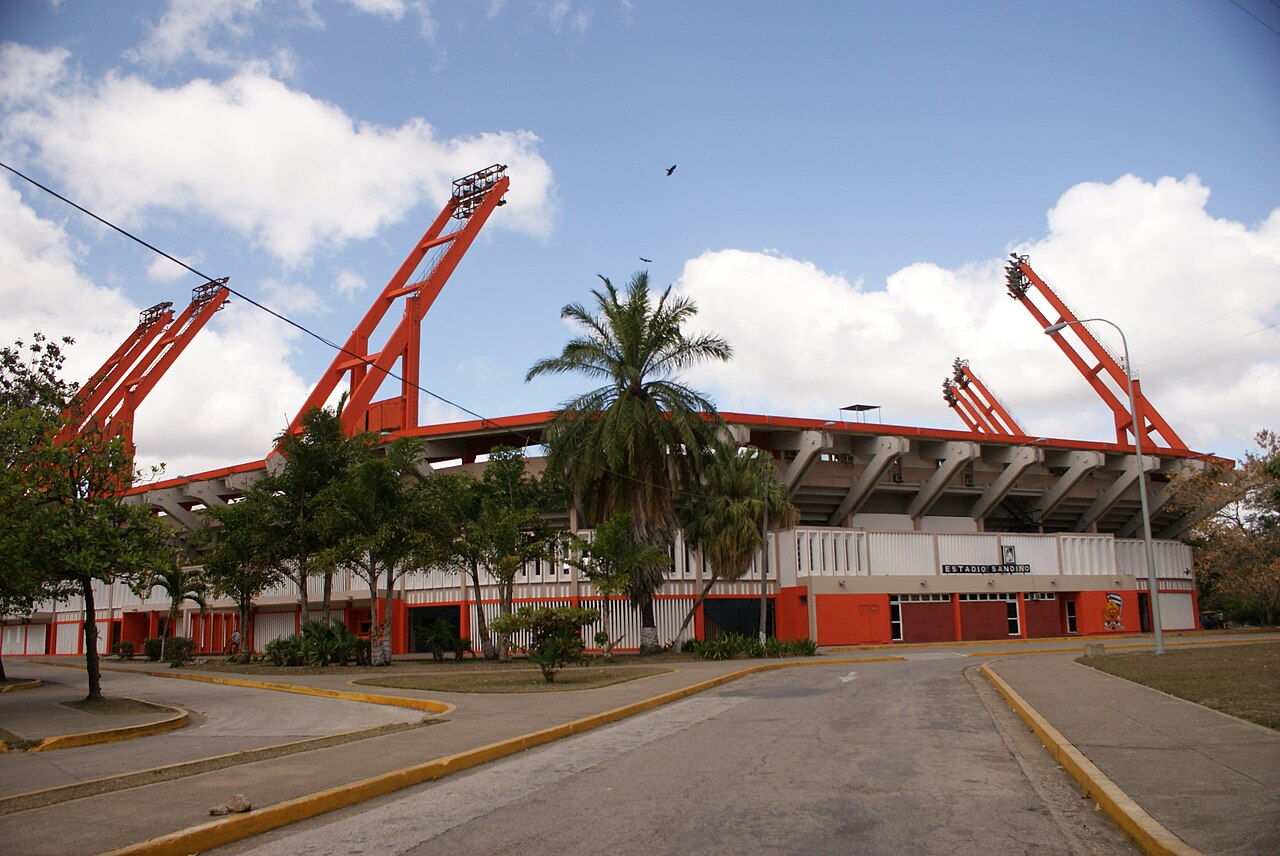
In the centre of the island, Estadio Augusto César Sandino in Santa Clara holds about 20,000 and is home to Villa Clara, nicknamed the Naranjas for their orange colours. Architects Emilio Castro and Gustavo R. Arnavat designed it in 1963 using precast concrete, specifically to make a cheap stadium that could be copied in other cities. In the tobacco country of the far west, Estadio Capitán San Luis in Pinar del Río opened on 19 January 1969 with room for 8,000. Its team, the Vegueros (Tobacco Growers), have won ten National Series titles and in 2015 won the Caribbean Series, the first Cuban club to do so since Cienfuegos in 1960.
From Barcelona to Beijing: Cuba’s Olympic Diamonds
Because the domestic league stayed nominally amateur, Cuba could send its best players to tournaments from which professionals were barred, and for half a century it dominated them. Between 1939 and 2005 it won the Baseball World Cup, first called the Amateur World Series, 25 times, 22 more than the next country. When baseball became a full Olympic sport at Barcelona in 1992, Cuba won gold, and it won again at Atlanta in 1996. It took silver at Sydney in 2000 after losing the final to the United States, gold again at Athens in 2004 on the diamonds of the Helliniko Olympic Complex, and silver at Beijing in 2008. That is a medal in five of the six Olympic baseball tournaments held so far; Cuba did not qualify for the sixth, at Tokyo.
The same system brought hardship. Pay stayed low: as of early 2019, players in the National Series received about 40 dollars a month. After the collapse of the Soviet Union in 1991 many leading players left for Major League Baseball; by the end of 2014 about 30 defectors had signed MLB contracts worth nearly 500 million dollars. Since 2022 the National Series has been reshaped several times, running as a summer league from 2022 to 2024 alongside a new Cuban Elite League, and returning to a winter schedule from the 2025–26 season.
Coliseo de la Ciudad Deportiva and Cuba’s Other Sporting Arenas
Baseball is not the only sport that fills Cuban arenas. The round Coliseo de la Ciudad Deportiva, built in 1957 at the junction of Avenida de Rancho Boyeros and Vía Blanca in Havana, holds 15,000 spectators under an 88-metre concrete dome with no interior supports. Boxing is the other great Cuban export: a country whose population dipped below 10 million in 2025 has won 41 Olympic boxing gold medals and 78 medals in all, the second-highest total in the sport. Teófilo Stevenson (1952–2012), born in Puerto Padre, and Félix Savón, born in San Vicente, Guantánamo Province, in 1967, each won three Olympic heavyweight titles: Stevenson in 1972, 1976 and 1980, Savón in 1992, 1996 and 2000.
Cuba’s women’s volleyball team, the Morenas del Caribe, broke the dominance of the Soviet Union and Japan by winning the 1978 world championship, then won eight straight global titles between 1991 and 2000, including Olympic gold at Barcelona, Atlanta and Sydney. In athletics, high jumper Javier Sotomayor, born in 1967, won Olympic gold in 1992 and still holds the world record of 2.45 metres, which makes him the only person ever to clear eight feet. Football ranks second in popularity behind baseball, an unusual order for a Latin American country.
Wherever you go on the island, though, the talk comes back to pelota. For more on the country behind the stadiums, see our guides to Havana, the capital of Cuba and Cuba’s geography, or compare the island’s game with its spread across the Americas and East Asia in our post on where baseball is played around the world.