
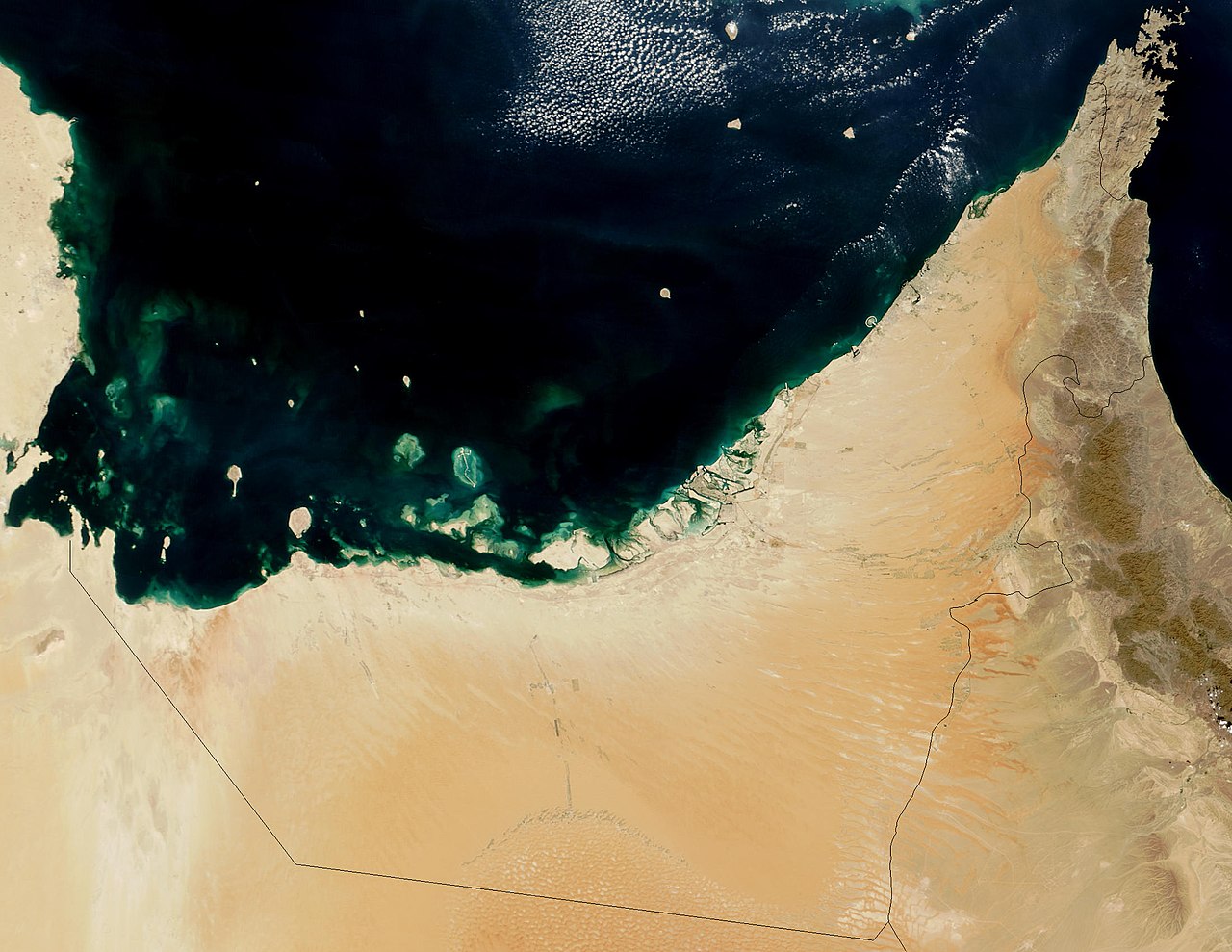
The major natural resources of the UAE are oil, natural gas, and an abundance of solar energy. The country holds roughly 98 billion barrels of proven oil reserves, the 6th largest in the world, with around 92% of that wealth concentrated in the emirate of Abu Dhabi. Alongside its 6.1 trillion cubic metres of natural gas, the UAE has built a world-class aluminium industry and the Arab world's first nuclear power plant, turning hydrocarbon riches into one of the planet's most diversified resource economies.
Introduction
Covering just 84,000 square kilometres on the south-eastern edge of the Arabian Peninsula, the United Arab Emirates is geographically modest yet economically formidable. Founded in 1971 from seven emirates, the federation transformed itself within a single generation from a string of pearling and fishing settlements into a global hub for energy, trade, and finance. That leap was financed almost entirely by petroleum, but the modern UAE story is increasingly about what comes after oil.
Today the Emirates balance an enormous hydrocarbon endowment against the reality of an arid, water-scarce, mineral-poor landscape. The result is a deliberate strategy: extract and add value to oil and gas while pouring petrodollars into solar power, nuclear energy, aluminium smelting, advanced agriculture, and knowledge industries. Understanding the UAE's natural resources means understanding both the geology beneath the desert and the engineering ambition layered on top of it.

Major Mineral Resources
- Aluminium: Major smelter operated by Emirates Global Aluminium
- Copper: Small deposits in the Hajar Mountains
- Chromite: Limited deposits in Fujairah and Ras Al Khaimah
- Construction Materials: Limestone, marble, and gypsum
- Desalination Salts: A byproduct of the country's massive desalination programme
The UAE's non-petroleum mineral base is genuinely thin, yet the country has turned this constraint into a global success story. Despite possessing no bauxite ore of its own, the UAE is home to one of the largest aluminium smelting industries on Earth. Emirates Global Aluminium (EGA) produces more than 2.5 million tonnes of aluminium annually, ranking the UAE as the 5th largest producer worldwide. The logic is simple: cheap, abundant energy makes smelting imported alumina commercially attractive, converting energy resources into a valuable export metal.
The rugged Hajar Mountains along the eastern border with Oman hold the country's only meaningful hard-rock minerals: scattered deposits of copper, chromite, and manganese. Copper mining in this region actually dates back to the Bronze Age, when ancient Magan supplied the metal across the Gulf. Elsewhere, limestone, marble, gypsum, and sand are quarried in large volumes to feed the relentless construction boom in Dubai, Abu Dhabi, and beyond. Increasingly, the Emirates have pushed to process raw materials domestically rather than simply exporting them, capturing more economic value at home.
Energy Resources
- Oil: 98 billion barrels of proven reserves, 6th globally
- Natural Gas: 6.1 trillion cubic metres, 7th largest reserves
- Solar: Among the highest solar irradiation levels on the planet
- Nuclear: Barakah, the Arab world's first nuclear power station
- Hydrogen: Ambitious blue and green hydrogen development plans
Energy is the foundation of everything the UAE has built. Abu Dhabi's onshore and offshore fields produce around 3 million barrels of oil per day, the vast majority handled by the Abu Dhabi National Oil Company (ADNOC). The offshore Upper Zakum field and the onshore Bu Hasa field rank among the largest oil reservoirs anywhere, and the country has set a target of lifting production capacity to 5 million barrels per day by 2027. With 6.1 trillion cubic metres of natural gas, the UAE is also a long-standing exporter of liquefied natural gas (LNG), a trade it pioneered in the region decades ago.
What sets the modern UAE apart is its rapid pivot toward clean power. The Noor Abu Dhabi solar park, at 1.2 gigawatts, was the world's largest single-site solar project when it came online, and the desert's intense sunshine makes solar one of the country's most promising long-term assets. The Barakah nuclear power plant, with four reactors generating 5.6 gigawatts, became the first operating nuclear facility in the Arab world. Looking further ahead, the Emirates are investing heavily in both blue hydrogen (made from gas with carbon capture) and green hydrogen (made from renewable electricity), positioning themselves as a future clean-fuel exporter.
Agricultural, Land & Food Resources
- Dates: A major producer with over 40 million date palm trees
- Hydroponics: Advanced indoor and vertical farming technology
- Fisheries: Catches from the Persian Gulf and Gulf of Oman
- Livestock: Desert-adapted camels and goats
- Food Tech: Major investment in food security innovation
Farming in a country that receives less than 100 millimetres of rain a year is a feat of technology rather than nature. Even so, the UAE sustains more than 40 million date palms, producing some of the finest dates in the Middle East and keeping alive a crop deeply woven into Emirati culture and cuisine. Beyond the date palm, the country has become a regional laboratory for agriculture, deploying hydroponics, vertical farms, and controlled-environment greenhouses to grow vegetables and herbs in conditions that would otherwise be impossible.
Because the Emirates import roughly 90% of their food, food security is treated as a strategic priority rather than an afterthought. National programmes back drone-assisted farming, desalinated-water irrigation, and even lab-grown protein research. Traditional fishing fleets working the Gulf waters supply a small but culturally significant seafood industry, while desert-adapted camels and goats remain part of the rural landscape. Readers interested in the wider picture can explore our UAE country guide for more on how geography shapes daily life here.
Water & Environmental Resources
- Desalination: Among the world's largest producers of desalinated water
- Groundwater: Limited and rapidly depleting fossil aquifers
- Mangroves: Coastal forests in Abu Dhabi under active restoration
- Marine Life: Persian Gulf coral reefs, dugongs, and sea turtles
Fresh water is arguably the UAE's scarcest and most precious resource. As one of the most water-stressed nations on Earth, the country runs more than 70 desalination plants that together produce over 14 million cubic metres of freshwater every day, ranking among the highest per-capita desalination rates anywhere. This dependence comes at a cost: desalination is energy-intensive, which ties the country's water supply directly to its abundant energy resources.
Environmental stewardship is becoming a larger part of the resource story. Abu Dhabi has planted millions of mangrove saplings along its coastline, restoring forests that protect shorelines and store carbon. The Gulf's warm waters, though stressed by coastal development and rising temperatures, still support coral reefs, dugongs, and nesting sea turtles in protected reserves. Managed aquifer recharge schemes aim to stretch the country's dwindling groundwater reserves for future generations.
How the UAE Compares to Similar Nations
Among Gulf petro-states, the UAE occupies a distinctive middle ground. Saudi Arabia dwarfs it in raw reserves, holding several times more oil and a far larger production capacity, but the UAE has arguably gone further in diversifying away from crude through tourism, finance, logistics, and aluminium. Qatar, by contrast, built its fortune chiefly on natural gas, ranking as one of the world's top LNG exporters, whereas the UAE's gas reserves are smaller and its profile is more balanced between oil, gas, and renewables.
The aluminium angle is where the comparison becomes striking. Norway and Iceland also smelt large quantities of aluminium without any bauxite, relying on cheap hydropower; the UAE achieves the same outcome using cheap thermal and increasingly solar energy. Meanwhile, in renewable ambition the Emirates lead the region outright, having commissioned the Arab world's first nuclear plant and one of the planet's largest solar parks, milestones that neighbouring oil giants have only begun to pursue.
Key Facts
- Proven oil reserves: 98 billion barrels, the 6th largest in the world
- Natural gas reserves: 6.1 trillion cubic metres, the 7th largest globally
- Aluminium output: Over 2.5 million tonnes a year, the 5th largest producer despite no bauxite
- Nuclear power: Barakah is the first nuclear plant in the Arab world (5.6 GW)
- Date palms: More than 40 million trees across the country
- Food imports: Approximately 90% of food is imported
- Desalination: Over 70 plants producing more than 14 million cubic metres of freshwater daily
Frequently Asked Questions
What are the most important natural resources of the UAE?
The UAE's most important natural resources are oil and natural gas, which underpin its entire economy. The country holds about 98 billion barrels of proven oil reserves and 6.1 trillion cubic metres of gas. Beyond hydrocarbons, abundant solar energy and a world-leading aluminium industry are increasingly significant.
Why is the UAE a major aluminium producer if it has no bauxite?
Aluminium smelting requires enormous amounts of electricity, and the UAE's cheap, plentiful energy makes it economical to import alumina and process it domestically. Emirates Global Aluminium produces more than 2.5 million tonnes a year, ranking the country 5th in the world. In effect, the UAE converts its energy resources into a high-value export metal.
How does the UAE get its fresh water?
With less than 100 millimetres of annual rainfall, the UAE depends overwhelmingly on desalination. More than 70 plants produce over 14 million cubic metres of freshwater each day, among the highest per-capita rates on Earth. Limited and shrinking fossil aquifers supply the remainder, supported by managed recharge programmes.
Is the UAE moving away from oil?
The UAE is actively diversifying rather than abandoning oil. It continues to expand production capacity toward 5 million barrels per day by 2027 while simultaneously investing in solar power, the Barakah nuclear plant, hydrogen, and non-energy sectors. The goal is to use petroleum wealth to build a broader, post-oil economy.
Test Your Geography Knowledge!
Think you know your world geography? Try our interactive quiz!
Play Geography Games →