

New England is a region in the northeastern United States comprising six states: Connecticut, Maine, Massachusetts, New Hampshire, Rhode Island, and Vermont. Covering approximately 186,458 square kilometers with a population of about 15.1 million people, it is one of the most historically significant and culturally distinct regions in America.
Introduction
Named by English explorer Captain John Smith in 1616, New England was the cradle of American independence, home to the Pilgrims' Plymouth Colony (1620), the first shots of the American Revolution at Lexington and Concord (1775), and the founding of Harvard University (1636), the oldest institution of higher learning in the United States.
Geography & Landscape
- Total Area: 186,458 km²
- States: Connecticut, Maine, Massachusetts, New Hampshire, Rhode Island, Vermont
- Highest Point: Mount Washington, NH (1,917 m)
- Coastline: ~9,650 km
New England's terrain is shaped by ancient geological forces. The Appalachian Mountains run through Vermont, New Hampshire, and western Massachusetts, with the White Mountains of New Hampshire containing Mount Washington — notorious for some of the most extreme weather on Earth, including a wind speed record of 372 km/h recorded in 1934. The Green Mountains of Vermont and the Berkshires of Massachusetts complete the highland spine.
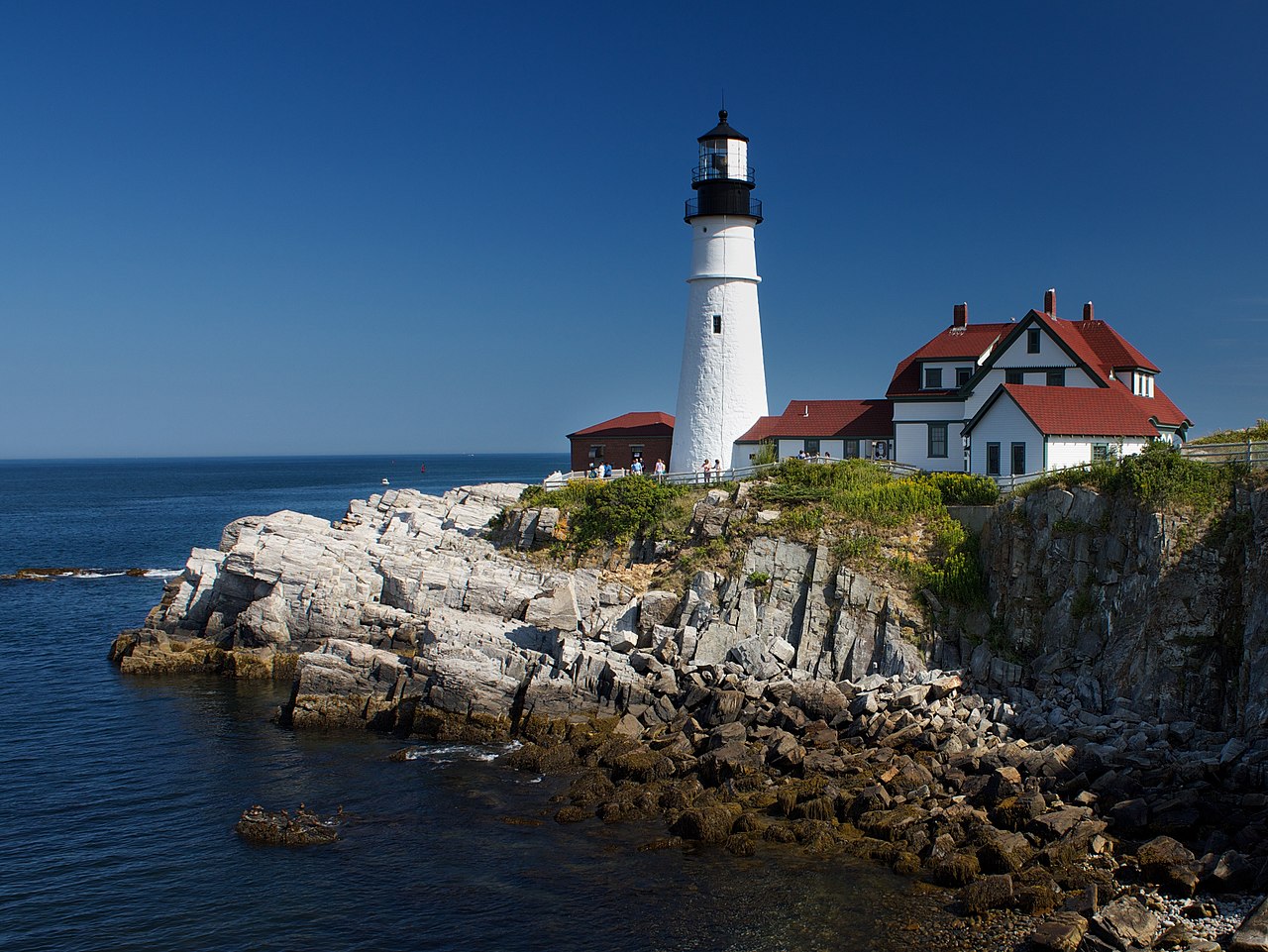
The coastline stretches from the sandy beaches of Connecticut and Rhode Island to the dramatic rocky shores and deep harbors of Maine, which alone accounts for roughly 5,600 kilometers of tidal coastline. Cape Cod, a 100-kilometer hook-shaped peninsula formed by glacial deposits, and the islands of Martha's Vineyard and Nantucket are iconic coastal features shaped during the last Ice Age roughly 18,000 years ago.
Climate & Environment
- Climate Type: Humid continental (Dfb/Dfa)
- Average Annual Snowfall: 150–250 cm in northern areas
- Fall Foliage Season: Late September to late October
- Growing Season: 120–180 days
New England experiences a humid continental climate with four distinct seasons. Winters are cold and snowy, particularly in northern areas where average annual snowfall exceeds 250 centimeters. Summers are warm and humid, with average July temperatures ranging from 20°C in northern Maine to 27°C in southern Connecticut. The region is also prone to powerful nor'easters — large-scale storms that can dump heavy snow and generate hurricane-force winds.
The region is world-famous for its fall foliage. Deciduous forests dominated by sugar maples, red maples, birches, and oaks produce a kaleidoscope of reds, oranges, and golds from late September through late October. Foliage tourism, known as "leaf peeping," generates an estimated $3 billion annually across the six states.
Economy & Industry
- GDP: ~$1.1 trillion combined
- Key Industries: Education, healthcare, finance, technology, tourism
- Major Universities: Harvard, MIT, Yale, Brown, Dartmouth
- Fishing Heritage: Lobster, cod, clams, scallops
New England punches far above its weight economically. Massachusetts alone has a GDP exceeding $600 billion, driven by world-leading clusters in biotechnology, higher education, healthcare, and financial services. The Boston-Cambridge corridor is one of the densest concentrations of research universities and biotech firms on the planet, anchored by Harvard University, MIT, and dozens of teaching hospitals.
The region's maritime economy remains significant. Maine is the nation's top lobster producer, landing over 45,000 metric tonnes annually worth more than $700 million at the dock. New Bedford, Massachusetts, is America's most valuable fishing port by dollar value, driven by its scallop fleet. Tourism contributes over $70 billion to the regional economy, with visitors drawn to coastal villages, ski resorts, and historic sites.
Culture & Identity
- Founded: 1620 (Plymouth Colony)
- Cultural Hallmarks: Town meetings, covered bridges, clam chowder
- Sports: Boston Red Sox, Celtics, Patriots, Bruins
- Literary Heritage: Thoreau, Hawthorne, Dickinson, Frost
New England's cultural identity is deeply rooted in its colonial and maritime heritage. The town meeting, a form of direct democracy dating to the 1630s, remains the governing institution in hundreds of small towns across the region. White-steepled churches, village greens, stone walls, and covered bridges define the archetypal New England landscape.
The region has produced an outsized share of American literary and intellectual culture. The Transcendentalist movement emerged in Concord, Massachusetts, with Henry David Thoreau and Ralph Waldo Emerson. Emily Dickinson wrote in Amherst, Nathaniel Hawthorne set his novels in Salem, and Robert Frost immortalized the Vermont countryside. Today, Boston remains one of the most educated cities in America, with over 50 colleges and universities in the metropolitan area.
Challenges & Future
- Population Growth: Slower than national average
- Housing Costs: Among highest in the US
- Climate Risks: Rising seas, stronger nor'easters
- Demographic Shift: Aging population in rural areas
New England faces significant challenges including some of the highest housing costs in the nation, particularly in the Boston metropolitan area where median home prices exceed $600,000. Rural areas of Maine, Vermont, and New Hampshire are experiencing population stagnation and aging demographics as younger residents migrate to cities.
Climate change is already reshaping the region. Sea levels along the New England coast are rising faster than the global average, threatening coastal communities and infrastructure. Warmer winters are shortening ski seasons, altering maple syrup production, and shifting the range of iconic species like the Atlantic cod and the moose. The Gulf of Maine is warming faster than 99 percent of the world's oceans.
Key Facts
- New England comprises six states covering 186,458 km² with 15.1 million residents.
- Mount Washington in New Hampshire recorded a wind speed of 372 km/h in 1934.
- Harvard University, founded in 1636, is the oldest university in the United States.
- Maine produces over 45,000 metric tonnes of lobster annually.
- The Gulf of Maine is warming faster than 99% of the global ocean.
Fun Facts
- Rhode Island is the smallest US state at just 4,001 km², yet it has over 640 km of coastline.
- Vermont was an independent republic from 1777 to 1791 before joining the United States.
- The first American Thanksgiving was celebrated by Pilgrims and Wampanoag people at Plymouth in 1621.
- Boston's subway system, opened in 1897, was the first underground rapid transit in North America.
Final Thoughts
New England is a region where deep history meets modern innovation. From the cobblestone streets of colonial-era towns to the cutting-edge labs of Cambridge, this compact corner of America continues to shape the nation's culture, economy, and intellectual life far beyond its modest geographic footprint.
Test Your Knowledge!
Think you know American geography? Try our interactive geography quiz!
Play Geography Games →