
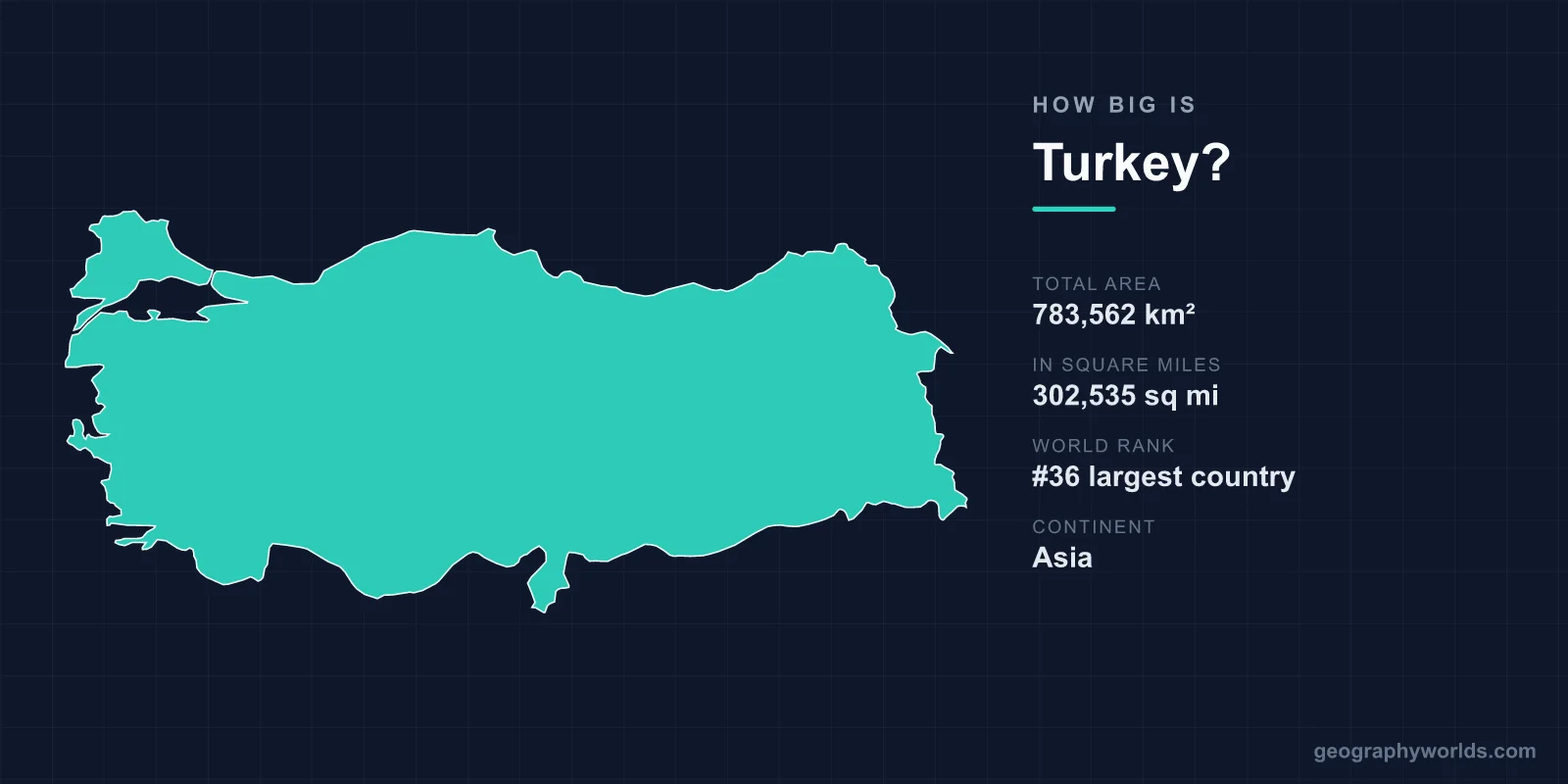
Turkey covers a total area of 783,562 km² (302,535 sq mi), making it the 36th largest country in the world — roughly the same size as the U.S. state of Texas. Straddling the boundary between Europe and Asia, Turkey is a transcontinental nation whose landmass accounts for about 0.53% of the Earth's total land area of roughly 148.94 million km². For a country that sits at the crossroads of two continents, its footprint is large enough to contain an extraordinary range of landscapes, from Mediterranean beaches to snow-capped volcanic peaks.
How Big Is Turkey Exactly?
Turkey's 783,562 km² of territory places it comfortably in the upper third of the world's roughly 195 countries by area. To picture that number, imagine an expanse a little larger than Texas (about 695,662 km²) or close to the combined size of France and the United Kingdom. The country measures roughly 1,600 km from east to west and about 660 km from north to south, giving it a distinctly elongated, rectangular shape across the Anatolian peninsula.
- Total area: 783,562 km² (302,535 sq mi)
- World rank: 36th largest country
- Share of world land area: approximately 0.53%
- East–west span: about 1,600 km
- North–south span: about 660 km
- Coastline: roughly 7,200 km
A Country on Two Continents
One of the most striking facts about Turkey's geography is that it belongs to two continents at once. About 97% of its territory lies in Asia, on the broad peninsula known as Anatolia (or Asia Minor), while the remaining 3% sits in Europe, in the region called Thrace. The two halves are separated by the narrow waterways of the Bosphorus Strait, the Sea of Marmara, and the Dardanelles. This is why Istanbul — though not the capital — is famously described as the only major city in the world that spans two continents, with neighborhoods on both the European and Asian shores. The official capital is Ankara, located in the central Anatolian plateau.
The Landscape Within Its Borders
Turkey's size is matched by its topographic variety. The heart of the country is the Anatolian Plateau, a high, semi-arid tableland ringed by mountains. Along the Black Sea coast in the north rise the Pontic Alps, while the Taurus Mountains run parallel to the Mediterranean shore in the south. Eastern Turkey is dominated by rugged volcanic highlands, where the country's highest point, Mount Ararat, reaches 5,137 m (16,854 ft) above sea level. Traditionally linked with the legend of Noah's Ark, Ararat towers over the surrounding plains near the borders with Armenia and Iran.
This terrain produces sharply different climates across relatively short distances: Mediterranean and subtropical conditions along the southern and Aegean coasts, humid weather on the Black Sea coast, and a continental climate of hot summers and cold, snowy winters in the interior. With coastlines on four seas — the Mediterranean, the Aegean, the Black Sea, and the Sea of Marmara — Turkey's 7,200 km of shoreline give it an outsized maritime presence for its land area.
How Turkey Compares to Other Countries
Comparisons make Turkey's scale easier to grasp. It is about 122% the size of France (640,679 km²) and more than twice the area of Japan (377,975 km²), which covers 377,975 km². Within Europe, Turkey is larger than every member of the European Union, and it dwarfs neighbors such as Greece (131,957 km²) — Turkey is roughly six times bigger. Yet it is far smaller than the world's giants: Russia, the largest country, is more than 21 times Turkey's size, and even Iran, its eastern neighbor, is noticeably larger. This middle-tier status reflects Turkey's position as a regional heavyweight rather than a continental colossus. For more on the country's regions, history, and culture, see our turkey country guide.
Why Turkey's Size Matters
Turkey's substantial and strategically located territory has shaped its history for millennia. The land has hosted some of civilization's earliest settlements and later anchored the Hittite, Roman, Byzantine, and Ottoman empires. Its breadth allows for striking geographic landmarks scattered across the map: the fairy chimneys and underground cities of Cappadocia in central Anatolia, the gleaming white thermal terraces of Pamukkale (whose name means "Cotton Castle"), the ancient ruins of Ephesus and Troy in the west, and the turquoise Mediterranean coastline in the south. The country is also home to 19 UNESCO World Heritage Sites, a number befitting a land that bridges continents and epochs.
Frequently Asked Questions
Is Turkey bigger than Texas?
Turkey is slightly larger than Texas. Turkey covers about 783,562 km², while Texas spans roughly 695,662 km². The two are often compared because they are close in size, but Turkey edges ahead by around 88,000 km².
What is the largest country compared to Turkey?
Many countries are larger than Turkey, including Russia, Canada, the United States, China, Brazil, Australia, and India. Russia, the world's biggest country, is more than 21 times the size of Turkey.
How much of Turkey is in Europe?
Only about 3% of Turkey's land area lies in Europe, in the region known as Thrace around Istanbul's western districts. The remaining 97% sits in Asia, on the Anatolian peninsula.
What is the highest point in Turkey?
The highest point in Turkey is Mount Ararat, a dormant volcano in the far east of the country that rises to 5,137 m (16,854 ft) above sea level.