
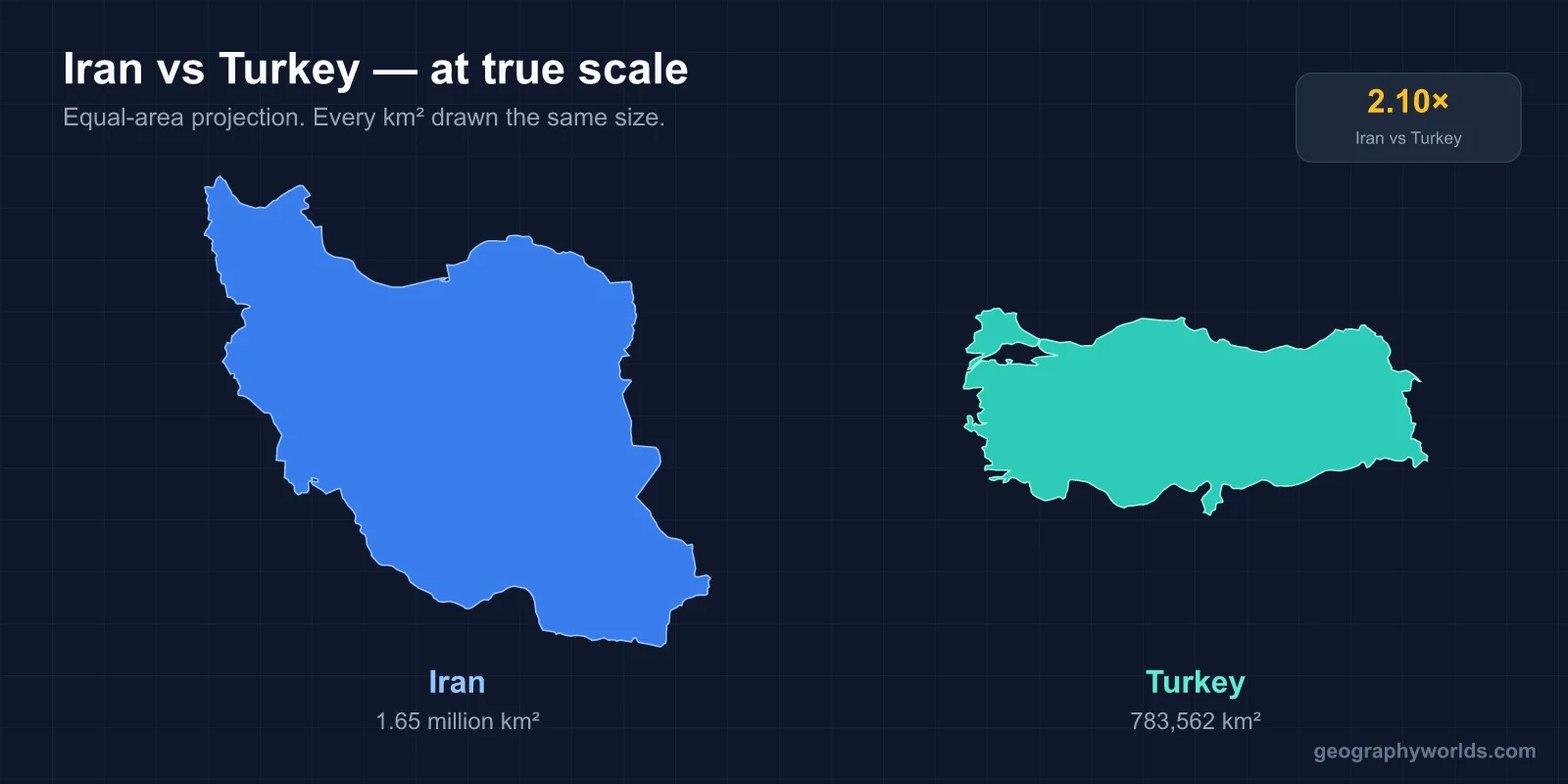
Iran and Turkey are two of the most influential nations in the broader Middle East — both ancient civilizations, both regional powerhouses, both at the center of major geopolitical fault lines. So how do they compare in size?
The Short Answer
Yes, Iran is bigger than Turkey. Iran covers 1,648,195 km². Turkey covers 783,562 km². Iran is approximately 110% larger — more than twice the size of Turkey.
Side-by-Side Numbers
- Iran area: 1,648,195 km² (636,372 sq mi)
- Turkey area: 783,562 km² (302,535 sq mi)
- Difference: Iran is ~865,000 km² larger
- Ratio: Iran is ~2.10× the size of Turkey
- Iran population: ~89 million
- Turkey population: ~85 million
Iran
Iran (formerly known internationally as Persia until 1935) is in Western Asia. It borders Iraq and Turkey to the west, Armenia and Azerbaijan to the northwest, the Caspian Sea and Turkmenistan to the north, Afghanistan and Pakistan to the east, and the Persian Gulf and Gulf of Oman to the south. Iran is the 17th largest country in the world by area, the 2nd largest in the Middle East (after Saudi Arabia), and home to about 89 million people.
Iran's geography is dominated by mountains and high plateaus. The Zagros Mountains run along the western and southwestern parts of the country; the Alborz Mountains, including Mount Damavand (5,610 m, the highest peak in the Middle East and a dormant volcano), border the Caspian Sea in the north. The vast Iranian Plateau forms the country's interior, with two great deserts — the Dasht-e Kavir (Great Salt Desert) and the Dasht-e Lut. Tehran, the capital, has about 9 million people in the city and 15 million in the metro area.
Turkey
Turkey is a transcontinental country straddling Europe and Asia, with most of its land area (about 97%) in Anatolia (Asia Minor) and a smaller portion in southeastern Europe (East Thrace). It borders eight countries: Greece, Bulgaria, Georgia, Armenia, Azerbaijan (Nakhchivan exclave), Iran, Iraq, and Syria. The Bosphorus and Dardanelles straits give Turkey control of one of the world's most strategically important shipping routes between the Black Sea and the Mediterranean.
Turkey's geography is dominated by mountainous terrain. The Anatolian Plateau is bordered by the Pontic Mountains in the north and the Taurus Mountains in the south. Mount Ararat (5,137 m), in eastern Turkey, is the country's highest peak. Istanbul, with about 16 million residents, is the largest city, while Ankara (5.7 million) is the capital.
Population
Iran and Turkey have remarkably similar populations — Iran about 89 million, Turkey about 85 million. But because Iran is more than twice the size of Turkey, the population density is dramatically different. Iran has about 54 per km², Turkey about 109 per km². Both countries have aging populations, though Turkey is somewhat older on average. Both have experienced significant emigration, particularly of educated populations seeking economic opportunities elsewhere.
Religion
Iran is overwhelmingly Shia Muslim (about 90% of the population), and the country is the spiritual and political center of Shia Islam globally. The Islamic Republic of Iran was established after the 1979 revolution that overthrew the Shah. Iran also has small Christian, Jewish, Zoroastrian, and Baha'i minorities. Turkey is about 99% Muslim, but mostly Sunni (about 80%) with a significant Alevi minority (about 15–20%). Turkey is officially secular under its 1923 constitution, though religious practice has become more publicly prominent under recent governments. The country has had small Christian, Jewish, and Yazidi minorities for centuries.
Economy
Turkey has a larger economy than Iran despite being smaller in area. Turkey's GDP is about $1.1 trillion (PPP about $3.3 trillion), with strong industries in automotive manufacturing, textiles, consumer electronics, tourism, agriculture, and construction. Iran's economy is approximately $1.4 trillion in PPP terms but is much smaller in nominal dollars (around $400 billion) due to currency depreciation and international sanctions. Iran has the world's 4th largest oil reserves and 2nd largest natural gas reserves but cannot fully exploit these due to sanctions. Major industries also include petrochemicals, automotive manufacturing, steel, and pharmaceuticals.
Civilizational History
Both have civilizational histories going back thousands of years. Iran (Persia) has one of the deepest continuous civilizational histories on Earth. The Persian Empire under Cyrus the Great (550–530 BCE) became the largest empire of the ancient world, stretching from the Mediterranean to the Indus. Successive dynasties — Parthians, Sasanians, Safavids, Qajars, Pahlavis — shaped Persian culture, art, science, and language. The 1979 Islamic Revolution established the current Islamic Republic.
Turkey's land has been home to many civilizations — Hittites, Phrygians, Lydians, Greeks (especially Ionian Greeks on the Aegean coast), Romans, Byzantines, and Seljuk Turks before the Ottoman Empire (1299–1922) became one of the world's great Islamic empires. At its peak, the Ottoman Empire stretched from Hungary to Yemen, from Algeria to Iraq. Modern Turkey was founded by Mustafa Kemal Atatürk in 1923 as a secular republic from the ashes of the Ottoman Empire.
Strategic Importance
Both countries are critical to regional and global geopolitics. Iran sits at the strategic intersection of the Persian Gulf (through which a large share of the world's oil ships), Central Asia, and the broader Middle East. Its nuclear program, regional influence (proxies in Lebanon, Iraq, Yemen, Syria), and ongoing tensions with the US, Israel, and Saudi Arabia make it a perennial geopolitical focus. Turkey is a NATO member, a candidate for EU membership (in slow-motion accession since 1999), and a critical bridge between Europe, the Middle East, and Central Asia. Turkey controls the Bosphorus and Dardanelles, choke points for Russian access to the Mediterranean. The country has played increasingly assertive regional roles in Syria, Libya, Azerbaijan, and Central Asia.
Cuisine and Culture
Both have famous food cultures. Persian cuisine emphasizes saffron, rice, kebabs, herbs, and dried fruits. Iconic dishes include chelo kabab (the national dish), ghormeh sabzi, fesenjan (chicken or duck in walnut-pomegranate sauce), and baklava. Persian poetry (Hafez, Rumi, Omar Khayyam) has had global influence. Turkish cuisine reflects Ottoman culinary traditions and is one of the world's great cuisines — kebabs, dolmas, baklava, Turkish coffee, Turkish delight, and elaborate breakfasts (kahvaltı) are globally recognized. UNESCO inscribed Turkish coffee culture and tradition on its Intangible Cultural Heritage list in 2013.
Tourism
Turkey is one of the world's most-visited countries, welcoming about 50 million international visitors per year. Top destinations include Istanbul (the Hagia Sophia, Topkapi Palace, Grand Bazaar, Blue Mosque), Cappadocia's otherworldly landscapes with hot-air balloons, the ancient ruins of Ephesus and Troy, the beach resorts of the Turkish Riviera, and the surreal travertine pools of Pamukkale. Iran was historically a major tourism destination — its Persian gardens, Persepolis, Isfahan's historic squares and mosques, Yazd's mud-brick architecture, and Persian cuisine attract about 5 million international visitors per year. Sanctions and political tensions have suppressed tourism in recent years.
Languages and People
Iran is a multi-ethnic country, though the dominant ethnic group is Persian (Fars), making up about 61% of the population. Significant minorities include Azeris (about 16%), Kurds (10%), Lurs, Baluchis, Arabs, Turkmen, and others. Persian (Farsi) is the official language and is also spoken in Afghanistan and Tajikistan, with hundreds of millions of speakers globally. Turkey is similarly multi-ethnic. Turks make up about 70–75% of the population, with significant Kurdish (15–20%), Arab, Circassian, and other minorities. Turkish is the official language, related to other Turkic languages spoken across Central Asia. The Kurdish question — about the political and cultural rights of Kurds in eastern Turkey, Syria, Iraq, and Iran — has been a source of conflict for over a century.
Bilateral Relations
Iran and Turkey are neighbors with a complex relationship. They share a 534 km border and have significant trade ties. Both compete for regional influence, especially in the Caucasus, Iraq, and Syria, where they have sometimes opposed each other and sometimes cooperated. Both contain significant Kurdish populations, which complicates their cooperation on Kurdish issues. Turkey has generally been more aligned with the US and NATO; Iran has been in long-term confrontation with the US. The two have maintained pragmatic relations despite ideological and strategic differences.
Key Facts
- Iran is about 110% larger than Turkey by area.
- The two countries have nearly the same population (~85–89 million each).
- Iran is mostly Shia Muslim; Turkey is mostly Sunni Muslim.
- Turkey is a NATO and EU candidate member; Iran is under international sanctions.
- Both have civilizations going back over 2,500 years.
Fun Facts
- Iran has 27 UNESCO World Heritage Sites; Turkey has 19.
- Mount Damavand in Iran is the highest peak in the Middle East.
- The Bosphorus separates Europe from Asia in Istanbul.
- Iran was called Persia internationally until 1935.
- Both countries' carpet traditions are globally famous.
The Bottom Line
Iran is more than twice the size of Turkey — about 110% larger. Both nations have outsized regional and global influence relative to their size, both have civilizations stretching back thousands of years, and both will continue to shape Middle Eastern and broader geopolitics for the foreseeable future. Turkey has a more open economy and is integrated into Western security structures; Iran has been isolated by sanctions but has maintained significant regional influence through its network of proxies.