
Introduction
Nigeria 🇳🇬 and Egypt 🇪🇬 are two of Africa's heavyweight nations, but they earn that status in very different ways. Nigeria is the continent's demographic giant, while Egypt anchors one of the oldest continuous civilizations on Earth. Put them side by side and you get a study in contrasts: a humid, river-and-rainforest West African powerhouse against a desert state that survives almost entirely along a single ribbon of green.
This comparison walks through the numbers and the geography that shape both countries, from land area and population to capitals, climate, languages, and what each economy actually runs on.
Size & Geography
| Feature | Nigeria 🇳🇬 | Egypt 🇪🇬 |
|---|---|---|
| Area | 923,768 km² | 1,002,450 km² |
| Continent | Africa | Africa |
| Region | West Africa | North Africa |
| Land Borders | Benin, Niger, Chad, Cameroon | Libya, Sudan, Israel, Palestine |
| Landscape | tropical forests, savannas, and the Niger Delta | vast desert with the fertile Nile Valley |
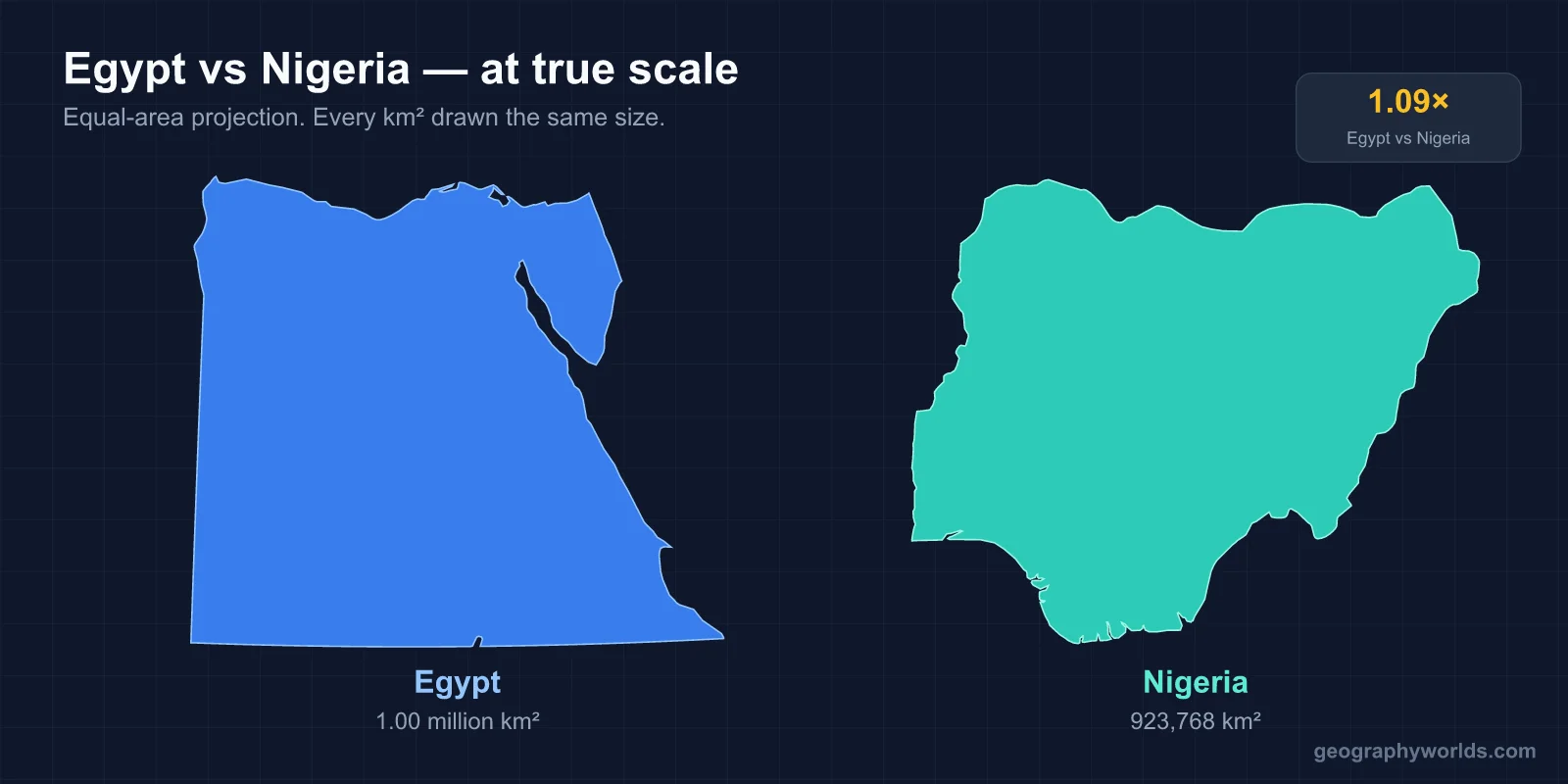
The two countries are surprisingly close in size. At 1,002,450 km², Egypt edges out Nigeria's 923,768 km² by a factor of about 1.1, so neither dwarfs the other on the map. What differs is how usable that land is. Nigeria spreads across tropical forests, savannas, and the Niger Delta, with terrain that supports settlement across most of the country. Egypt's territory is overwhelmingly desert, with life concentrated in the fertile Nile Valley that threads through it. Both sit in Africa, but Nigeria belongs to West Africa and shares borders with Benin, Niger, Chad, and Cameroon, while Egypt occupies the northeastern corner alongside Libya, Sudan, Israel, and Palestine.
Population & Demographics
| Metric | Nigeria 🇳🇬 | Egypt 🇪🇬 |
|---|---|---|
| Population | 242.4 million | 120.1 million |
| Population Density | 262.4 per km² | 119.8 per km² |
This is where the two part ways dramatically. Nigeria is home to 242.4 million people, roughly twice Egypt's 120.1 million, making it the most populous country in all of Africa. Its density of 262.4 people per km² is also more than double Egypt's reported 119.8 per km², a gap of about 142.6 people per km². One caveat worth keeping in mind: Egypt's figure is spread evenly across a country that is mostly empty desert, so the lived reality along the Nile is far more crowded than the national average suggests.
Capital Cities
Nigeria governs from Abuja, a purpose-built capital in the center of the country, while Egypt's capital is the sprawling metropolis of Cairo. Both are African capitals, but they sit in different corners of the continent: Abuja in West Africa and Cairo in North Africa, on the banks of the Nile near the river's delta.
Language, Currency & Culture
| Aspect | Nigeria 🇳🇬 | Egypt 🇪🇬 |
|---|---|---|
| Languages | English (official), Hausa, Yoruba, Igbo | Arabic (official), Egyptian Arabic widely spoken |
| Currency | Nigerian Naira (NGN) | Egyptian Pound (EGP) |
Language tells the story of each country's makeup. Nigeria uses English as its official language, a legacy of British colonial rule, layered over major indigenous tongues including Hausa, Yoruba, and Igbo. Egypt is far more linguistically uniform: Arabic is official, and the everyday Egyptian Arabic dialect is understood across the Arab world thanks to the country's outsized film and media output. The currencies differ too, with Nigeria using the Naira (NGN) and Egypt the Egyptian Pound (EGP).
Climate & Natural Features
| Aspect | Nigeria 🇳🇬 | Egypt 🇪🇬 |
|---|---|---|
| Climate | tropical in the south, arid in the north | desert; hot, dry summers and mild winters |
| Key Features | Niger River, Jos Plateau, tropical rainforests | Nile River, Sahara Desert, Suez Canal, Sinai Peninsula |
| Economy | oil, agriculture, tech startup hub | tourism, Suez Canal revenues, oil, agriculture |
Nigeria's climate shifts as you move north, from tropical and humid in the south to arid toward the Sahel, and its landscape reflects that range with the Niger River, the elevated Jos Plateau, and tropical rainforests. Egypt is essentially one climate, desert, with hot, dry summers and mild winters, and its defining features are the Nile River, the surrounding Sahara, the Suez Canal, and the Sinai Peninsula. Economically, both lean on oil and agriculture, but Nigeria has built a notable tech startup scene, while Egypt earns heavily from tourism and the toll revenues of the Suez Canal, one of the world's busiest shipping arteries.
What Makes Each Country Unique
Nigeria punches well above its weight culturally. Its Nollywood film industry is one of the largest by output anywhere, jollof rice is a point of regional pride, and its festivals draw on a deep well of traditions. With over 500 living languages, Nigeria ranks among the most linguistically diverse countries on the planet.
Egypt carries the weight of antiquity. The Pyramids of Giza, the pharaonic dynasties, and the life-giving Nile have fascinated the world for millennia. The Great Pyramid of Giza held the title of tallest man-made structure on Earth for more than 3,800 years, a record almost impossible to imagine being broken today.
Key Differences at a Glance
- Area: Nigeria (923,768 km²) vs Egypt (1,002,450 km²) — Egypt is 1.1x larger
- Population: Nigeria (242.4 million) vs Egypt (120.1 million) — Nigeria is 2.0x more populous
- Capitals: Abuja vs Cairo
- Currency: Nigerian Naira (NGN) vs Egyptian Pound (EGP)
- Continents: Africa vs Africa
- Density: Nigeria is more densely populated (difference of ~142.6 people per km²)
- Languages: English (official) vs Arabic (official)
Verdict
Nigeria and Egypt show how two countries of nearly identical size can feel like opposites. Egypt holds a slim edge in land area, yet Nigeria carries twice the population, a reminder that a country's footprint says little about how many people call it home, especially when most of Egypt's territory is uninhabitable desert.
Nigeria's appeal lies in its tropical-to-arid range and landmarks like the Niger River, alongside an economy spanning oil, farming, and a fast-growing tech sector. Egypt is defined by its desert climate, the Nile, and monuments that predate most of recorded history, with tourism and the Suez Canal underpinning its economy. One looks firmly to the future; the other guards an extraordinary past.
Comparing them side by side is a good reminder of how varied a single continent can be. Whether you are planning a trip, brushing up for a class, or just feeding your curiosity, these contrasts help bring the map to life.
Test Your Knowledge!
Think you know your countries? Try our interactive geography quiz!
Play Geography Games →