

Petrified forests are one of nature's most remarkable phenomena — entire ancient forests turned to stone through a geological process called permineralization. Over millions of years, silica-rich groundwater infiltrates buried wood, replacing organic material cell by cell with minerals, most commonly quartz. The result is a perfect stone replica of the original tree, preserving details down to individual growth rings and cellular structures.
Introduction
Petrified forests exist on every continent and span a vast range of geological ages, from Devonian forests over 380 million years old to Miocene forests just 5 million years old. They provide invaluable windows into ancient climates, ecosystems, and evolutionary history, revealing forests that grew in locations now covered by deserts, ice sheets, or oceans.
The Petrification Process
- Mechanism: Permineralization — mineral replacement of organic material
- Primary Mineral: Silicon dioxide (quartz/chalcedony)
- Time Required: Thousands to millions of years
- Other Minerals: Iron, manganese, copper (create colors)
Petrification begins when a tree is rapidly buried by volcanic ash, sediment, or floodwaters, cutting off oxygen and preventing normal decomposition. Silica-rich groundwater then percolates through the buried wood, and dissolved silicon dioxide (SiO₂) gradually fills the cellular spaces. Over thousands to millions of years, the organic material is replaced molecule by molecule with microcrystalline quartz (chalcedony).
The colors in petrified wood come from trace minerals present during the permineralization process. Iron produces reds, yellows, and browns. Manganese creates pinks and purples. Copper yields greens and blues. Carbon produces black. The most spectacular petrified wood displays rainbow-like patterns where different minerals infiltrated at different stages. The preservation is so precise that scientists can identify the tree species, count annual growth rings, and even detect fungal infections and insect damage.
Petrified Forest National Park (Arizona)
- Location: Northeastern Arizona, USA
- Age: ~225 million years (Late Triassic)
- Dominant Species: Araucarioxylon arizonicum (related to modern Araucaria)
- Area: 896 km²
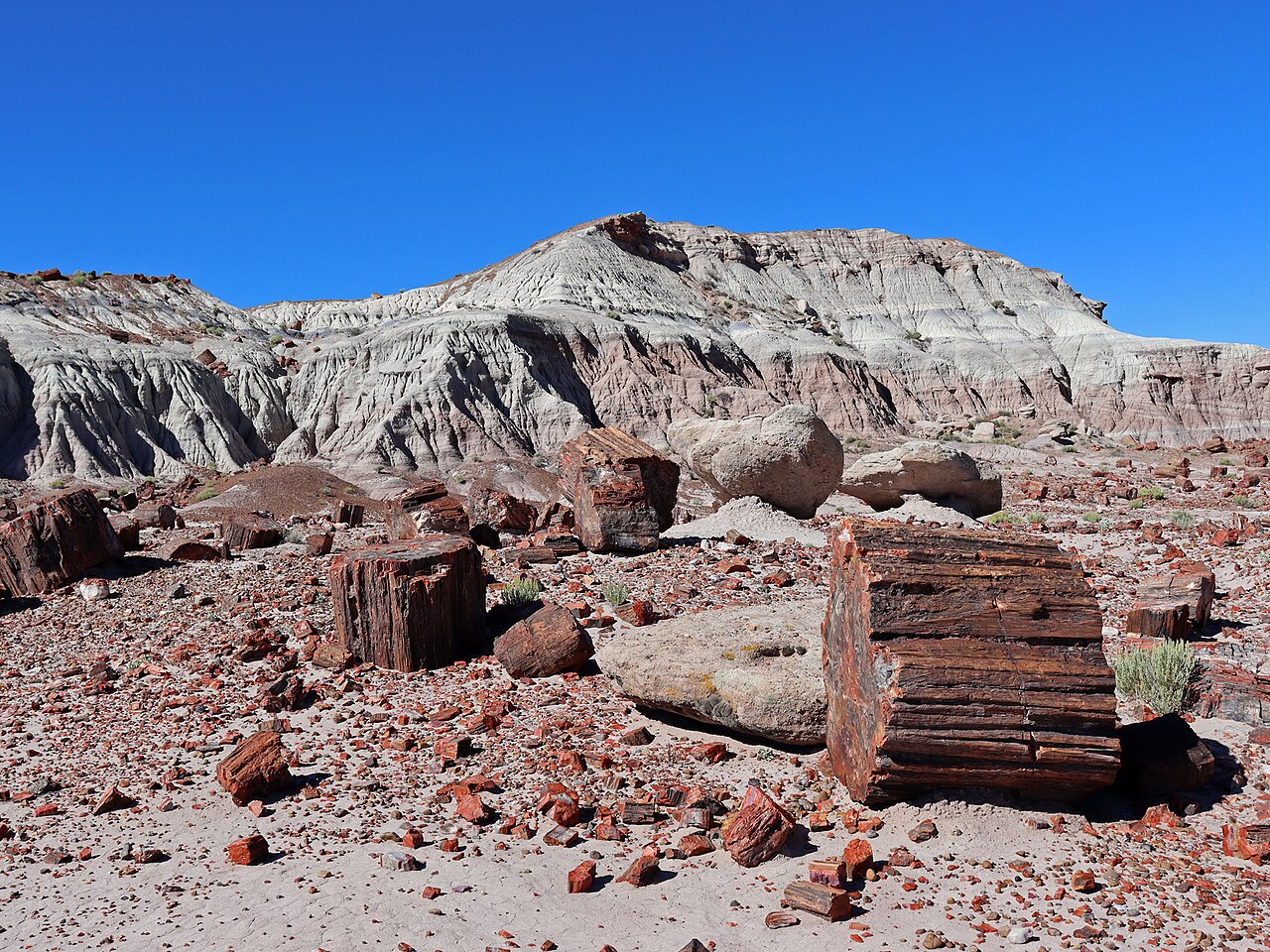
Petrified Forest National Park in Arizona contains the world's largest and most colorful concentration of petrified wood. The logs, which date to the Late Triassic period roughly 225 million years ago, belong mainly to Araucarioxylon arizonicum, a large conifer related to the modern monkey puzzle tree. During the Triassic, this region of Arizona was located near the equator and covered in a lush tropical forest.
The petrified logs of Arizona are famous for their brilliant colors — deep reds, oranges, purples, and yellows created by iron and manganese minerals. Some logs exceed 3 meters in diameter and 30 meters in length. The park also preserves the Painted Desert, a landscape of colorful badlands that erode to reveal new petrified wood. Despite protection, illegal collecting of petrified wood remains a significant problem, with an estimated 12 tonnes stolen annually.
Other Major Petrified Forests
- Lesbos, Greece: 20 million years old, largest petrified forest in the Eastern Mediterranean
- Patagonia, Argentina: Cerro Cuadrado forest, 160 million years old (Jurassic)
- Chemnitz, Germany: 291 million years old (Permian), oldest petrified forest with preserved tree structure
- Yellowstone, USA: Multiple levels of petrified forests stacked vertically
The Petrified Forest of Lesbos, Greece, dates to the Miocene epoch roughly 20 million years ago, when a volcanic eruption buried a subtropical forest of sequoias, pines, and palms. Standing petrified tree trunks up to 7 meters tall remain in their original growth position. The site is a UNESCO Global Geopark and one of the most impressive petrified forests in Europe.
In Patagonia, Argentina, the Cerro Cuadrado Petrified Forest preserves a Jurassic-age forest approximately 160 million years old. The site includes petrified Araucaria trunks up to 30 meters long, along with petrified ferns and seed cones. The Chemnitz Petrified Forest in Germany, at 291 million years old, preserves a Permian tropical forest that grew on the site of a volcanic eruption in what is now central Europe. Yellowstone National Park contains multiple layers of petrified forests stacked vertically, each representing a forest that grew, was buried by volcanic debris, and was replaced by a new forest.
Scientific Importance
- Climate Records: Growth rings reveal ancient climate patterns
- Evolutionary Evidence: Track the evolution of tree families across geological time
- Paleoecology: Reveal entire ancient ecosystem structures
- Disease Records: Preserve evidence of ancient fungal infections and insect damage
Petrified forests are invaluable to paleontologists and climate scientists. Growth rings in petrified wood record annual climate variations — wide rings indicate favorable growing conditions, while narrow rings suggest drought or cold. By studying growth ring patterns in petrified wood from different geological periods, scientists can reconstruct climate histories stretching back hundreds of millions of years.
Petrified forests also reveal the evolutionary history of trees. The presence of Araucaria-like trees in Triassic Arizona and Jurassic Patagonia shows that this ancient tree family once had a nearly global distribution, now restricted to the Southern Hemisphere. Similarly, petrified sequoias found in Arctic locations demonstrate that polar regions were once warm enough to support giant trees — evidence for past periods of extreme global warmth.
Visiting Petrified Forests
- Arizona: Petrified Forest National Park — open year-round, $25 per vehicle
- Lesbos: Petrified Forest Geopark — open April-October
- Patagonia: Bosque Petrificado José Ormachea — near Sarmiento, Argentina
- Laws: Collecting petrified wood from national parks is illegal in most countries
Petrified Forest National Park in Arizona is the most accessible major petrified forest, located along Interstate 40 between Holbrook and Navajo, Arizona. A 45-kilometer scenic road loops through the park, with numerous pullouts and short trails leading to concentrations of petrified logs. The Crystal Forest and Giant Logs trails showcase the most spectacular specimens.
Visitors should be aware that removing petrified wood from national parks and protected sites is illegal and subject to significant fines. The "conscience pile" at Petrified Forest National Park consists of thousands of wood fragments mailed back by visitors who felt guilty after taking them. Despite legal protection, theft remains a serious problem at petrified forest sites worldwide.
Key Facts
- Petrification preserves trees cell by cell, with quartz replacing organic material over millions of years.
- Arizona's Petrified Forest contains logs 225 million years old, from the Late Triassic period.
- Trace minerals create the spectacular colors in petrified wood: iron for reds, manganese for purples, copper for greens.
- Petrified forests exist on every continent, including Antarctica, where they reveal past warm climates.
- Growth rings in petrified wood allow scientists to reconstruct ancient climate patterns.
Fun Facts
- An estimated 12 tonnes of petrified wood are illegally removed from Arizona's Petrified Forest National Park every year.
- Petrified forests in the Arctic contain remnants of ancient tropical and subtropical trees, proving polar regions were once warm.
- Yellowstone contains petrified forests stacked in up to 27 layers, each representing a forest that grew and was buried by volcanic activity.
- Some petrified wood is so perfectly preserved that individual plant cells can be studied under a microscope.
Final Thoughts
Petrified forests are time capsules from ancient worlds — forests turned to stone that preserve the structure and beauty of trees that grew millions or even hundreds of millions of years ago. They remind us that the Earth's landscapes are not permanent but are constantly changing over geological time. From the colorful logs of Arizona to the standing stone trunks of Lesbos, petrified forests inspire wonder and offer irreplaceable evidence about the history of life on our planet.
Test Your Knowledge!
Think you know the world's forests? Try our interactive geography quiz!
Play Geographic Features Quiz →