
Introduction
Poland 🇵🇱 and Romania 🇷🇴 are two of the larger countries on the eastern flank of the European Union, and both have become significant players in the region since joining the bloc. They are closer in size than many people expect, yet their landscapes could hardly be more different, with Poland defined by open plains and Romania wrapped around a great arc of mountains.
Here we compare the two head to head, looking at area, population, capitals, languages, climate, and the industries that anchor each economy.
Size & Geography
| Feature | Poland 🇵🇱 | Romania 🇷🇴 |
|---|---|---|
| Area | 312,696 km² | 238,391 km² |
| Continent | Europe | Europe |
| Region | Eastern Europe | Eastern Europe |
| Land Borders | Germany, Czech Republic, Slovakia, Ukraine, Belarus, Lithuania, Russia (Kaliningrad) | Hungary, Serbia, Bulgaria, Ukraine, Moldova |
| Landscape | mostly flat plains; mountains along southern border | central Transylvanian Basin; Carpathian Mountains arc |
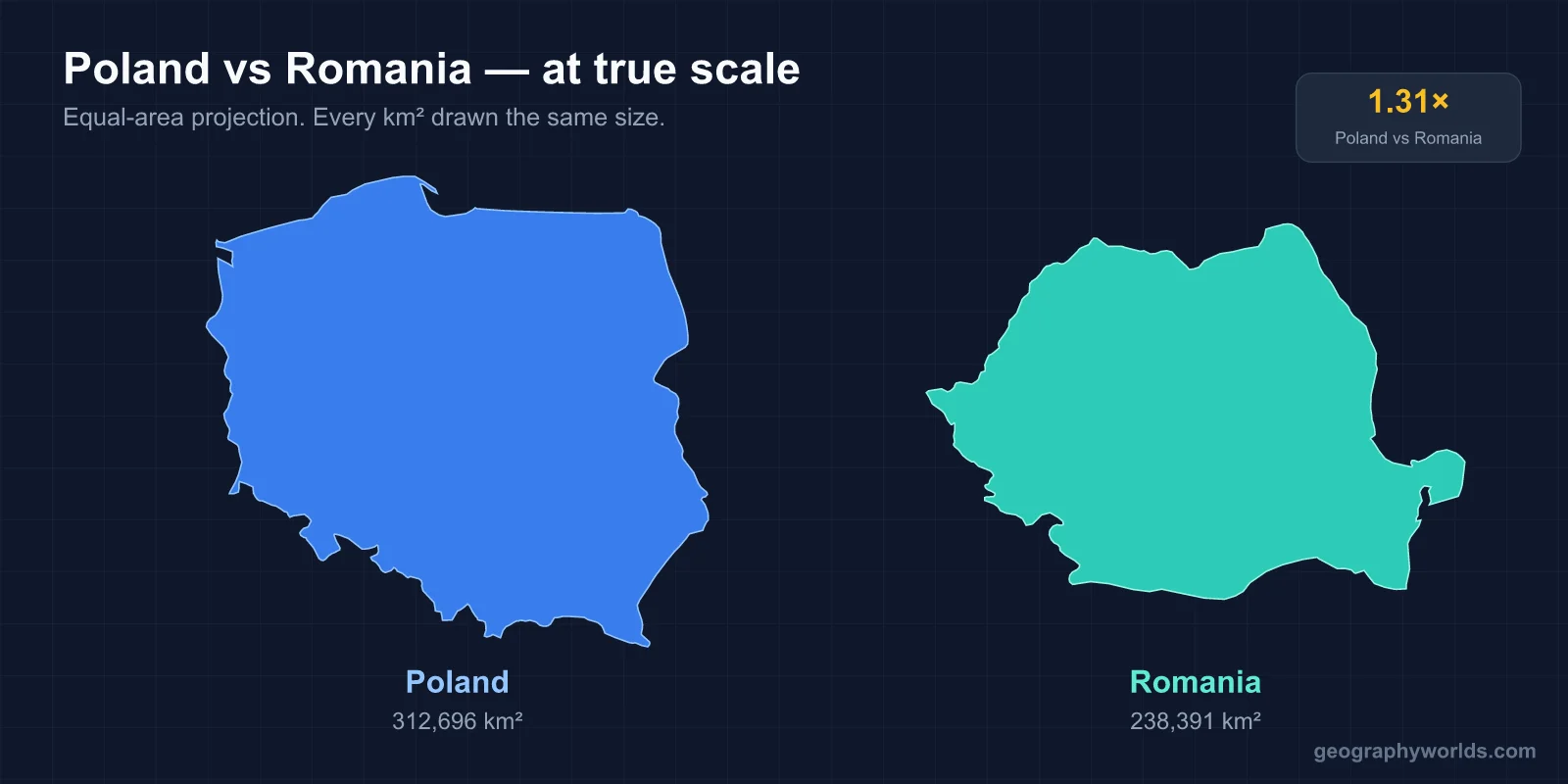
Poland is the larger of the two, but only modestly so: its 312,696 km² is about 1.3 times Romania's 238,391 km². The real difference is in the lay of the land. Poland is dominated by flat, open plains, with mountains confined to its southern border, terrain that has made it a natural corridor across the North European Plain. Romania, by contrast, is shaped by the Carpathian Mountains, which sweep around the central Transylvanian Basin in a great arc, giving the country a mountainous spine and a far more enclosed interior. Poland borders seven countries; Romania, five.
Population & Demographics
| Metric | Poland 🇵🇱 | Romania 🇷🇴 |
|---|---|---|
| Population | 37.8 million | 18.8 million |
| Population Density | 121.0 per km² | 78.9 per km² |
The population gap is wider than the size gap. Poland has 37.8 million people to Romania's 18.8 million, almost exactly twice as many. Poland is also the denser country, at 121.0 people per km² against Romania's 78.9, a difference of roughly 42.2 per km². Romania's mountainous terrain helps explain its lower density, since much of the Carpathian interior is thinly settled compared with Poland's broad, habitable plains.
Capital Cities
Poland is governed from Warsaw, while Romania's capital and largest city is Bucharest. Both sit in the Eastern Europe region of the continent and serve as the political and economic hubs of their respective countries.
Language, Currency & Culture
| Aspect | Poland 🇵🇱 | Romania 🇷🇴 |
|---|---|---|
| Languages | Polish (official) | Romanian (official) |
| Currency | Polish Złoty (PLN) | Romanian Leu (RON) |
Language is one of the clearest dividing lines. Polish is a Slavic language, while Romanian is a Romance language descended from Latin, a striking outlier among its Slavic-speaking neighbors and a clue to the region's Roman past. Both countries have kept their own currencies inside the EU rather than adopting the euro, with Poland using the Złoty (PLN) and Romania the Leu (RON).
Climate & Natural Features
| Aspect | Poland 🇵🇱 | Romania 🇷🇴 |
|---|---|---|
| Climate | temperate with cold, cloudy winters and warm summers | temperate continental; cold winters, warm summers |
| Key Features | Tatra Mountains, Masuria lakes, Baltic coast, Białowieża Forest | Carpathian Mountains, Transylvania, Danube Delta |
| Economy | manufacturing, agriculture, IT services | automotive, IT, agriculture, energy |
Both countries experience a temperate continental climate with cold winters and warm summers, typical of this part of Europe. Their signature landscapes diverge sharply, though. Poland stretches from the Tatra Mountains and Masurian lakes to the Baltic coast and the primeval Białowieża Forest, while Romania is defined by the Carpathian Mountains, the historic region of Transylvania, and the vast wetlands of the Danube Delta where the river meets the Black Sea. Economically the two overlap considerably: both have strong automotive and IT sectors and significant agriculture, with Poland adding broad manufacturing and Romania a notable energy industry.
What Makes Each Country Unique
Poland is known internationally for Kraków's Old Town, the Auschwitz memorial, pierogi, and a history defined by resilience. One of its standout sights is the Wieliczka Salt Mine, an underground world of chapels and sculptures hewn entirely from rock salt and continuously worked since the 13th century.
Romania draws visitors with Transylvania and the castle linked to the Dracula legend, the painted monasteries of Bucovina, the Carpathian Mountains, and the Danube Delta. Its capital is home to the Palace of the Parliament, the heaviest building in the world and the second-largest administrative building anywhere after the Pentagon.
Key Differences at a Glance
- Area: Poland (312,696 km²) vs Romania (238,391 km²) — Poland is 1.3x larger
- Population: Poland (37.8 million) vs Romania (18.8 million) — Poland is 2.0x more populous
- Capitals: Warsaw vs Bucharest
- Currency: Polish Złoty (PLN) vs Romanian Leu (RON)
- Continents: Europe vs Europe
- Density: Poland is more densely populated (difference of ~42.2 people per km²)
- Languages: Polish (official) vs Romanian (official)
Verdict
Poland and Romania are comparable in territory but quite distinct in everything else. Poland edges ahead on area and holds twice the population, and it is the more densely settled of the two, helped by its expanse of flat, livable plain. Romania trades density for drama, with the Carpathians shaping a landscape Poland simply does not have.
Poland's identity runs from the Tatras to the Baltic, backed by a manufacturing-heavy economy, while Romania centers on its mountains, Transylvania, and the Danube Delta, with automotive and energy among its growth drivers. The Slavic-versus-Romance language split only deepens the contrast between these two EU neighbors.
Placed side by side, they reveal how diverse Eastern Europe really is beneath its shared post-communist trajectory. Whether you are planning travel, studying geography, or simply curious, comparisons like this fill in the texture of the map.
Test Your Knowledge!
Think you know your countries? Try our interactive geography quiz!
Play Geography Games →