

Bangladesh is a Muslim-majority country: the 2022 census counted 91.04% of its 165.16 million people as Muslim, almost all of them Sunni, followed by Hindus at 7.95%, Buddhists at 0.61%, Christians at about 0.30% and roughly 0.1% belonging to other faiths. Islam has been the state religion since 1988, yet the constitution also lists secularism as one of its four founding principles and promises "equal status and equal right" to Hindus, Buddhists, Christians and followers of other religions. The country is home to the world's fourth-largest Muslim population and its third-largest Hindu population, after India and Nepal.
Each of these communities arrived by a different road, and each has its own map inside the country. Taking them one at a time explains why Rangamati is the only district without a Muslim majority, why the national temple stands in Old Dhaka and why a Portuguese-era church still gathers thousands of worshippers every Sunday.
Islam: 150 Million Muslims and a Faith Carried by Sufis to the Delta
The 2022 census recorded about 150.36 million Muslims. They form the majority in all eight divisions and in every district except Rangamati in the Chittagong Hill Tracts. Roughly 98% are Bengali Muslims; the rest are mainly Urdu-speaking Biharis and Rohingya. Most follow the Hanafi school of Sunni law. Shia Muslims are a small minority whose Ashura processions in Dhaka mark the death of Husain ibn Ali, and an Ahmadiyya community was estimated at about 100,000 in 2004.
Islam first reached the coast through trade. Arab merchants sailing to Chittagong brought it in the late centuries of the first millennium, and coins from the Abbasid era have turned up across Bengal. Conquest followed in the early 13th century, when Muhammad bin Bakhtiyar Khalji took western and northern Bengal and founded the first Muslim kingdom in the region. Conversion in the countryside was largely the work of Sufi preachers. The best known is Shah Jalal, who with some three hundred followers helped take Sylhet in 1303 and then dispersed his disciples across Bengal; his name remains a household one among Bangladeshi Muslims. In 1352 Shamsuddin Ilyas Shah united the city-states of Sonargaon, Satgaon and Lakhnauti into an independent Bengal Sultanate, whose rulers patronised Bengali rather than only Persian or Sanskrit.
That sultanate left Bangladesh its most celebrated mosque. In the mid-15th century a saint-general named Khan Jahan Ali founded a town called Khalifatabad on the edge of the Sundarbans, near present-day Bagerhat. Its Sixty Dome Mosque, built between 1442 and 1459, actually has 81 domes resting on sixty columns, and the surrounding Mosque City of Bagerhat is a UNESCO World Heritage Site. Modern Dhaka's counterpart is Baitul Mukarram, the national mosque, completed in 1968 and able to hold more than 42,000 worshippers.
The largest religious gathering, though, is not held in a mosque at all. Every year the Bishwa Ijtema, organised by the Tablighi Jamaat, brings millions of people to the banks of the Turag River at Tongi on the edge of Dhaka for three days of prayer and sermons, ending in a final supplication known as the Akheri Munajat. Eid ul-Fitr, Eid ul-Adha, Shab-e-Barat and Mawlid are celebrated across the country, and rural practice often blends orthodox ritual with veneration of local saints' tombs.
Hinduism: 13.1 Million People and the Dhakeshwari National Temple
About 13.1 million Bangladeshis identified as Hindu in 2022. They live in every region, and Hinduism is the second religion in 61 of the 64 districts, with larger concentrations in the north, the south-west and the north-east. Most are Bengali Hindus whose rituals closely resemble those of the neighbouring Indian state of West Bengal. Hindu communities also exist among indigenous peoples such as the Garo, Khasi, Santhal, Tripuri and Bishnupriya Manipuri.
The community's share has fallen steeply over the past century. In 1941 Hindus made up 28% of East Bengal; partition in 1947 sent many across the new border, and the share was 22% by 1951. The 1971 war hit Hindus especially hard: an estimated 10 million people fled to India, most of them Hindu, and many never returned. Later censuses recorded 9.6% in 2001, 8.54% in 2011 and 7.95% in 2022, although the absolute number rose from 11.82 million to 13.1 million over those two decades.
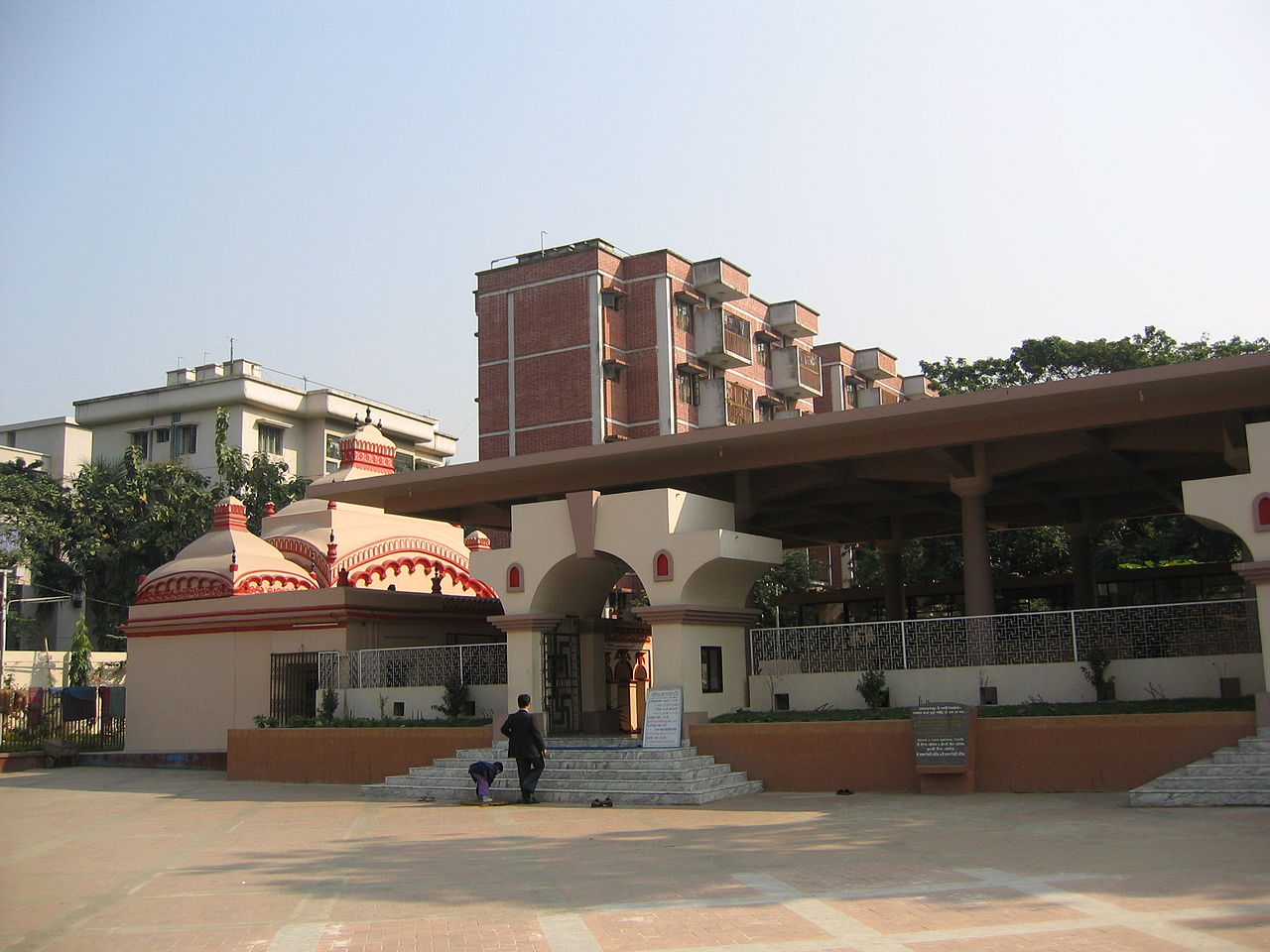
The religion's anchor is the Dhakeshwari Temple in Old Dhaka. Tradition dates its founding to the 12th-century Sena king Ballal Sen, and the city's name is often linked to the goddess Dhakeshwari, though the present buildings are the result of many rebuilds. It is state-owned, which gives it the title of National Temple, and since the Pakistani army destroyed the Ramna Kali Mandir in 1971 it has been the most important Hindu place of worship in the country. Durga Puja is the community's largest festival; Rath Yatra, Janmashtami, Kali Puja and Saraswati Puja are also widely celebrated. Hindu family law governs marriage and inheritance within the community.
Buddhism: 0.61% From Paharpur to the Chittagong Hill Tracts
Buddhists numbered about 1 million in 2022, making Buddhism the third religion of Bangladesh. Most follow the Theravada school. More than 65% live in the Chittagong Hill Tracts, where Buddhism is the main faith of the Chakma, Marma, Tanchangya, Mru, Khumi, Chak and Rakhine peoples, and it is the reason Rangamati district has a Buddhist majority. The rest are mostly Bengali-speaking Baruas, concentrated around Chittagong and Comilla, with smaller groups in Dhaka, Mymensingh, Rangpur and Sylhet. Buddha Purnima is the festival observed by all of them.
Buddhism was once far stronger here. Under the Pala dynasty, which ruled Bengal from the 8th to the 12th century, the region was a centre of Mahayana and Vajrayana learning. The scholar Atisha, born at Bikrampur near present-day Dhaka, rose to lead the monastery of Vikramashila and in the 11th century carried Buddhism to Tibet. The Somapura Mahavihara at Paharpur in Naogaon district was one of the great monastic universities of its age; its cross-shaped central shrine and ring of monks' cells were listed by UNESCO in 1985. Hindu Sena rulers and then Muslim sultans followed the Palas, and Buddhism contracted to the south-eastern hills and the Barua community that survives today.

Christianity: Around Half a Million Believers Since the Portuguese at Tejgaon
Christians account for roughly 0.3% of the population, about 488,000 people, and are largely urban. Roman Catholics are the largest group, with Baptists and other Protestants making up most of the remainder; Seventh-day Adventists and Latter-day Saints also have congregations. Among indigenous peoples, many Garo, Santal, Oraon, Khasi and Bawm families are Christian.
Christianity arrived with Portuguese traders in the early 16th century. By 1514 the Portuguese had the right to preach in Bengal under an agreement between the Pope and the King of Portugal, and Augustinian missionaries worked in and around Dhaka. The Holy Rosary Church at Tejgaon, built in 1677, is the oldest surviving church building in the city and today serves a Catholic parish of more than 17,000 people.
Sikhs, Bahá'ís, Jains and the Animist Faiths of the Hills
The remaining tenth of one percent covers several small but long-established communities. Sikh tradition holds that Guru Nanak visited the region in 1506–07; the Gurdwara Nanak Shahi beside the University of Dhaka, built in 1830, is the oldest of about ten gurdwaras, and the Sikh population is estimated at around 23,000. The Bahá'í Faith has a national centre in Dhaka and spiritual centres in cities including Chittagong, Khulna and Rajshahi. Jainism reached Bengal in antiquity and enjoyed patronage under the Pala and Sena rulers; about 1,000 Jains remain. A Jewish presence dating from the 18th century has all but disappeared.
Indigenous animist and folk religions are harder to count, because census takers often record their followers as Hindu, Buddhist, Christian or "other". They include Songsarek among the Garo of the Mymensingh hills, Sakhua among the Bawm and Lushai, Krama among the Mru, Khumi and Chak, and Sanamahism among Meitei families in Sylhet and Mymensingh divisions. Many of these traditions mix ancestral rites with Buddhist or Hindu elements.
Secularism, the 1988 State Religion and the 2011 Restoration
The constitution of 1972 made secularism one of four fundamental principles of the new state, alongside nationalism, socialism and democracy, and Article 12 committed the state to ending communalism and the political abuse of religion. After the assassination of Sheikh Mujibur Rahman in 1975, a martial-law order under Ziaur Rahman removed secularism from the text in 1977. In 1988 parliament, during the presidency of Hussain Muhammad Ershad, declared Islam the state religion. Both major parties kept that clause after democracy returned in 1990. In 2010 the Supreme Court ruled that the 1977 removal had been unconstitutional, and secularism was restored in 2011, so the two principles now sit side by side.
In practice, most law is secular and inherited from British-era codes, while marriage, divorce and inheritance follow each community's religious law. Islamic affairs such as the Hajj and zakat are handled by the Ministry of Religious Affairs and the Islamic Foundation Bangladesh. In 2022 Freedom House scored the country 2 out of 4 for religious freedom, reflecting attacks on Hindu homes and temples and pressure on Ahmadis. The same Bengali language and culture that bind the country's faiths together, explored in our guide to the languages spoken in Bangladesh, are shared by Muslims, Hindus, Buddhists and Christians alike. The 1947 border that first divided Bengal's Hindus and Muslims is traced in our account of the partition of India, and the very different story of the other half of the old Pakistan is told in our guide to religion in Pakistan.