

Hinduism is the majority religion in India, practised by 79.8% of the population, followed by Islam at 14.2%, Christianity at 2.3% and Sikhism at 1.7%. India is the only country that is both the birthplace of four world religions and home to the world's largest Hindu population and one of its largest Muslim ones — roughly 1.1 billion Hindus and over 200 million Muslims living under a constitution that names no state religion at all.
What the Census Actually Records
India's religion figures come from the decennial census, and the most recent complete religious data is from 2011 — the 2021 round was postponed and has not yet reported, so every percentage in circulation is now well over a decade old.
| Religion | Share | Approx. people |
|---|---|---|
| Hinduism | 79.8% | ~1.1 billion |
| Islam | 14.2% | ~200 million |
| Christianity | 2.3% | ~32 million |
| Sikhism | 1.7% | ~24 million |
| Buddhism | 0.7% | ~10 million |
| Jainism | 0.4% | ~5 million |
The census also records a category of "other religions and persuasions" covering tribal and animist traditions — around 8 million people, mostly Adivasi communities following Sarnaism and related traditions in Jharkhand, Odisha and Chhattisgarh, who have campaigned for decades for their own census code rather than being folded into Hinduism. A smaller group is recorded as "religion not stated". Scale matters more than percentage here: 2.3% Christian sounds marginal until you notice it is more Christians than live in Australia and New Zealand combined.
Four Religions Were Founded Here
No other country originated so many living faiths. Hinduism has no founder and no single founding moment — it grew out of Vedic traditions from roughly 1500 BCE, which makes it the oldest religion still widely practised.
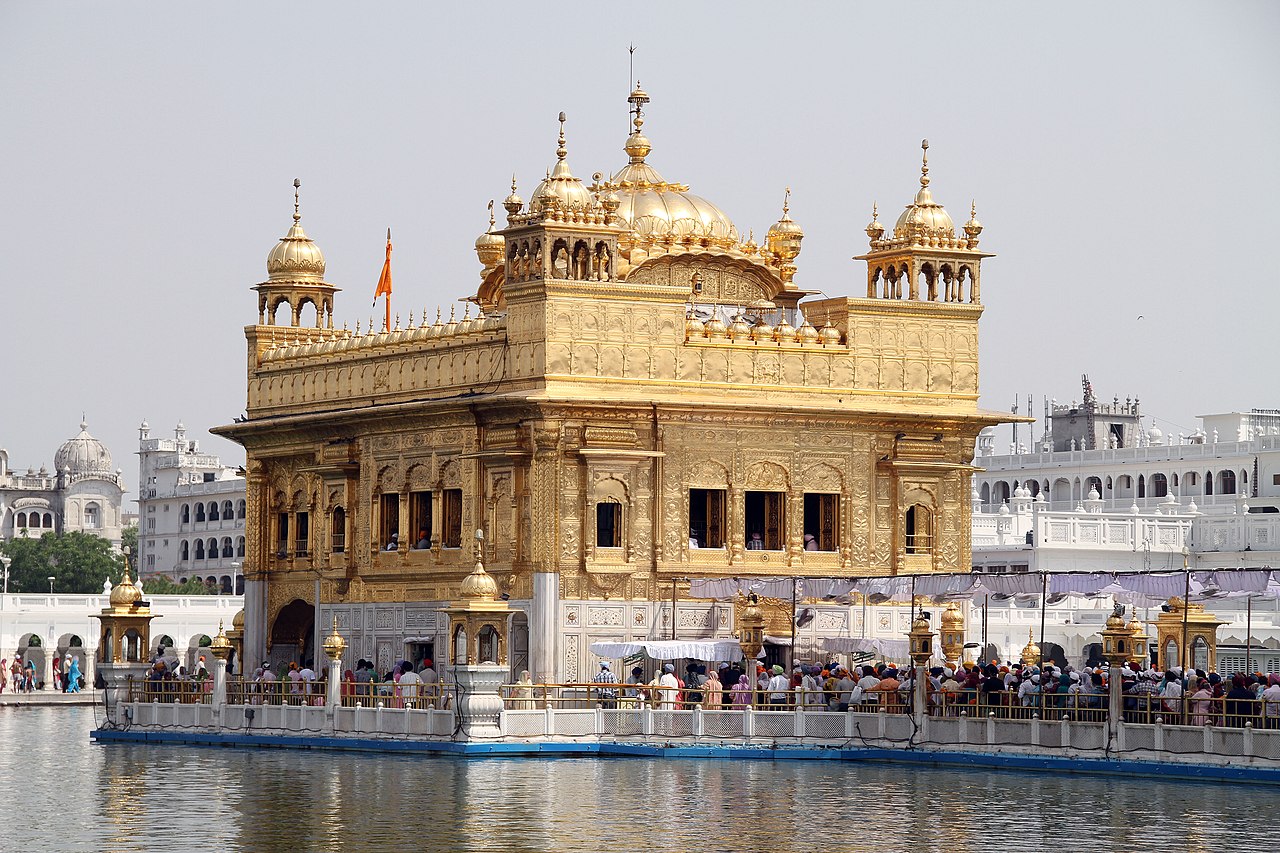
Buddhism began with Siddhartha Gautama's enlightenment at Bodh Gaya in what is now Bihar, around the fifth century BCE. Jainism was crystallised by Mahavira in the same period and the same region, and holds non-violence to a degree no other tradition matches. Sikhism came much later, founded by Guru Nanak in fifteenth-century Punjab, and is the youngest of the major world religions.
The geographic concentration is striking: three of the four emerged within a few hundred kilometres of each other along the Gangetic plain.
Buddhism Left and Came Back
India is the birthplace of Buddhism and one of the countries where it nearly disappeared. Having spread across Asia from the third century BCE, Buddhism declined sharply in India itself from around the twelfth century and by the colonial period was down to a fraction of a per cent.
Its modern figure of 0.7% is largely a twentieth-century revival with a specific origin. In October 1956, B. R. Ambedkar — the principal architect of India's constitution, born into a Dalit family — publicly converted to Buddhism at Nagpur along with several hundred thousand followers, explicitly as a rejection of caste. The Navayana movement that followed accounts for most Indian Buddhists today, concentrated in Maharashtra.
What Partition Did to the Map
The single largest change to India's religious geography happened in a matter of months. The partition of British India in August 1947 created Pakistan as a Muslim-majority state and triggered the largest mass migration in human history: roughly 15 million people displaced, and deaths estimated between several hundred thousand and two million.
The demographic effect was permanent. Punjab and Bengal were both split, Sikhs moved almost entirely to the Indian side, and the Hindu share of what became Pakistan collapsed. India, notably, did not become a Hindu state in response — the Constituent Assembly deliberately chose otherwise, and Muslims remained roughly a tenth of the population, a proportion that has since risen slightly.
The Largest Human Gathering on Earth
Religious observance in India operates at a scale with no parallel. The Kumbh Mela, a Hindu pilgrimage rotating between Prayagraj, Haridwar, Ujjain and Nashik, is the largest peaceful gathering of people anywhere on the planet.
The 2013 Prayagraj Kumbh drew an estimated 120 million people over 55 days, with around 30 million on the single busiest bathing day. Temporary cities are built for it — pontoon bridges, a grid of streets, hospitals, police stations and power supply for a population larger than most countries, then dismantled. It is visible from orbit.
Other observances run at similar scale in a lower key: the Tirumala Venkateswara temple in Andhra Pradesh receives tens of thousands of pilgrims daily and is among the wealthiest religious institutions in the world.
Islam's Thousand Years in India
Islam did not arrive in India with the Mughals. Arab traders brought it to the Malabar coast of Kerala in the seventh century, within decades of the Prophet's lifetime, and the Cheraman Juma Mosque there claims a foundation date of 629 CE — potentially the oldest mosque in the subcontinent and among the oldest anywhere outside Arabia. Sindh was under Muslim rule from 711.
The Delhi Sultanate from 1206 and the Mughal Empire from 1526 made Islam a governing religion across much of the north for over six centuries, and the architectural legacy is the one most visitors see first: the Taj Mahal, Fatehpur Sikri, the Jama Masjid. But conversion was never uniform. Muslim populations concentrated where Sufi orders were active and where caste exclusion made an egalitarian creed attractive, which is why Kerala and Bengal have large Muslim populations while regions under Mughal rule for longer sometimes have fewer.
Today India has the third-largest Muslim population of any country, behind Indonesia and Pakistan, and it is growing slightly as a share — from about 13.4% in 2001 to 14.2% in 2011, driven by a fertility rate that is falling but still above the national average.
Regional Concentration Hides Inside the National Figures
National percentages conceal how sharply religion varies by state. Nagaland and Mizoram are over 87% Christian, products of nineteenth-century Baptist and Presbyterian missions in the north-east; Meghalaya is around 75%. Punjab is the only Sikh-majority state at roughly 58%. Jammu and Kashmir is Muslim-majority. Lakshadweep is 97% Muslim.
Kerala is the most evenly divided large state in the country — roughly 55% Hindu, 27% Muslim and 18% Christian — and its Christian communities trace themselves to Saint Thomas the Apostle rather than to colonial missions, making them older than most churches in Europe.
This is why "religion in India" resists a single description. A Hindu-majority country at the national level contains Christian-majority states, a Sikh-majority state, and Muslim-majority territories, several of which have had that character for a thousand years.
Secular by Constitution, Devout in Practice
India has no established religion. Article 25 guarantees freedom of conscience and the right to profess, practise and propagate religion; the word "secular" was inserted into the constitution's preamble by the 42nd Amendment in 1976, though the courts had already treated the principle as basic structure.
Indian secularism differs from the French or American model. Rather than separating state and religion entirely, it commits the state to treating all religions equally while remaining involved with them — administering major temples in several states, maintaining separate personal-law codes for different communities in matters of marriage and inheritance, and funding pilgrimages. The result is a state that is officially neutral and practically entangled, which is why questions like the uniform civil code remain politically live decades after independence.
Festivals Set the National Calendar
India's public holidays are the clearest sign of how plural the country's religious life is officially treated. The central government publishes a list combining Hindu, Muslim, Christian, Sikh, Buddhist and Jain observances, and states add their own — so the working year is shaped by Diwali, Eid al-Fitr, Christmas, Guru Nanak Jayanti, Buddha Purnima and Mahavir Jayanti together.
Diwali is the largest, observed by Hindus, Sikhs, Jains and some Buddhists for different reasons — a rare case of one festival carrying four distinct religious meanings. Kerala's Onam and Bengal's Durga Puja function as regional equivalents, the latter now inscribed on UNESCO's intangible cultural heritage list. Ratha Yatra at Puri moves temple deities through the streets on chariots so large the English word "juggernaut" derives from the name Jagannath.
The Communities That Are Vanishing
Two of India's oldest minorities are now very small. The Parsis, Zoroastrians who arrived from Persia over a thousand years ago and became disproportionately important in Indian commerce and industry, number around 57,000 and are declining — a consequence of late marriage, low birth rates and strict rules on conversion and intermarriage. The Indian government funds a scheme specifically aimed at reversing it.
India's Jewish communities — the Bene Israel of Maharashtra, the Cochin Jews of Kerala and the Baghdadi Jews of Kolkata — once numbered tens of thousands and are now a few thousand, most having emigrated to Israel after 1948. Both communities are notable for having lived in India for centuries without experiencing the persecution they faced almost everywhere else.
Religious identity in India is also legally consequential in ways it is not in most countries. Personal law — governing marriage, divorce, inheritance and adoption — differs by community, so a Hindu, a Muslim, a Christian and a Parsi are governed by different statutes in the same courts. The Special Marriage Act of 1954 exists precisely to give couples a civil route around this, and inter-religious couples who use it must post a public notice of intent, a requirement courts have repeatedly been asked to strike down.
India's religious map is best understood as scale plus plurality rather than any single number; the same is true of the wider region, and the count of countries in Asia shows how much variation sits inside one continent — compare religion in China, where the state recognises five faiths and most people report none at all.