
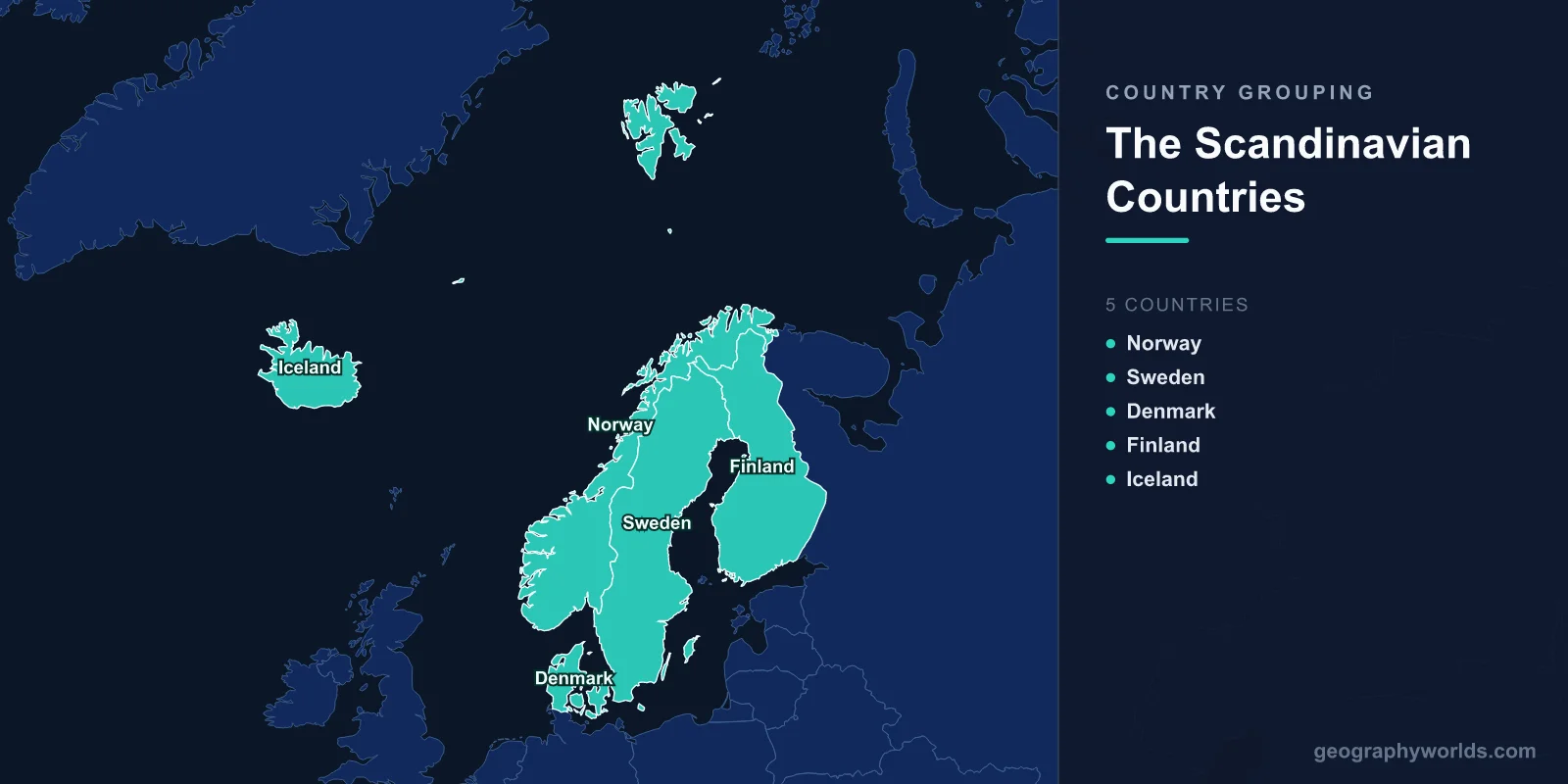
Introduction to The Scandinavian Countries
Scandinavia — in its strictest geographic sense — refers to the three kingdoms of Norway, Sweden, and Denmark, which share closely related North Germanic languages, intertwined royal histories, and the Scandinavian Peninsula's dramatic landscapes of fjords, forests, and Arctic tundra. In broader cultural usage, the term often expands to include Finland and Iceland under the "Nordic" umbrella, encompassing five nations that consistently top global rankings for happiness, equality, education, and quality of life. With a combined population of roughly 27 million, these countries punch far above their weight in innovation, sustainability, and cultural exports — from IKEA and Spotify to Nordic noir fiction and New Nordic cuisine. The Scandinavian model of governance, blending free-market capitalism with comprehensive welfare states funded by progressive taxation, has become a reference point in global political discourse. Whether you are drawn by Norway's otherworldly fjords, Sweden's vast boreal forests, Denmark's cozy hygge culture, Finland's pristine lakeland, or Iceland's volcanic moonscapes, the Scandinavian and Nordic world offers some of the most rewarding experiences on Earth.

Countries in The Scandinavian Countries
- Norway
- Sweden
- Denmark
- Finland
- Iceland
Location: Northern Europe, the Scandinavian Peninsula and surrounding islands
Shared Characteristics: Viking heritage, welfare state model, high quality of life, midnight sun, design and innovation
History
Scandinavian history is inseparable from the Viking Age (roughly 793 to 1066 CE), when Norse seafarers from Denmark, Norway, and Sweden explored, raided, and settled across an astonishing range — from Newfoundland in the west to Constantinople in the east, from the British Isles to the rivers of Russia. The Vikings were not merely raiders but also traders, farmers, lawmakers, and storytellers whose sagas and runic inscriptions constitute some of medieval Europe's richest literature. The three Scandinavian kingdoms emerged as distinct political entities during the medieval period and were briefly united under the Kalmar Union from 1397 to 1523, which brought Denmark, Norway, and Sweden (including Finland) under a single crown. Sweden rose to become a major European power in the 17th century, while Denmark-Norway maintained a dual kingdom until 1814, when Norway was ceded to Sweden following the Napoleonic Wars. Norway gained full independence in 1905 through a peaceful dissolution. Finland, ruled by Sweden for over 600 years and then by Russia from 1809, achieved independence in 1917 after the Russian Revolution. Iceland, governed by Denmark for centuries, became a fully sovereign republic in 1944. The 20th century saw all five nations develop their distinctive welfare states, emphasizing universal healthcare, free education through university, strong labor rights, and generous social safety nets built on high levels of social trust and civic participation.
Geography & Climate
The Scandinavian Peninsula, shared by Norway and Sweden, is one of Europe's largest landmasses, stretching over 1,800 kilometers from the North Sea to well above the Arctic Circle. Norway's western coast is spectacularly carved by fjords — deep, glacier-cut inlets flanked by towering cliffs — with the Sognefjord reaching over 200 kilometers inland and plunging 1,300 meters deep, making it the longest and deepest fjord in mainland Europe. The Scandinavian Mountains (Scandes) form the spine of the peninsula, with peaks reaching above 2,400 meters at Galdhopiggen in Norway. Sweden's terrain is gentler, featuring dense boreal forests covering over half the country, nearly 100,000 lakes, and the fertile agricultural plains of Skane in the south. Denmark is dramatically different — a low-lying country of rolling farmland, sandy beaches, and over 400 islands, with its highest point a mere 171 meters above sea level. Finland is characterized by roughly 188,000 lakes, vast coniferous forests covering 73 percent of its territory, and a flat terrain shaped by Ice Age glaciers. Iceland sits on the Mid-Atlantic Ridge where the Eurasian and North American tectonic plates diverge, creating a landscape of active volcanoes, geysers (the word itself comes from Icelandic), hot springs, glaciers, and black sand beaches. The region experiences extreme seasonal light variation, with the midnight sun illuminating summer nights above the Arctic Circle and the polar night bringing weeks of darkness in winter.
Culture & Society
Scandinavian culture masterfully blends ancient traditions with cutting-edge modernity. The Danish concept of hygge (a warm, cozy atmosphere), the Swedish principle of lagom (just the right amount), and the Finnish quality of sisu (stoic determination) have entered the global vocabulary as lifestyle philosophies. Scandinavian design — characterized by minimalism, functionality, natural materials, and clean lines — has shaped global architecture, furniture, and fashion through brands like IKEA, Marimekko, Georg Jensen, and H&M. The region has produced an outsized share of global cultural exports: ABBA, Bjork, Stieg Larsson's Millennium Trilogy, Karl Ove Knausgard's My Struggle, and the entire Nordic noir genre of dark, atmospheric crime fiction. Finland's sauna culture is deeply embedded in national identity, with over 3 million saunas for 5.5 million people — saunas are found in homes, offices, government buildings, and even Burger King restaurants. Norway's friluftsliv (open-air living) philosophy encourages year-round outdoor activity regardless of weather. All five nations celebrate Midsummer with elaborate festivals, bonfires, and communal feasts under the endless daylight of the summer solstice. The Song and Dance Celebrations of the region, and Finland's heavy metal music scene (the country has more metal bands per capita than any other nation), reflect a culture that values both communal tradition and individual expression.
Economy
The Scandinavian economies rank among the most competitive, innovative, and equal in the world, successfully combining open free-market capitalism with comprehensive welfare states. Norway's economy is anchored by its sovereign wealth fund — the Government Pension Fund Global — which at over $1.6 trillion is the largest in the world, built from North Sea oil and gas revenues and invested globally for the benefit of future generations. Sweden is a powerhouse of innovation and entrepreneurship, home to Spotify, Klarna, Minecraft (Mojang), Volvo, Ericsson, and H&M, and produces more billion-dollar startups per capita than almost any country outside Silicon Valley. Denmark leads globally in wind energy technology (Vestas and Orsted), pharmaceutical research (Novo Nordisk), and sustainable agriculture, while its flexicurity labor model balances employer flexibility with strong worker protections. Finland's economy is driven by technology (Nokia, gaming companies like Supercell and Rovio), forestry, and an education system consistently ranked among the world's best — Finnish students routinely top international assessments despite spending fewer hours in school and receiving no homework until their teens. Iceland has leveraged its abundant geothermal and hydroelectric energy for aluminum smelting and data centers while building a thriving tourism industry that now accounts for a significant share of GDP. All five nations have high unionization rates, low corruption, and some of the highest standards of living on Earth, though they face common challenges including aging populations, high costs of living, and the integration of growing immigrant communities.
The Region Today
The Scandinavian and Nordic countries today face a transformative period shaped by geopolitical shifts, climate leadership, and social evolution. Finland and Sweden both joined NATO in 2023 and 2024 respectively, ending decades of military non-alignment in direct response to Russia's full-scale invasion of Ukraine in 2022 — a seismic shift in Nordic security policy. The region leads the global green energy transition: Denmark aims for carbon neutrality by 2050, Norway is the world leader in electric vehicle adoption (over 80 percent of new car sales are electric), Sweden plans to be fossil-fuel-free by 2045, and Iceland already generates virtually all its electricity from renewable geothermal and hydroelectric sources. Arctic politics have gained new strategic importance as climate change melts sea ice, opens northern shipping routes, and makes Arctic resources more accessible. Immigration and integration remain politically sensitive topics across the region, with right-wing populist parties gaining influence in all five countries. Despite these challenges, the Nordic model continues to attract worldwide admiration for its ability to deliver economic prosperity, social equality, environmental responsibility, and consistently high happiness scores.
Interesting Facts About The Scandinavian Countries
- Norway's sovereign wealth fund owns roughly 1.5 percent of all publicly listed stocks globally, making every Norwegian a theoretical multimillionaire
- Sweden has a nationwide "right to roam" (allemansratten) allowing anyone to walk, camp, and pick berries on private land
- Denmark's Faroe Islands have more sheep than people — roughly 80,000 sheep for 54,000 residents
- Finland has the most saunas per capita in the world — over 3 million saunas for 5.5 million people
- Iceland has no mosquitoes despite its many wetlands, due to the sub-Arctic climate and ocean isolation
- The Swedish word "fika" — a coffee and pastry break — is considered a fundamental part of Swedish working culture
Conclusion
The Scandinavian Countries (Norway, Sweden, Denmark, Finland, Iceland) represent a fascinating regional grouping with shared history, cultural ties, and common challenges. Whether you're studying world geography, planning travel, or simply curious about how the world's nations connect, understanding these regional groupings provides valuable context for making sense of our complex and interconnected world.