
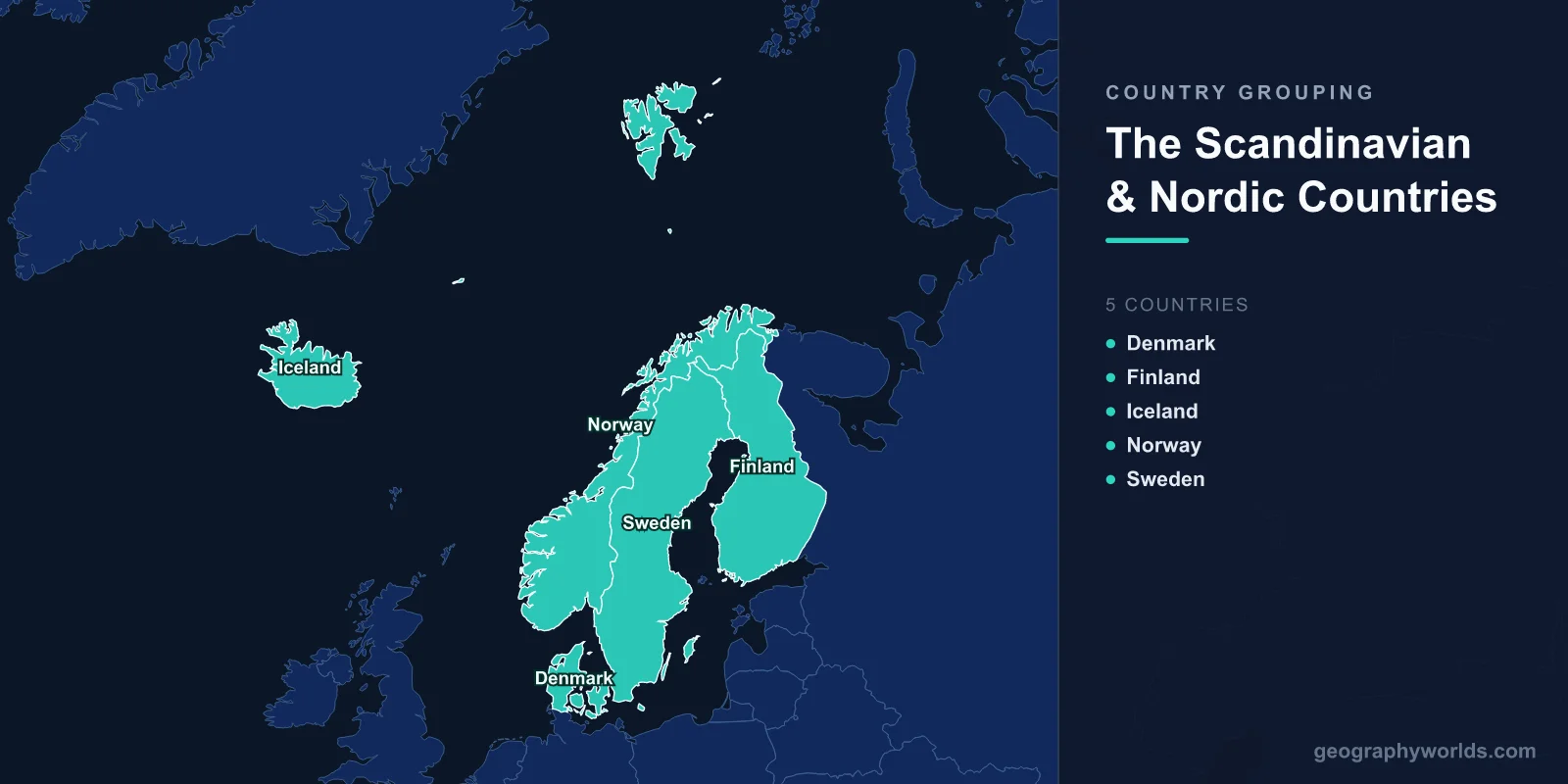
Introduction to The Scandinavian & Nordic Countries
The Scandinavian and Nordic countries — Denmark, Finland, Iceland, Norway, and Sweden — consistently rank among the world's happiest, most prosperous, and most egalitarian nations. Stretching from Denmark's flat, agricultural lowlands to Iceland's volcanic moonscapes and Norway's deep fjords, these five nations share a commitment to social welfare, environmental sustainability, and democratic governance that has become known as the "Nordic model." While the term "Scandinavian" technically refers only to Denmark, Norway, and Sweden (which share closely related languages and historical ties), the broader "Nordic" family includes Finland and Iceland, each with distinct linguistic and cultural identities. Together, these nations punch far above their combined population of roughly 27 million people in innovation, design, literature, and quality of life.

Countries in The Scandinavian & Nordic Countries
- Denmark
- Finland
- Iceland
- Norway
- Sweden
Location: Northern Europe, extending into the Arctic Circle
Shared Characteristics: High quality of life, welfare states, Viking heritage, design and innovation
History
The Nordic nations share deep roots in the Viking Age (roughly 793-1066 CE), when Norse seafarers from Scandinavia explored, traded, and settled across vast distances — from North America to Central Asia, from the British Isles to Constantinople. Denmark, Norway, and Sweden emerged as distinct kingdoms during the medieval period and were periodically united, most notably under the Kalmar Union (1397-1523) which brought all three Scandinavian crowns together. Finland was part of Sweden for over 600 years before becoming a Russian Grand Duchy in 1809 and achieving independence in 1917. Iceland was ruled by Norway and then Denmark for centuries before gaining sovereignty in 1944. The 20th century saw these nations develop their distinctive welfare states, emphasizing universal healthcare, free education, strong labor rights, and generous social safety nets, funded by progressive taxation and high levels of social trust.
Geography & Climate
The Nordic region encompasses some of Europe's most dramatic landscapes. Norway's western coast is carved by spectacular fjords — deep, glacier-cut inlets flanked by towering cliffs — with the Sognefjord reaching over 200 km inland and 1,300 meters deep. Sweden stretches over 1,500 km from north to south, featuring dense boreal forests, nearly 100,000 lakes, and the mountainous border with Norway. Finland is known as the "Land of a Thousand Lakes" though it actually has roughly 188,000 lakes, along with vast forests covering about 73% of its territory. Denmark is the flattest Nordic country, with rolling agricultural lowlands, sandy beaches, and the autonomous territories of Greenland (the world's largest island) and the Faroe Islands. Iceland sits atop the Mid-Atlantic Ridge, creating a landscape of active volcanoes, geysers, hot springs, glaciers, and black sand beaches found nowhere else in Europe.
Culture & Society
Nordic culture blends ancient traditions with cutting-edge modernity. The concept of "hygge" (Danish coziness), "lagom" (Swedish balance), and "sisu" (Finnish resilience) have entered the global vocabulary. Scandinavian design — characterized by minimalism, functionality, and clean lines — has influenced architecture, furniture, and fashion worldwide through brands like IKEA, Marimekko, and H&M. The Nordic nations have produced an outsized share of globally influential culture: from ABBA and Bjork to the Millennium Trilogy and Nordic noir detective fiction. Finland's sauna culture (with over 3 million saunas for 5.5 million people), Norway's outdoor friluftsliv lifestyle, and Sweden's fika coffee tradition reflect deeply held cultural values. The region celebrates the summer solstice with Midsummer festivals featuring maypoles, flower crowns, and long communal meals under the midnight sun.
Economy
The Nordic economies are among the most competitive and innovative in the world, combining open markets with comprehensive welfare states. Norway's enormous sovereign wealth fund, built on North Sea oil and gas revenues, is the world's largest at over $1.5 trillion. Sweden is a global hub for tech startups (Spotify, Klarna, Minecraft), automotive innovation (Volvo), and fashion. Denmark leads in wind energy technology, pharmaceutical research, and sustainable agriculture. Finland is renowned for its education system (consistently top-ranked globally) and technology sector (Nokia, gaming companies like Supercell). Iceland has leveraged its geothermal energy for aluminum smelting and data centers while building a thriving tourism industry. All five nations have high levels of economic equality, strong unions, and some of the highest standards of living on Earth.
The Region Today
Today, the Nordic nations face the challenge of maintaining their generous welfare models amid aging populations, immigration debates, and geopolitical shifts. Finland and Sweden joined NATO in 2023-2024, ending decades of military non-alignment in response to Russia's invasion of Ukraine. The region is a global leader in green energy transition, with Denmark aiming for carbon neutrality by 2050 and Iceland already running almost entirely on renewable energy. Arctic politics have gained new importance as climate change opens northern sea routes and access to resources. Despite challenges, the Nordic model continues to attract worldwide admiration for its ability to combine economic competitiveness with social equality and environmental responsibility.
Interesting Facts About The Scandinavian & Nordic Countries
- Finland has roughly 3 million saunas for a population of about 5.5 million people
- Norway's sovereign wealth fund is worth over $1.5 trillion, making every Norwegian a theoretical millionaire
- Iceland has no standing army and has not had one since 1869
- Sweden's IKEA furniture instructions use no text — only diagrams — making them universally understandable
- Denmark's Faroe Islands have more sheep than people, with roughly 80,000 sheep for 54,000 residents
- The longest place name in Iceland is Kirkjubaejarklaustur, a village named after a medieval convent
Conclusion
The Scandinavian & Nordic Countries (Denmark, Finland, Iceland, Norway, Sweden) represent a fascinating regional grouping with shared history, cultural ties, and common challenges. Whether you're studying world geography, planning travel, or simply curious about how the world's nations connect, understanding these regional groupings provides valuable context for making sense of our complex and interconnected world.