
Introduction
Spain 🇪🇸 and Mexico 🇲🇽 are bound together by history and language yet separated by an ocean and a continent. Spain, the former colonial power, sits in Southern Europe; Mexico, once the heart of New Spain, anchors the southern end of North America. Together they form two of the largest pillars of the Spanish-speaking world.
This comparison sets the two countries side by side across area, population, capitals, language, and landscape, so you can see exactly where the parent and the largest of its former colonies line up and where they part ways.
Size & Geography
| Feature | Spain 🇪🇸 | Mexico 🇲🇽 |
|---|---|---|
| Area | 505,992 km² | 1,964,375 km² |
| Continent | Europe | North America |
| Region | Southern Europe | Central America |
| Land Borders | France, Portugal, Andorra, Morocco (Ceuta), Gibraltar | United States, Guatemala, Belize |
| Landscape | large central plateau (Meseta), mountains, coastal plains | high plateaus, mountains, lowlands, deserts, tropical coasts |
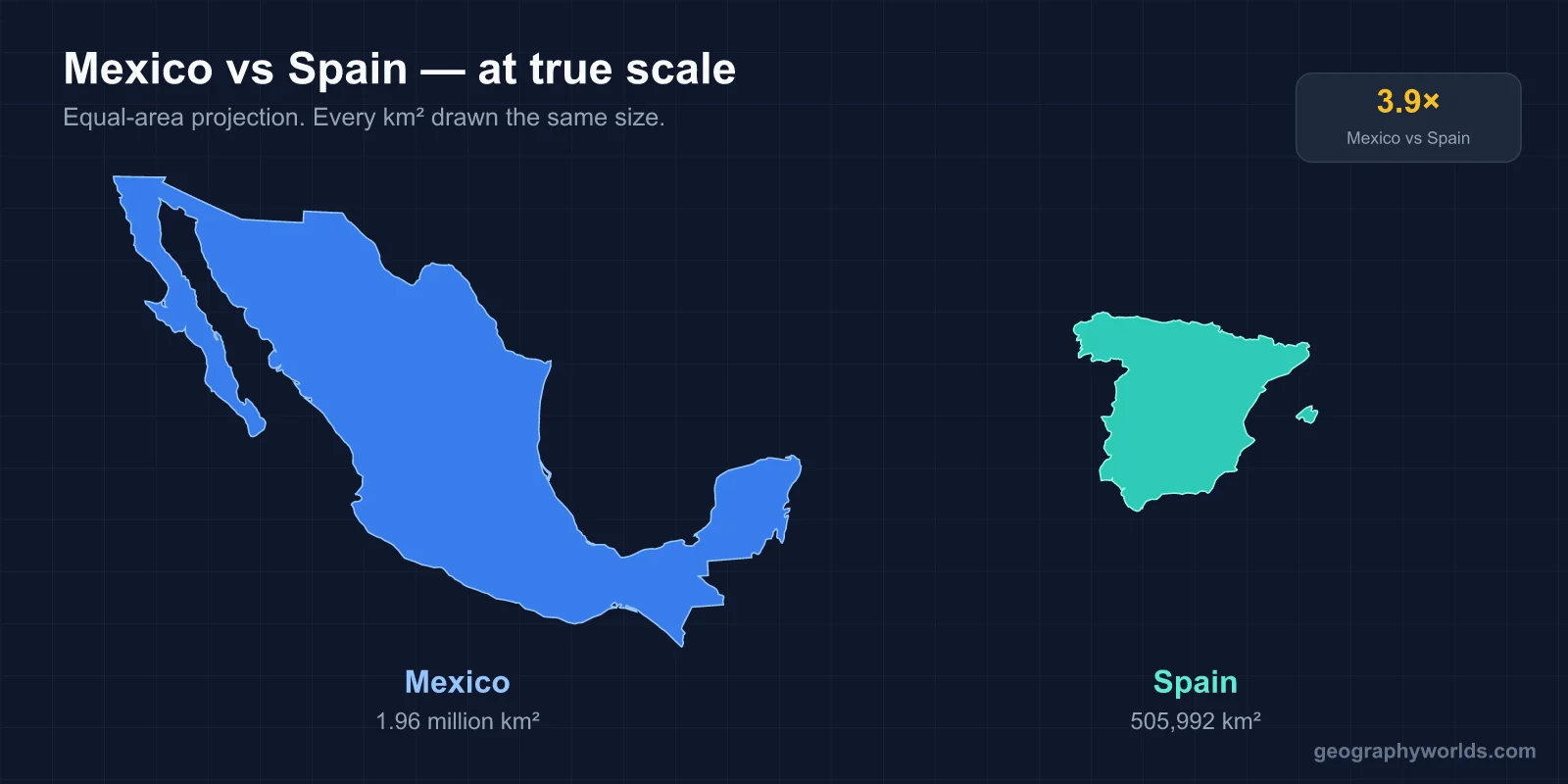
Here the former colony dwarfs the mother country: Mexico's 1,964,375 km² is nearly 3.9 times the size of Spain's 505,992 km². Their terrain rhymes in places — both are built around high central plateaus framed by mountain ranges — but Mexico's far greater span lets it stack up deserts in the north, tropical coasts in the south, and everything in between, while Spain's variety is concentrated into the Meseta, its surrounding ranges, and its coastal plains. Spain's borders run to European neighbors plus Morocco and Gibraltar, whereas Mexico fronts the United States to the north and Guatemala and Belize to the south.
Population & Demographics
| Metric | Spain 🇪🇸 | Mexico 🇲🇽 |
|---|---|---|
| Population | 47.9 million | 133.0 million |
| Population Density | 94.6 per km² | 67.7 per km² |
Mexico's population of 133.0 million is roughly 2.8 times Spain's 47.9 million, in keeping with its much larger territory. Yet because Mexico's land is so vast — and much of it desert or rugged highland — its people are spread thinner, at 67.7 per km², while Spain comes in denser at 94.6 per km², a difference of about 26.9 people per km². So even though Spain holds far fewer people, they are packed more tightly into its smaller frame.
Capital Cities
Madrid is the capital of Spain, sitting on the Meseta in the interior of Europe, while Mexico City is the capital of Mexico, sprawling across a high valley in North America. Both are among the most populous capitals of their regions, but they belong to entirely different continents, a reminder that the shared language stretches right across the Atlantic.
Language, Currency & Culture
| Aspect | Spain 🇪🇸 | Mexico 🇲🇽 |
|---|---|---|
| Languages | Spanish/Castilian (official), Catalan, Galician, Basque | Spanish (de facto official), plus 68 recognized indigenous languages |
| Currency | Euro (EUR) | Mexican Peso (MXN) |
Spanish is the common thread, though each country pairs it with its own linguistic landscape. Spain recognizes Spanish (Castilian) alongside regional languages such as Catalan, Galician, and Basque, while Mexico treats Spanish as its de facto national language alongside 68 recognized indigenous languages, a legacy of the Aztec, Maya, and many other peoples. The currencies differ entirely: Spain uses the Euro (EUR) as a eurozone member, while Mexico uses the Mexican Peso (MXN).
Climate & Natural Features
| Aspect | Spain 🇪🇸 | Mexico 🇲🇽 |
|---|---|---|
| Climate | Mediterranean and oceanic; hot summers in interior | varies from tropical to desert |
| Key Features | Pyrenees, Sierra Nevada, Canary Islands, Balearic Islands | Sierra Madre, Yucatán Peninsula, Copper Canyon, cenotes |
| Economy | tourism, agriculture, automotive, renewable energy | manufacturing, oil, agriculture, tourism, remittances |
Climate is where Mexico's sheer reach shows most plainly. Its conditions run the full gamut from tropical to desert, while Spain's are broadly Mediterranean and oceanic, with notably hot summers in the interior. The signature features follow suit: Spain has the Pyrenees, the Sierra Nevada, and the Canary and Balearic Islands, while Mexico boasts the Sierra Madre ranges, the Yucatán Peninsula, the dramatic Copper Canyon, and the water-filled sinkholes known as cenotes. Both economies lean on tourism and agriculture, but Spain adds automotive and renewable energy, while Mexico's is driven heavily by manufacturing, oil, and remittances sent home from abroad.
What Makes Each Country Unique
Spain is internationally renowned for flamenco dancing, La Sagrada Família, tapas culture, and passionate football (soccer). Spain has the second-highest number of UNESCO World Heritage Sites in the world and is Europe's most popular tourist destination after France.
Mexico is best known for ancient Mayan and Aztec civilizations, tacos, tequila, Day of the Dead celebrations, and vibrant art. Mexico City is built on the ruins of the Aztec capital Tenochtitlán and is sinking at a rate of about 50 cm per year due to water extraction.
Key Differences at a Glance
- Area: Spain (505,992 km²) vs Mexico (1,964,375 km²) — Mexico is 3.9x larger
- Population: Spain (47.9 million) vs Mexico (133.0 million) — Mexico is 2.8x more populous
- Capitals: Madrid vs Mexico City
- Currency: Euro (EUR) vs Mexican Peso (MXN)
- Continents: Europe vs North America
- Density: Spain is more densely populated (difference of ~26.9 people per km²)
- Languages: Spanish/Castilian (official) vs Spanish (de facto official)
Verdict
Spain and Mexico are a study in how a shared language can span two continents while everything else scales up. Mexico is the giant here, nearly four times Spain's area and almost three times its population, yet Spain remains the more densely settled of the two, fitting more people into each square kilometer of its smaller territory.
Spain's geography centers on the Meseta and its Mediterranean coasts, anchored by the Pyrenees and its island groups, while Mexico ranges from desert to tropics across the Sierra Madre, the Yucatán, and its cenotes. Their economies reflect their roles too — Spain in tourism and automotive industry, Mexico in manufacturing, oil, and remittances — even as Spanish links the two across the Atlantic.
Comparing them is one of the clearest ways to see how a colonial relationship echoes through geography centuries later. Side by side, Spain and Mexico show how language can unite two nations that differ in almost every physical respect.
Test Your Knowledge!
Think you know your countries? Try our interactive geography quiz!
Play Geography Games →