
The St. Lawrence River flows 1,197 kilometers from the outlet of Lake Ontario to the Gulf of St. Lawrence on Canada's Atlantic coast. Together with the Great Lakes, it forms the St. Lawrence Seaway system — one of the longest navigable inland waterways in the world, extending over 3,700 kilometers from the Atlantic to the heart of the North American continent.
Introduction
The St. Lawrence has been the principal corridor of European exploration, settlement, and commerce in Canada since Jacques Cartier first sailed up the river in 1535. Montreal, Quebec City, and the national capital Ottawa (on the Ottawa River, a major tributary) all owe their existence to the St. Lawrence system.
Geography & Course
- Length: 1,197 km (744 mi)
- Basin Area: 1,344,200 km² (including Great Lakes)
- Average Discharge: 16,800 m³/s at Quebec City
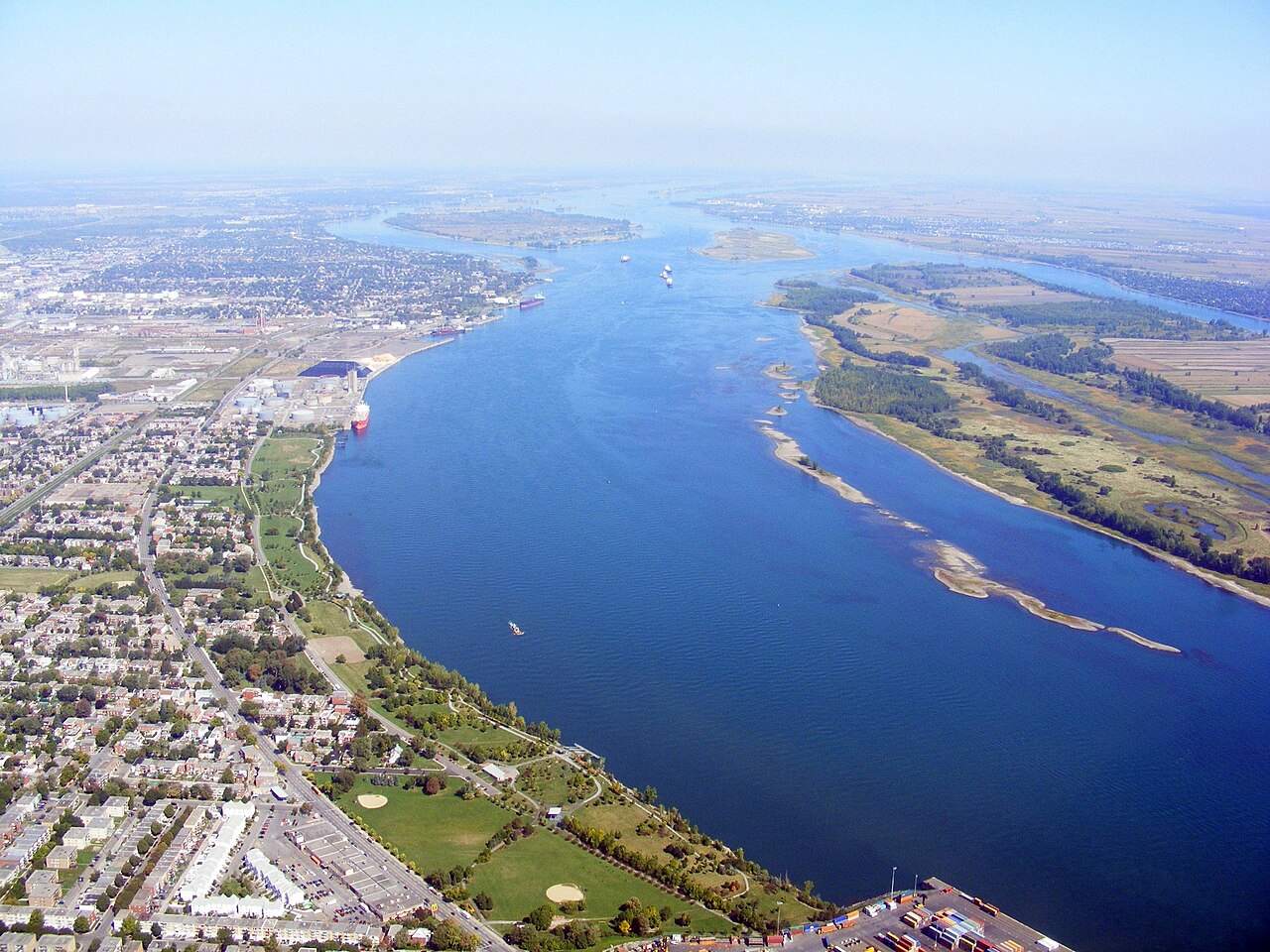
The St. Lawrence begins at the outlet of Lake Ontario near Kingston, Ontario, flowing northeast through the Thousand Islands region — an archipelago of over 1,800 islands straddling the US-Canada border. Below the islands, the river widens and is joined by the Ottawa River near Montreal.
Below Quebec City, the river broadens dramatically into an estuary and then the Gulf of St. Lawrence, a semi-enclosed sea larger than the United Kingdom. The transition from fresh to salt water occurs gradually over several hundred kilometers, creating unique ecological zones. The river's enormous discharge — averaging 16,800 cubic meters per second — makes it one of the largest rivers in North America by volume.
St. Lawrence Seaway
- Opened: 1959
- Total Length: 3,700+ km (with Great Lakes)
- Locks: 15 (7 Canadian, 8 US)
- Ship Size: Up to 225.5 m (Seawaymax)
The St. Lawrence Seaway, a system of locks, canals, and channels completed in 1959 by Canada and the United States, allows ocean-going vessels to travel from the Atlantic to ports on all five Great Lakes. The Seaway bypasses natural barriers including the Lachine Rapids near Montreal and the Niagara Falls escarpment.
The Seaway transformed cities like Chicago, Detroit, Cleveland, and Duluth into de facto ocean ports, enabling them to ship grain, iron ore, and manufactured goods directly to global markets. It handles about 40 million tons of cargo annually, though its size limitations (maximum vessel length 225.5 meters) mean it cannot accommodate the largest modern cargo ships.
Wildlife & Ecology
- Beluga Whales: ~900 in the St. Lawrence estuary
- Fish Species: Over 100
- Marine Mammals: Blue whales, minke whales, seals
The St. Lawrence estuary is one of the richest marine ecosystems in the North Atlantic. A resident population of approximately 900 beluga whales inhabits the river, the southernmost beluga population in the world. The estuary also attracts seasonal visitors including blue whales, humpback whales, minke whales, and fin whales, drawn by the rich upwelling of nutrients where fresh and salt water mix.
The freshwater sections of the river support over 100 fish species, including lake sturgeon, walleye, muskellunge, and Atlantic salmon (which were extirpated but are being reintroduced). The Thousand Islands region is a biodiversity hotspot, with species from both Carolinian and boreal forest zones coexisting on the islands.
Historical Significance
- Jacques Cartier: First European to navigate upriver (1535)
- Battle of Quebec: 1759 (British vs. French)
- Founding of Montreal: 1642
The St. Lawrence was the gateway to French colonization of North America. Jacques Cartier sailed up the river in 1535, reaching the site of present-day Montreal. Samuel de Champlain founded Quebec City in 1608, and Montreal was established in 1642. The river became the spine of New France, the vast French colonial territory in North America.
The Battle of the Plains of Abraham at Quebec City in 1759, one of the most decisive battles in North American history, was fought for control of the St. Lawrence. The British victory transferred Canada from French to British rule and fundamentally shaped the future of the continent. The river remains the boundary between English-speaking and French-speaking Canada in many ways.
Environmental Challenges
- Pollution: Industrial contamination legacy
- Invasive Species: Sea lamprey, zebra mussels via Seaway
- Climate Change: Declining ice cover, water level fluctuations
The St. Lawrence has suffered from decades of industrial pollution, particularly in the Montreal-Quebec City corridor. PCBs, mercury, and other contaminants have accumulated in river sediments and in the tissues of beluga whales, which have the highest cancer rates of any whale population in the world — likely linked to chemical exposure.
The Seaway has also served as a highway for invasive species. Sea lampreys, zebra mussels, and dozens of other non-native organisms have entered the Great Lakes-St. Lawrence system through ballast water discharged by ocean-going ships, causing billions of dollars in ecological and economic damage.
Key Facts
- The St. Lawrence is 1,197 km long and connects the Great Lakes to the Atlantic.
- The St. Lawrence Seaway (1959) allows ocean ships to reach ports 3,700+ km inland.
- About 900 beluga whales live in the St. Lawrence estuary year-round.
- The river was the gateway to French colonization of North America.
- The Battle of Quebec (1759) on the St. Lawrence changed North American history.
Fun Facts
- The Thousand Islands in the St. Lawrence gave their name to Thousand Island salad dressing, reputedly invented by a fishing guide's wife in the early 1900s.
- Anticosti Island in the Gulf of St. Lawrence is one of the largest islands in Canada, with more white-tailed deer than people (roughly 166,000 deer vs. 200 human residents).
- The St. Lawrence is one of the few places in the world where you can watch blue whales — the largest animals ever to live — from shore.
- Ice canoes, a tradition dating to the 18th century, still race across the partially frozen St. Lawrence during Quebec's Winter Carnival.
Final Thoughts
The St. Lawrence River is one of North America's great natural and cultural corridors. From its role as the gateway to a continent in the age of exploration to its modern function as an international shipping lane, the St. Lawrence has shaped the history, economy, and ecology of Canada in ways few other rivers can match.
Test Your Knowledge!
Think you know your rivers? Try our interactive quiz!
Play Geography Games →