
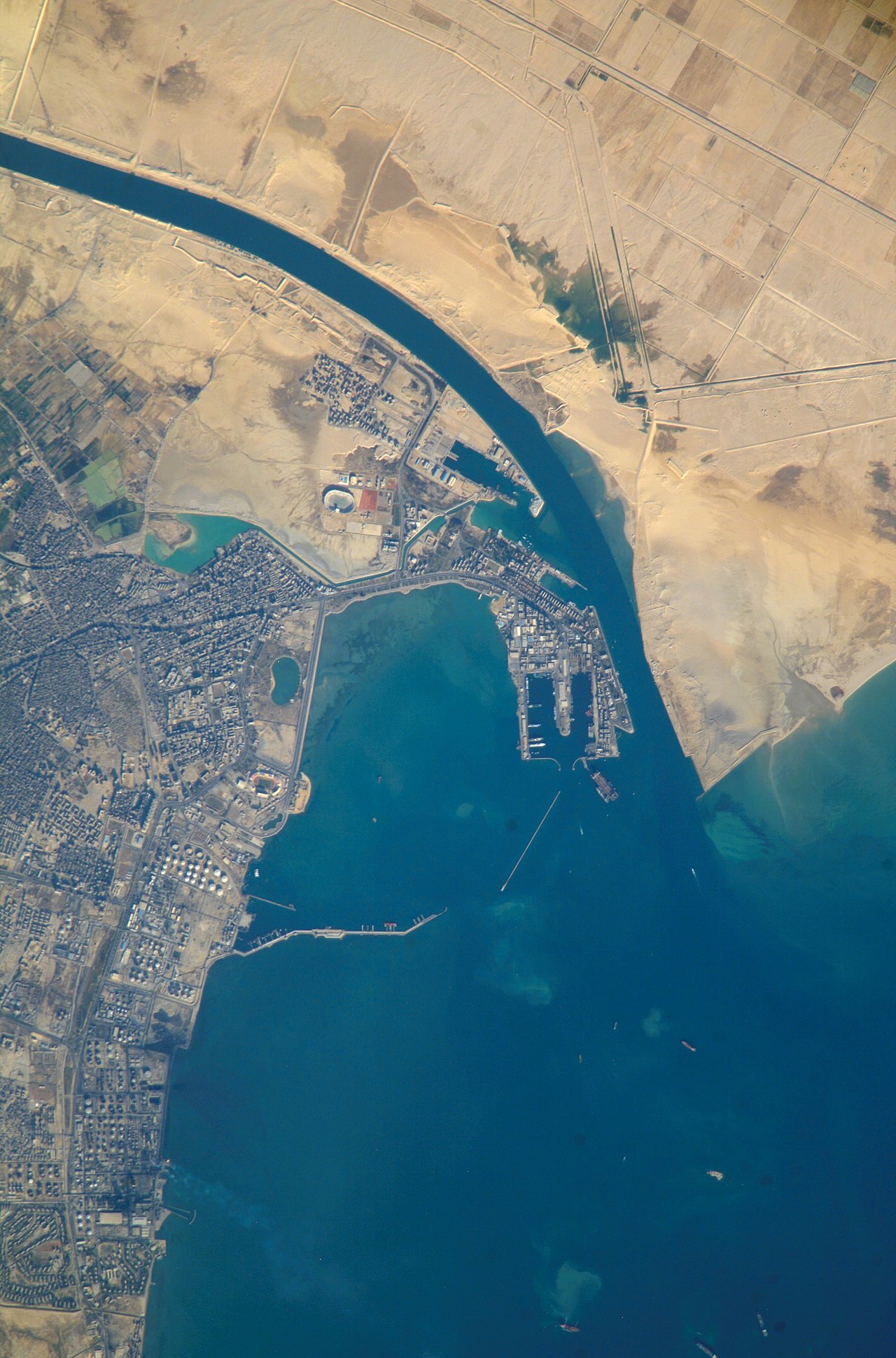
The Suez Canal is a 193-kilometer artificial, sea-level waterway across the Isthmus of Suez in northeastern Egypt, connecting the Mediterranean Sea to the Red Sea. Opened in 1869, it provides the shortest maritime route between Europe and Asia, eliminating the long voyage around Africa and carrying roughly 12 percent of global trade.
Few human-made structures have reshaped the world economy as profoundly as the Suez Canal. By slicing a navigable channel through the narrow land bridge between Africa and Asia, it turned a multi-week detour around the Cape of Good Hope into a transit of barely half a day. The result is a single ribbon of water on which a substantial share of the world's oil, grain, manufactured goods, and consumer products depends every single day.

Where the Suez Canal Is and What It Connects
The canal runs north to south through one of the flattest, driest landscapes on Earth, crossing the Isthmus of Suez between the African and Asian continents. From Port Said on the Mediterranean coast, it passes through Lake Manzala, the El Qantara crossing point, Lake Timsah, and the Great Bitter Lake before reaching the city of Suez on the Red Sea. The expanding port city of Ismailia sits roughly at the canal's midpoint and serves as the headquarters of the Suez Canal Authority.
Unlike the Panama Canal, the Suez Canal has no locks. The Mediterranean and Red Seas sit at nearly identical elevations, so ships simply sail through at sea level. Tidal differences of up to two meters at the southern end still require careful management of water flow, and the surrounding Sinai Desert receives less than 50 millimeters of rainfall a year, making the waterway an oasis corridor through otherwise barren terrain.
History and Construction
The dream of linking the Mediterranean to the Red Sea is ancient. Egyptian pharaohs dug a canal connecting the Nile to the Red Sea as early as the 19th century BCE, and later rulers, including the Persians and Romans, periodically reopened or extended these waterways. The modern project was championed by French diplomat Ferdinand de Lesseps, who secured a concession from Egypt's ruler Said Pasha and founded the Suez Canal Company in 1858.
Construction ran from 1859 to 1869 and employed an estimated 1.5 million workers over the decade, many of them Egyptian forced laborers in the early years before mechanical dredgers took over much of the digging. The work moved roughly 75 million cubic meters of earth. The canal opened on November 17, 1869, with a lavish ceremony attended by European royalty. Control of the waterway became a flashpoint of imperial politics for nearly a century, until President Gamal Abdel Nasser nationalized it in 1956, triggering the Suez Crisis and a brief military intervention by Britain, France, and Israel.
How Ships Pass Through
Vessels transit the Suez Canal in organized convoys, with northbound and southbound groups passing each other in the Great Bitter Lake or using the parallel bypass channel. Pilots from the Suez Canal Authority board every vessel to guide it through the narrow channel. A complete transit takes between 11 and 16 hours, depending on ship speed and convoy scheduling, and roughly 70 to 80 ships pass through on a typical day.
- Lock system: none — it is a sea-level canal
- Transit time: 11 to 16 hours
- Ships per day: approximately 70 to 80
- Maximum draft: 20.1 meters (66 feet)
Expansion and Modernization
The original canal was a modest 8 meters deep and just 22 meters wide at the bottom. Over the following century and a half, successive engineering campaigns deepened and widened it to handle ever-larger ships. Today it exceeds 24 meters in depth and accommodates vessels with a draft of up to 20.1 meters. The 2015 New Suez Canal project added a 35-kilometer parallel channel, enabling simultaneous two-way traffic in the central section, cutting waiting times, and increasing the daily capacity of the waterway. These upgrades reflect a constant race to keep pace with the growing size of container ships and bulk carriers.
Economic and Strategic Importance
The Suez Canal is the single most important artificial waterway in global commerce. It saves ships sailing between Europe and Asia roughly 7,000 to 9,000 kilometers compared with the route around Africa's Cape of Good Hope, dramatically reducing fuel costs, transit time, and emissions. In 2023, canal revenues reached about $9.4 billion, making it one of Egypt's largest sources of foreign currency and a cornerstone of the national economy.
That concentration of traffic is also a vulnerability. In March 2021, the giant container ship Ever Given ran aground and wedged itself across the channel, blocking the canal for six days. The disruption held up an estimated $9.6 billion in trade per day and rippled through global supply chains for months, a vivid reminder of how much modern commerce depends on this narrow strip of water. Regional conflicts and security threats in the Red Sea have periodically rerouted shipping around Africa as well, underscoring the canal's geopolitical sensitivity.
Ecology and Lessepsian Migration
The canal did more than reshape trade — it linked two previously separate marine ecosystems. Since 1869, hundreds of Red Sea species of fish, invertebrates, and algae have spread into the Mediterranean through the canal, a one-directional flow scientists call Lessepsian migration, named after Ferdinand de Lesseps. This influx has altered Mediterranean food webs and fisheries, with some newcomers becoming dominant species along the eastern Mediterranean coast. The phenomenon remains one of the largest ongoing examples of human-driven biological exchange between oceans.
Key Facts
- Length: 193.3 km (120 miles)
- Country: Egypt
- Connects: Mediterranean Sea to the Red Sea
- Opened: November 17, 1869
- Designed by: Ferdinand de Lesseps
- Locks: none (sea-level waterway)
- Share of global trade: about 12 percent
Frequently Asked Questions
How long is the Suez Canal and how long does it take to cross?
The Suez Canal is 193.3 kilometers (about 120 miles) long. A full transit takes between 11 and 16 hours, with ships moving in scheduled convoys guided by Suez Canal Authority pilots.
Why does the Suez Canal have no locks?
The Mediterranean Sea and the Red Sea sit at nearly the same elevation, so there is no need to raise or lower ships between water levels. This makes the Suez a simple sea-level canal, unlike the Panama Canal, which uses locks to lift ships over higher terrain.
Why is the Suez Canal so important to global trade?
It offers the shortest sea route between Europe and Asia, saving ships 7,000 to 9,000 kilometers compared with sailing around Africa. Roughly 12 percent of world trade and a large share of global oil and container shipping pass through it, making it vital to supply chains worldwide.
What happened when the Ever Given blocked the canal?
In March 2021 the container ship Ever Given ran aground and blocked the canal for six days, halting an estimated $9.6 billion in trade per day. Hundreds of ships were stranded, demonstrating how dependent global commerce is on this single waterway.
Test Your Knowledge!
Think you know the world's famous canals and waterways? Try our geography quiz games!
Play Geography Games →