
Introduction
Thailand 🇹🇭 and Indonesia 🇮🇩 are two of Southeast Asia's biggest tourism names, but the resemblance ends quickly. Thailand is a single mainland country built around a central plain; Indonesia is a vast archipelago of thousands of islands strung along the equator. This comparison lines them up across size, population, capitals, climate, and the features that set each apart.
Whether you are studying geography, planning a trip, or just curious how the two measure up, the tables below lay out the key facts.
Size & Geography
| Feature | Thailand 🇹🇭 | Indonesia 🇮🇩 |
|---|---|---|
| Area | 513,120 km² | 1,904,569 km² |
| Continent | Asia | Asia |
| Region | Southeast Asia | Southeast Asia |
| Land Borders | Myanmar, Laos, Cambodia, Malaysia | Malaysia, Papua New Guinea, Timor-Leste |
| Landscape | central plain, Khorat Plateau, mountains, southern isthmus | 17,000+ islands; mountains, rainforests, volcanic terrain |
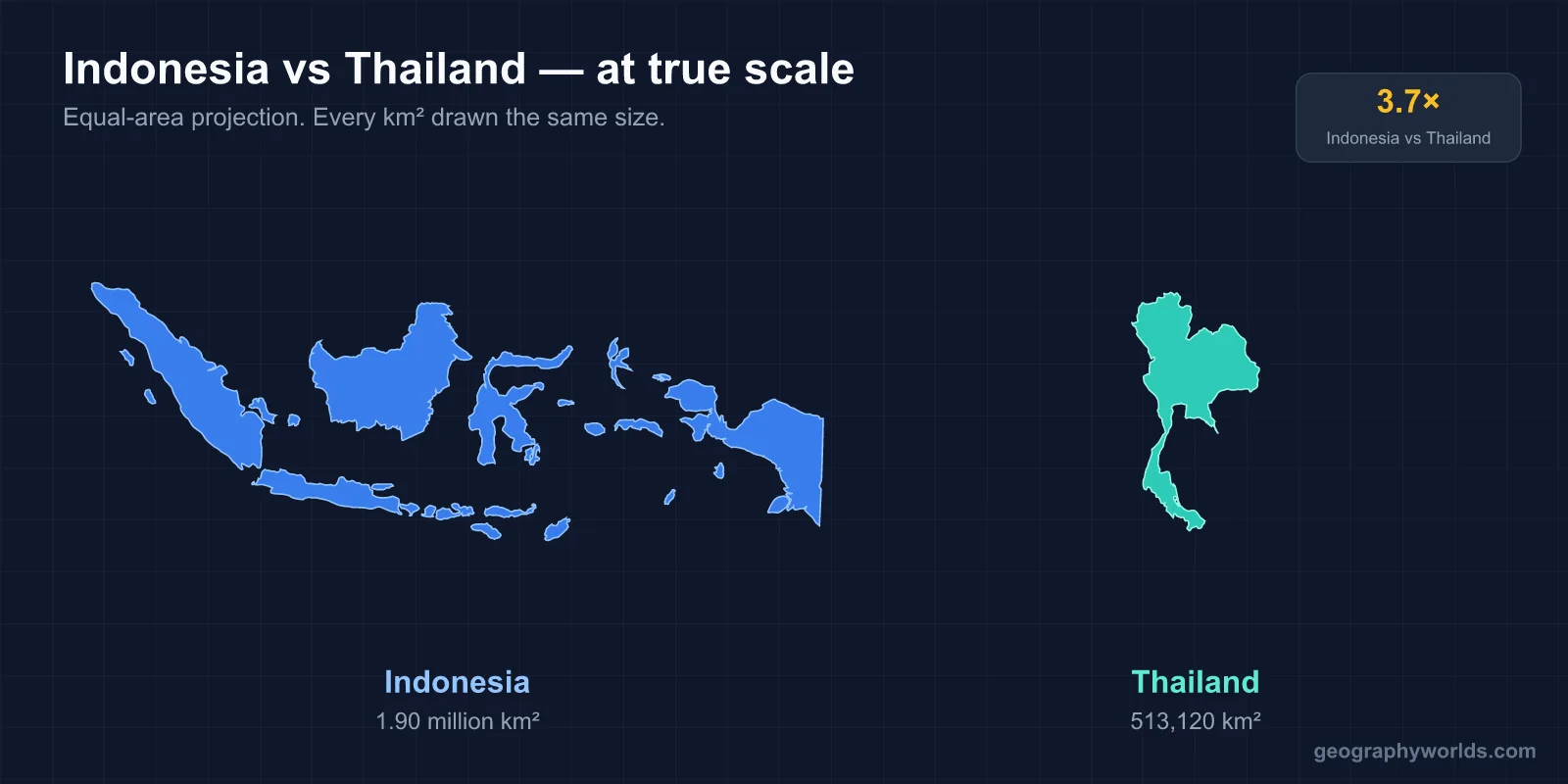
Indonesia dwarfs Thailand in area, its 1,904,569 km² coming in about 3.7 times Thailand's 513,120 km². The difference is not just scale but form: Thailand is one connected mainland of central plain, the Khorat Plateau, mountains, and a southern isthmus, while Indonesia spreads across more than 17,000 islands of mountains, rainforests, and volcanic terrain. That archipelago layout means Indonesia's land borders run through shared islands, with Malaysia, Papua New Guinea, and Timor-Leste, while Thailand's borders follow the mainland with Myanmar, Laos, Cambodia, and Malaysia.
Population & Demographics
| Metric | Thailand 🇹🇭 | Indonesia 🇮🇩 |
|---|---|---|
| Population | 71.6 million | 287.9 million |
| Population Density | 139.5 per km² | 151.2 per km² |
Indonesia leads on people as well, with 287.9 million residents to Thailand's 71.6 million, about four times as many, ranking it among the most populous countries on Earth. Density, though, is surprisingly close. Spread over its huge island area, Indonesia averages 151.2 people per km² against Thailand's 139.5, a difference of just 11.7. Indonesia's population is famously uneven, heavily concentrated on Java while many outer islands stay sparsely settled.
Capital Cities
Both capitals sit within Southeast Asia. Bangkok, on the Chao Phraya River, is Thailand's capital and largest city, while Jakarta, on the island of Java, is Indonesia's. Both lie in Asia.
Language, Currency & Culture
| Aspect | Thailand 🇹🇭 | Indonesia 🇮🇩 |
|---|---|---|
| Languages | Thai (official) | Indonesian (Bahasa Indonesia, official), plus over 700 regional languages |
| Currency | Thai Baht (THB) | Indonesian Rupiah (IDR) |
Language reflects each country's structure. Thailand is built around a single official language, Thai, written in its own script. Indonesia uses Indonesian (Bahasa Indonesia) as its official tongue, but it functions as a unifying common language over more than 700 regional ones spoken across the islands, a striking measure of the archipelago's diversity. Each keeps its own currency, the Thai Baht (THB) and the Indonesian Rupiah (IDR).
Climate & Natural Features
| Aspect | Thailand 🇹🇭 | Indonesia 🇮🇩 |
|---|---|---|
| Climate | tropical; hot and humid monsoon climate | tropical; hot and humid |
| Key Features | Chao Phraya River, Phi Phi Islands, northern highlands | Borneo, Sumatra, Java, Bali, Ring of Fire volcanoes |
| Economy | tourism, automotive, agriculture (rice), electronics | commodities, manufacturing, palm oil, mining |
Both sit squarely in the tropics, hot and humid year-round, with Thailand's pattern driven by the monsoon. Their landmarks reflect mainland versus archipelago: Thailand is tied to the Chao Phraya River, the Phi Phi Islands, and its northern highlands, while Indonesia is defined by giant islands like Borneo, Sumatra, Java, and Bali and by the volcanoes of the Ring of Fire. Economically the two diverge: Thailand emphasizes tourism, automotive production, rice, and electronics, whereas Indonesia leans on commodities, manufacturing, palm oil, and mining, drawing on its enormous natural resource base.
What Makes Each Country Unique
Thailand is renowned for its ornate Buddhist temples, street-food culture, tropical beaches, and Muay Thai martial arts. It is the only Southeast Asian country never colonized by a European power, and its name means "Land of the Free."
Indonesia is best known for Bali, Komodo dragons, the world's largest archipelago, and extraordinary biodiversity. It has more than 17,000 islands, the most of any country, though only about 6,000 are inhabited.
Key Differences at a Glance
- Area: Thailand (513,120 km²) vs Indonesia (1,904,569 km²) — Indonesia is 3.7x larger
- Population: Thailand (71.6 million) vs Indonesia (287.9 million) — Indonesia is 4.0x more populous
- Capitals: Bangkok vs Jakarta
- Currency: Thai Baht (THB) vs Indonesian Rupiah (IDR)
- Continents: Asia vs Asia
- Density: Indonesia is more densely populated (difference of ~11.7 people per km²)
- Languages: Thai (official) vs Indonesian (Bahasa Indonesia)
Verdict
Indonesia is the larger nation on almost every count, roughly 3.7 times Thailand's area and about four times its population, yet the two end up with remarkably similar population densities because Indonesia's people are spread across so much island territory. It is a neat illustration of how raw totals and density can tell different stories.
Thailand's strength lies in its compact mainland geography, its temples and beaches, and an economy led by tourism and automotive manufacturing. Indonesia's lies in its sheer scale, an archipelago of thousands of islands, hundreds of languages, and an economy built on commodities and natural resources. One is a single connected country, the other a sprawling island nation.
Set side by side, the two Southeast Asian tourism giants reveal how different two neighbors in the same region can be. Whether you are traveling, studying, or simply curious, comparing them sharpens the picture of the wider area.
Test Your Knowledge!
Think you know your countries? Try our interactive geography quiz!
Play Geography Games →