
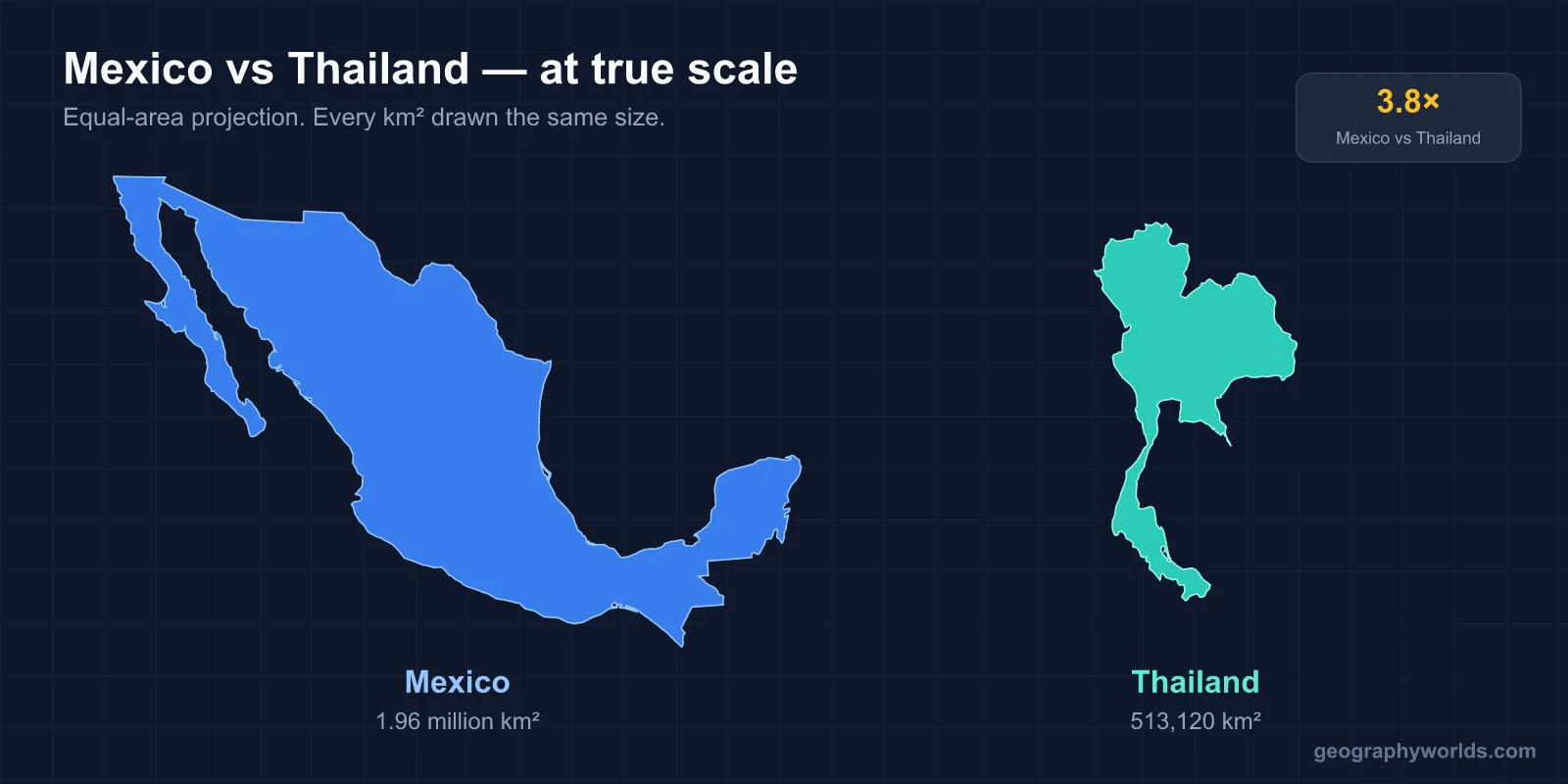
Mexico is the bigger, more populous and richer of the two. It covers 1,972,550 km², about 3.8 times Thailand's 513,120 km², and its government demographers put the population at roughly 134 million in 2026, about twice Thailand's 66 million (civil registration, 2024). The IMF's 2026 estimate of GDP per capita is about $15,800 for Mexico against about $8,100 for Thailand. Mexico City is Mexico's capital and Bangkok is Thailand's. Spanish is Mexico's de facto official language, alongside 68 recognised Indigenous languages, while Thai is Thailand's official language. The more interesting difference is historical: one was conquered by Spain in 1521 and fought its way out three centuries later, while the other is the only country in Southeast Asia that was never colonised by a European power. Setting their timelines side by side shows where the two paths ran parallel and where they split.
| Period | Thailand (Siam) | Mexico |
|---|---|---|
| Before Europe | Sukhothai Kingdom (1238), Ayutthaya (1351) | Olmec, Maya, Teotihuacan, Aztec Empire |
| Europeans arrive | Portuguese envoys reach Ayutthaya, 1511 | Cortés lands in 1519; the Aztec Empire falls to a Spanish-Indigenous alliance, 1521 |
| Rupture | Ayutthaya destroyed by Burmese forces, 1767 | War of Independence, 1810–1821 |
| Territory lost | Most of present-day Laos to France, 1893 | About 55 percent of its land to the United States, 1848 |
| New constitutional order | Siamese revolution, 24 June 1932 | Constitution of 5 February 1917 |
| Currency shock | Baht floated, 2 July 1997 | Peso devalued, December 1994 |
Sukhothai and the Mesoamerican Cities: Two Worlds Before 1500
Both countries trace their states back long before any European arrived, but the depth of the record differs. Human presence in Mexico dates to at least 11,500 BC, and the region called Mesoamerica is counted among the cradles of civilisation: the Olmecs, the Maya, the Zapotecs, the city of Teotihuacan and the Purépecha all rose and fell there before the Mexica built the Aztec Empire around the Valley of Mexico. The name Mexico itself comes from the Nahuatl word for that heartland.
Thailand's story is younger as a Thai story. Archaeology shows people in the area for at least 40,000 years, and Mon, Khmer and Malay peoples were established before the Tai. The Tai migrated south into the territory between the 8th and 10th centuries, and Thai historians date the start of their national history to the Sukhothai Kingdom (1238–1438). The Ayutthaya Kingdom, founded in 1351, then became the regional power, replacing the Khmer Empire as the dominant state of the mainland. Around 1374, according to the royal chronicles, work began on Wat Mahathat, the Temple of the Great Relic, in the heart of the Ayutthaya capital.
1511 and 1521: Ten Years That Set Opposite Courses
The Europeans reached both regions within a single decade. In 1511 Portuguese envoys arrived at the court of Ayutthaya, after Portugal had taken Malacca to the south. They came as traders and diplomats, and the kingdom dealt with them, and with the Dutch, English and French who followed, while remaining independent.
Ten years later, in 1521, the Aztec capital Tenochtitlan fell to Spanish forces fighting alongside an alliance of Indigenous peoples who had been subject to the Aztecs. Spain founded the colony of New Spain with its capital on the ruins of Tenochtitlan, the site of today's Mexico City. New Spain became a hub of the early global economy, shipping silver across the Atlantic and linking Europe with Asia across the Pacific, and its colonial society laid the ground for today's Mexico, where people of mixed ancestry form the largest ethnic group. Here is the first great divergence: Mexico's language, religion and legal system were rebuilt on a Spanish model for three centuries, while Siam's monarchy, Buddhist institutions and Thai language carried on without interruption.
1767 and 1810: Ayutthaya Falls, New Spain Revolts
Both countries went through a violent break around the turn of the 19th century, though from different causes. Siam's came from a neighbour. During the Burmese–Siamese War of 1765–1767, forces of Burma's Konbaung dynasty destroyed Ayutthaya completely in 1767. King Taksin reunified the country from Thonburi, and after he was overthrown, Rama I founded the Chakri dynasty, which still reigns, and moved the capital across the Chao Phraya River to Bangkok in 1782.

Mexico's break came from within the Spanish empire. When Napoleon's invasion of Spain in the Peninsular War shook royal authority, the Cry of Dolores on 16 September 1810 launched the Mexican War of Independence. The war ended when the Army of the Three Guarantees entered Mexico City on 27 September 1821, and the country emerged first as the short-lived First Mexican Empire and then as a republic under the 1824 constitution. Spain did not recognise it until 28 December 1836. So by the 1820s both states had been remade: Siam under a new dynasty in a new capital, Mexico as a new republic with an old colonial capital.
1848 and 1893: Losing Land to Stronger Powers
In the 19th century both countries shrank under pressure from bigger neighbours, and the way each handled it is where their paths diverged most sharply. Mexico fought and lost. The Mexican–American War of 1846–1848 ended with the fall of Mexico City in September 1847 and the Treaty of Guadalupe Hidalgo, signed on 2 February 1848, by which Mexico ceded about 55 percent of its territory, including what are now California, Nevada, Utah and most of Arizona, in exchange for $15 million. The Rio Grande became the boundary with Texas, and today's frontier is described in our guide to the US–Mexico border. French troops landed in January 1862, and from 1864 to 1867 Archduke Maximilian of Habsburg ruled as emperor from Chapultepec Castle until republican forces under Benito Juárez overthrew him; he was executed in June 1867.

Siam bargained instead. The Bowring Treaty, signed with Britain on 18 April 1855 under King Mongkut, opened the country to free trade and granted Britons legal privileges; it became the model for similar unequal treaties with other Western nations. In the Franco-Siamese crisis of 1893, French gunboats sailed up the Chao Phraya to blockade Bangkok, and Siam ceded most of present-day Laos to France. The Anglo-Siamese Treaty of 10 March 1909 gave up Kedah, Kelantan, Perlis and Terengganu to British Malaya. Siam lost land on its edges but kept its core and its crown, and that trade-off is why it avoided colonisation.
Chulalongkorn and Díaz: Two Modernisers Who Ruled Past 1900
The late 19th century produced a long-ruling moderniser in each country. Chulalongkorn, Rama V, reigned from 1868 until his death in 1910. He centralised the government into an absolute monarchy run by ministries, reformed administration and society, and made his concessions to Britain and France in order to keep the rest of the kingdom independent. Thais remember him as the Great Beloved King.
Porfirio Díaz seized power in Mexico in a coup in 1876 and, apart from one term, ruled until 1911. His slogan was "order and progress": he invited foreign investment, built railways and kept control by force where needed. Their rules overlapped for more than three decades, and both tied their countries to foreign capital. The outcomes differed. Chulalongkorn died on the throne and his dynasty continued; Díaz was overthrown in the Mexican Revolution that began in 1910 and lasted a decade.
1917, 1932 and 1938: Revolution, Coup and Nationalisation
The revolution gave Mexico the Constitution of 5 February 1917, still in force, whose Article 27 declared that the nation owns its subsoil. On 18 March 1938 President Lázaro Cárdenas used it to nationalise all oil reserves and foreign oil companies, creating the state company Pemex. In the same year of 1917, Siam took a different step onto the world stage: in July it declared war on Germany and Austria-Hungary and later sent troops to the Western Front, a decision aimed at getting its unequal treaties revised.
Siam's own constitutional break came on 24 June 1932, when the People's Party ended absolute monarchy and made the country a constitutional monarchy. The name Thailand replaced Siam internationally in 1939. From here the two political systems ran on very different lines. Mexico's revolutionary party, founded in 1929 and renamed the PRI in 1946, held the presidency without interruption for 71 years, until Vicente Fox's victory in 2000. Thailand alternated between elected governments and military rule, with coups as recent as 2006 and 2014, and it now operates under the 2017 constitution.
NAFTA, ASEAN and the Car Plants: Where the Paths Meet Again
After 1945 both countries chose a powerful partner. Thailand became a close ally of the United States during the Cold War, and on 8 August 1967 its capital gave its name to the Bangkok Declaration that founded ASEAN. Mexico bound its economy to its northern neighbour, signing the North American Free Trade Agreement, which came into force in 1994; its successor, the United States–Mexico–Canada Agreement, took effect in 2020.
Each then suffered a currency crisis that spread abroad. In December 1994 Mexico's sudden peso devaluation became one of the first international crises driven by capital flight. On 2 July 1997 Thailand was forced to float the baht, and the collapse spread across East and Southeast Asia as the Asian financial crisis, known in Thailand as the Tom Yum Kung crisis.
Today the two economies look more alike than their histories do. Both are major car producers: Thailand's industry is the largest in Southeast Asia and turns out nearly 1.5 million vehicles a year, and automotive manufacturing is one of Mexico's most important industries. Both depend heavily on tourists, with Thailand receiving 39.8 million international arrivals in 2019 and Mexico 42.2 million in 2022. Mexico's economy is the world's 13th largest by nominal GDP; Thailand's ranks 31st in the IMF's 2026 estimates.
The land itself explains some of the remaining difference. Mexico's highest point, Pico de Orizaba, rises to 5,700 m in the Trans-Mexican Volcanic Belt, and much of the country is high plateau between the Sierra Madre ranges, with long stretches too dry for farming. Thailand's highest point, Doi Inthanon, reaches 2,565 m, and its heartland is the flat, well-watered Chao Phraya valley that fed the kingdoms of Sukhothai and Ayutthaya. You can walk the ruins of that older capital through our guide to the Ayutthaya historical site, or follow Thailand's plains, plateau and peninsula in more detail in the geography of Thailand.