
Tucked into the green folds of Africa's Great Lakes region, Burundi is one of the smallest and most overlooked countries on the continent, yet it packs an astonishing amount of beauty, history, and resilience into its modest borders. From a drum tradition recognized by UNESCO to a contested claim on the source of the Nile, this tiny nation rewards anyone willing to look closer. Here are ten genuinely fascinating facts about Burundi.
1. One of the World's Most Densely Packed Nations
Burundi covers just about 27,800 square kilometers, roughly the size of the U.S. state of Maryland, yet it is home to well over 12 million people, making it one of the most densely populated countries in mainland Africa. The vast majority live in rural areas, farming the steep, terraced hillsides that give the country its famous rolling, almost corrugated landscape. This intense pressure on land shapes nearly everything in Burundi, from food production to family life, and helps explain why agriculture dominates the economy. The countryside is a patchwork of small plots, banana groves, and coffee bushes climbing the slopes, a green and crowded mosaic that few outsiders ever picture when they imagine East Africa.
2. It Has Two Capitals, and the Newer One Is in the Hills
For decades, the lakeside city of Bujumbura served as Burundi's capital and remains its largest city and economic engine. But in 2019, the government officially designated Gitega, an inland city in the central highlands, as the country's political capital, relocating institutions of government there. Gitega sits roughly in the geographic heart of the nation and was historically the seat of the Burundian monarchy, giving the move deep symbolic weight. Today Bujumbura continues to function as the commercial and diplomatic hub, while Gitega anchors politics and administration. To dig deeper into the country's geography and cities, see our country guide.
3. The Royal Drummers Are a UNESCO Treasure
Few cultural traditions are as electrifying as Burundi's Royal Drummers. Performed on towering wooden drums called karyenda, these thunderous, synchronized rhythms were historically reserved for sacred royal ceremonies, coronations, and funerals. Drummers balance heavy drums on their heads as they march, then form a circle and take turns leaping, dancing, and pounding out interlocking beats. In 2014, UNESCO inscribed the ritual dance of the royal drum on its list of Intangible Cultural Heritage of Humanity. The drum was once a powerful symbol of the king and the fertility of the land, and today it remains a proud emblem of national identity, performed at major events and for visitors alike.
4. A Shared Language Unites the Nation
Unlike many African countries fractured along linguistic lines, almost everyone in Burundi speaks a single common tongue: Kirundi. This Bantu language is understood across virtually the entire population, an unusual feature that gives the country a strong shared cultural foundation. French, a legacy of Belgian colonial rule, is also an official language and is used in government, education, and business, while English and Swahili have grown in importance thanks to Burundi's membership in the East African Community. This blend of a unifying indigenous language and international ones reflects Burundi's position at the crossroads of Francophone and Anglophone Africa.
5. It Borders One of the World's Oldest and Deepest Lakes
Burundi's southwestern edge rests on the shores of Lake Tanganyika, a body of water of staggering superlatives. It is the second-deepest lake on Earth after Lake Baikal, plunging to around 1,470 meters, and it is also among the oldest lakes in the world, estimated to be millions of years old. The lake holds an enormous share of the planet's unfrozen surface freshwater and teems with hundreds of unique fish species, many found nowhere else. For Burundians, Tanganyika is a vital source of fish, transport, and livelihood, and its sandy beaches near Bujumbura are a rare spot for leisure and recreation.
6. A Contested Source of the Nile Lies Here
The question of where the Nile truly begins has fascinated explorers for centuries, and Burundi sits at the center of one compelling answer. A spring in the country's southern highlands, near Rutovu, is widely regarded as one of the southernmost and most remote sources of the Nile, feeding waters that eventually flow thousands of kilometers north through the White Nile system. A modest stone pyramid marks the spot, drawing geography enthusiasts who want to stand at the symbolic headwaters of the world's longest river. Whether or not it is the definitive source, the claim places this small, landlocked country at the heart of one of history's greatest geographic riddles.
7. Coffee and Tea Drive the Economy
Burundi is overwhelmingly an agricultural nation, and its most valuable exports come straight from those terraced hillsides. Coffee is the star, with high-altitude Arabica beans that specialty roasters around the world increasingly prize for their bright, complex flavors. Tea follows close behind as a major export crop. Together they account for a large share of the country's foreign earnings, meaning that global price swings can ripple powerfully through the national economy. Hundreds of thousands of smallholder families depend on coffee for their income, picking cherries by hand and carrying them to local washing stations, making each cup a product of intensely human labor.
8. Cattle Are a Symbol of Wealth and Respect
In Burundian culture, cattle are far more than livestock. The long-horned Ankole-type cows historically symbolized wealth, status, and social bonds, and gifting cattle was a way to seal friendships, marriages, and alliances. Traditional greetings and blessings even reference cows, with one well-known expression wishing someone a herd of cattle. This deep reverence runs through proverbs, songs, and customs, reflecting an agrarian society where a family's prosperity was once measured on the hoof. Even as the modern economy diversifies, the cultural prestige attached to owning cattle endures in rural communities across the country.
9. Home to Chimpanzees and Rare Highland Wildlife
Despite its small size and dense population, Burundi protects pockets of remarkable biodiversity. Kibira National Park, a montane rainforest in the northwest, shelters chimpanzees, several species of monkeys, and a rich array of birds, while also serving as a crucial water catchment for the region. In the country's east and south, savanna reserves such as Rurubu and the Ruvubu area support hippos, antelope, and abundant birdlife along winding rivers. These protected zones are ecological lifelines, safeguarding forests that regulate rainfall and rivers. For nature lovers, they offer a quieter, less-crowded alternative to East Africa's famous safari circuits.
10. The Flag Tells the Story of the Nation
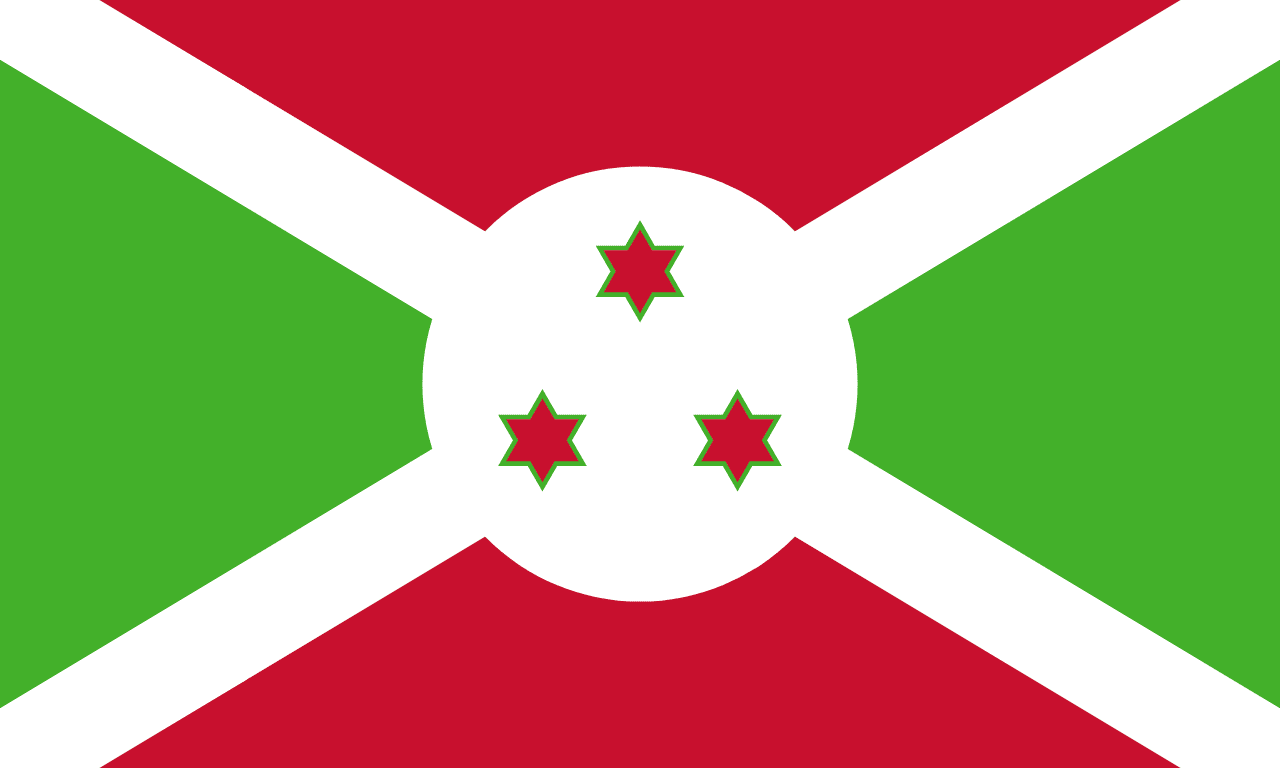
Burundi's flag is one of the most distinctive in the world. A white diagonal cross divides the field into red and green sections, with a white central disc holding three red, green-bordered six-pointed stars. The three stars stand for the national motto, Unité, Travail, Progrès (Unity, Work, Progress), and are also said to represent the country's historic communities. Red symbolizes the struggle for independence, green represents hope, and white stands for peace. It is a flag dense with meaning, designed around the time the nation gained independence from Belgium in 1962. Learn more about its design and symbolism in our piece on the flag of Burundi.
Frequently Asked Questions
What is the capital of Burundi?
Burundi's political capital is Gitega, located in the central highlands, which the government designated as the seat of government in 2019. The lakeside city of Bujumbura remains the largest city and serves as the country's economic and commercial center.
What is Burundi famous for?
Burundi is best known for its UNESCO-recognized Royal Drummers, its high-quality specialty coffee, and its dramatic, hilly landscapes along the shores of Lake Tanganyika, the world's second-deepest lake. It is also linked to one of the contested southernmost sources of the Nile River.
Is Burundi landlocked?
Yes. Burundi is a landlocked country with no ocean coastline, bordered by Rwanda, Tanzania, and the Democratic Republic of the Congo. However, its western edge sits on vast Lake Tanganyika, which provides fishing, transport, and a precious stretch of freshwater shoreline.
Conclusion
Burundi may be small and rarely make global headlines, but it is a country of outsized character, from thundering royal drums and prized hillside coffee to ancient lakes and a contested claim on the mighty Nile. Its dense, terraced hills hold stories of kings, resilience, and a culture bound together by a shared language and a deep love of the land. For the curious traveler and geography enthusiast alike, Burundi proves that some of the world's most rewarding discoveries come in the most unexpected packages.
