
Tucked along the Red Sea where Africa nearly touches Arabia, Eritrea is one of the most underexplored countries on the continent, a land of Italian-era cafes, ancient ports, and nine distinct ethnic communities. It is a place where you can sip a macchiato beneath an Art Deco skyline in the morning and watch fishermen haul their catch from coral lagoons by afternoon. Here are ten fascinating facts that reveal why this small, secretive nation deserves a much bigger place on the map.
1. It Sits on One of the World's Busiest Maritime Highways
Eritrea commands more than 1,000 kilometers of Red Sea coastline, placing it beside the Bab-el-Mandeb strait, the narrow chokepoint through which a huge share of global oil and container traffic passes between the Suez Canal and the Indian Ocean. This strategic geography has shaped Eritrea's entire history, drawing in Ottomans, Egyptians, Italians, and the British, each eager to control access to the sea. The country's two main ports, Massawa and Assab, were once thriving trade hubs linking Africa to Arabia and beyond. Even today, that coastal position remains central to Eritrea's identity as a maritime nation rather than a purely inland African state.
2. Asmara Is "Africa's Secret Modernist City"
The capital, Asmara, sits on a high plateau around 2,300 meters above sea level, giving it a famously mild, spring-like climate year-round. What truly sets it apart is its architecture: during the 1930s, Italian colonists turned Asmara into a laboratory for Futurist and Art Deco design, leaving behind cinemas, service stations, and villas that look like spaceships frozen mid-flight. The Fiat Tagliero building, shaped like an airplane with cantilevered concrete wings, is the most beloved example. In 2017, UNESCO inscribed the entire city center as a World Heritage Site, calling it an exceptionally well-preserved modernist urban landscape. You can read more in our country guide.
3. It Took a 30-Year War to Become Independent
Eritrea is one of Africa's youngest nations, formally gaining independence in 1993. That milestone followed a brutal 30-year armed struggle against Ethiopia, which had annexed Eritrea in 1962 after a period of federation. The conflict, fought largely by the Eritrean People's Liberation Front, became one of the longest wars in modern African history. Independence was confirmed by a near-unanimous referendum in which Eritreans overwhelmingly voted to break away. The memory of that long fight is woven deeply into national life, commemorated in monuments, holidays, and the enduring reverence for the fighters who took shelter in mountain trenches for decades.
4. Nine Ethnic Groups Share One Nation
For a country of roughly 3.7 million people, Eritrea is remarkably diverse, officially recognizing nine ethnic groups, each with its own language and customs. The Tigrinya, concentrated in the highlands, form the largest community, while groups like the Tigre, Saho, Afar, Bilen, Kunama, Nara, Hedareb, and Rashaida give the lowlands and coast their distinct character. This patchwork roughly splits between Christian highlanders and Muslim lowlanders, a balance the government has long emphasized to promote national unity. The result is a country where you can travel a few hundred kilometers and encounter entirely different dress, music, dialects, and architecture.
5. There Is No Single Official Language
Unusually, Eritrea does not designate one official national language. Instead, it embraces linguistic equality, with Tigrinya, Arabic, and English serving as the main working languages in government, business, and education. Tigrinya, written in the ancient Ge'ez script, is the most widely spoken, but all nine ethnic languages are recognized and used in early schooling. English is the medium of instruction in higher grades and universities, a legacy of the brief British administration after World War II. Italian also lingers in older generations and in everyday words like the macchiato. This deliberate multilingualism reflects the country's commitment to giving each community a voice.
6. Coffee Is a Ceremony, Not Just a Drink
In Eritrea, coffee is a ritual that can stretch for an hour or more. The traditional buna ceremony begins with green beans roasted over coals in front of guests, then ground by hand and brewed in a clay pot called a jebena. The coffee is served in three rounds, each with its own name, and skipping out before the third is considered impolite. Incense often burns alongside, and popcorn or roasted grain is passed around. This ceremony, shared with neighbors and visitors alike, is one of the warmest expressions of Eritrean hospitality and a daily anchor of social life across both highland and lowland communities.
7. Injera and Zigni Rule the Table
Eritrean cuisine centers on injera, a large, spongy, slightly sour flatbread made from teff flour that doubles as both plate and utensil. Diners tear pieces of it to scoop up richly spiced stews. The most iconic is zigni, a fiery beef stew built on berbere, a complex chili-and-spice blend, while tsebhi stews and ful (mashed fava beans) round out everyday meals. Decades of Italian influence also left a surprising mark: pasta and lasagna appear on menus in Asmara as comfortably as any traditional dish, making Eritrean food a genuine crossroads of African and Mediterranean flavors.
8. The Dahlak Archipelago Is a Hidden Marine Paradise
Off Eritrea's coast lies the Dahlak Archipelago, a scatter of more than 200 islands in the Red Sea, only a handful of which are inhabited. These remote, sun-baked isles fringe some of the least-disturbed coral reefs on Earth, sheltering sea turtles, dugongs, dolphins, and a dazzling array of tropical fish. For centuries the islands were a center of the pearl-diving trade, and the warm, salty waters still draw the occasional diver in search of pristine underwater scenery. Because tourism remains so limited, the Dahlak reefs are considered some of the most untouched marine ecosystems in the entire region.
9. Cycling Is the National Obsession
Perhaps the most surprising fact about Eritrea is its passion for competitive cycling, a sport inherited directly from the Italians and embraced like nowhere else in Africa. The Tour of Eritrea is a beloved national event, and the country has produced world-class riders such as Daniel Teklehaimanot and Biniam Girmay, the latter making history as the first Black African to win a stage of the Tour de France. The mountainous roads around Asmara, with their thin highland air, double as a natural training ground. On race days, crowds line the capital's avenues, turning cycling into a genuine point of national pride.
10. Its Flag Tells the Story of the Revolution
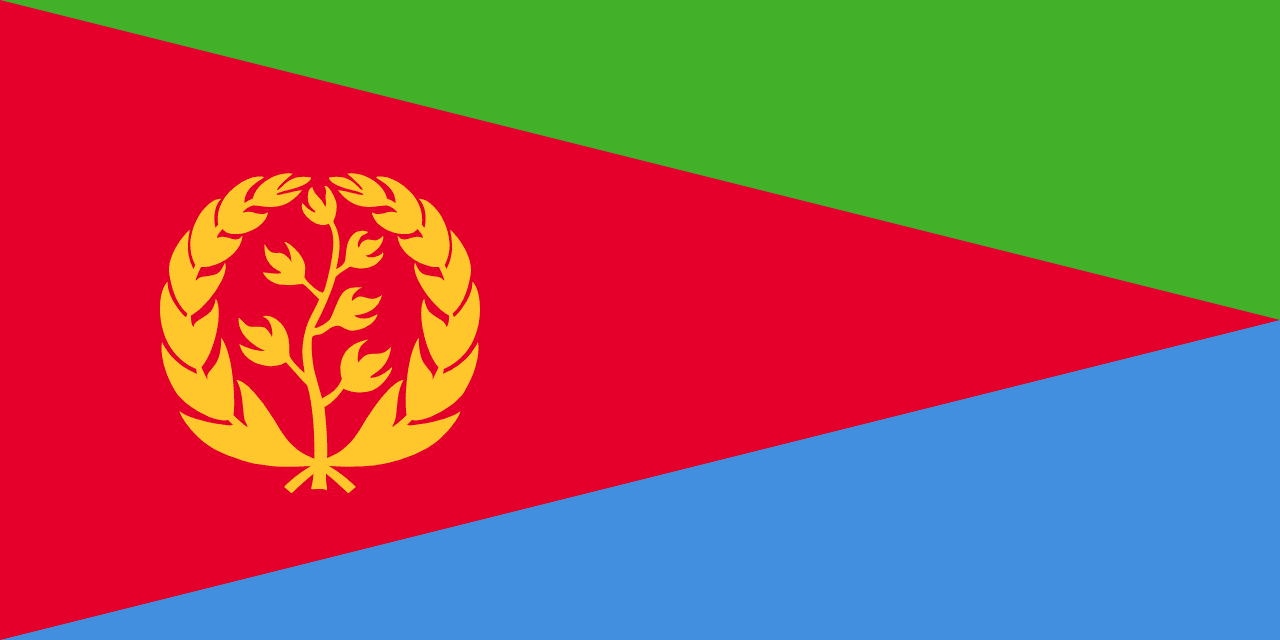
The Eritrean flag is rich with meaning. A red triangle anchored on the hoist side represents the blood shed during the long independence struggle, while a green triangle stands for the country's agriculture and fertile land and a blue triangle honors the wealth of the Red Sea. At the center of the red triangle sits a golden olive wreath encircling an upright olive branch, a symbol borrowed from the original 1952 flag and representing peace. Adopted at independence in 1993, the design fuses revolutionary memory with hope for a prosperous, peaceful future.
Frequently Asked Questions
What is the capital of Eritrea?
The capital is Asmara, a high-altitude city of around half a million people famous for its remarkably preserved Art Deco and Modernist architecture, which earned it UNESCO World Heritage status in 2017.
What is Eritrea famous for?
Eritrea is best known for its Italian-influenced architecture in Asmara, its long 30-year war of independence from Ethiopia, its strategic Red Sea coastline, and a surprisingly fierce national love of competitive cycling.
Why do Eritreans drink so much coffee?
Coffee is central to Eritrean social life through the traditional buna ceremony, where beans are roasted, ground, and brewed fresh in front of guests and served in three rounds. It is a gesture of hospitality and a daily ritual that brings families and neighbors together.
Conclusion
Eritrea packs an extraordinary amount of history, culture, and natural beauty into a small footprint on the Horn of Africa. From the spaceship-like buildings of Asmara to the untouched reefs of the Dahlak Islands, from steaming plates of zigni to roaring cycling crowds, it is a country that constantly defies expectations. These ten facts only begin to capture its character, and they make a strong case for why this quiet Red Sea nation deserves far more curiosity than it usually receives.
