
Ask anyone to picture paradise and the odds are good they will describe something that looks a lot like Fiji: powder-white sand, coconut palms leaning over impossibly blue water, and a smile from a stranger who genuinely means it. Yet behind the honeymoon-brochure image lies a country of remarkable complexity, where more than 300 islands, two living languages, and a famously friendly people combine into something far richer than a beach. Here are ten facts that reveal the real Fiji.
1. It Is an Archipelago of More Than 330 Islands
Fiji is not a single island but a sprawling archipelago of roughly 330 islands scattered across the South Pacific, of which only around a third are permanently inhabited. The two largest, Viti Levu and Vanua Levu, are big, mountainous landmasses of volcanic origin and together hold the vast majority of the population. The remaining islands range from sizable to specks barely large enough for a single resort.
This scattering across the ocean means Fiji controls an enormous maritime territory. Geography here is defined by water as much as by land, and the contrast between the dramatic green volcanic interior of the big islands and the flat coral cays of the outer groups gives the country an unusually varied landscape for such a compact nation.
2. Suva Is the Largest City in the South Pacific
The capital, Suva, sits on the southeastern coast of Viti Levu and is widely regarded as the largest and most cosmopolitan city in the South Pacific outside of Australia and New Zealand. It is the political, commercial, and cultural heart of Fiji, home to the national parliament, the University of the South Pacific, colonial-era architecture, and a lively, multicultural street life.
Suva is famously rainy, sitting on the wet windward side of the island, which keeps it lush and green year-round. Visitors looking for sun often head to the drier western side near Nadi, but Suva remains the place where the real business and intellectual life of the country happens. You can dig deeper in our country guide.
3. Its Population Is a Tale of Two Communities
Fiji is home to roughly 930,000 people, and its modern society is shaped by two major communities. The iTaukei (Indigenous Fijians) form the majority, while Indo-Fijians, descendants of laborers brought from India during the British colonial era, make up a substantial portion of the population.
This dual heritage gives Fiji a uniquely layered culture. Hindu temples and mosques stand near Christian churches, Bollywood films play alongside traditional Fijian music, and curry sits comfortably beside coconut-rich island dishes. The relationship between the two communities has shaped Fijian politics for decades, but it has also produced one of the most genuinely multicultural societies in the Pacific.
4. It Has Three Official Languages
Fiji recognizes three official languages: English, iTaukei (Fijian), and Fiji Hindi. English, a legacy of British rule, is the main language of government, business, and education, which makes Fiji especially easy for travelers to navigate.
The Fijian language is famous for one word every visitor learns within hours of arriving: bula. Literally meaning "life," it is used as an all-purpose greeting, a toast, and an expression of warmth, and it captures the buoyant national spirit better than any tourism slogan could. Fiji Hindi, meanwhile, is a distinct dialect that evolved among the Indo-Fijian community and differs noticeably from the Hindi spoken in India.
5. Kava Is the National Drink and a Social Ritual
No introduction to Fijian culture is complete without kava, known locally as yaqona or simply "grog." Made from the pounded root of a pepper plant mixed with water, kava is a mildly sedative, earthy-tasting drink that numbs the lips and produces a calm, relaxed feeling.
Far more than a beverage, kava is the centerpiece of social and ceremonial life. Drinking it follows a formal ritual involving a communal bowl, clapping, and the call of "bula" before each cup. Kava ceremonies mark welcomes, weddings, funerals, and village meetings, and being invited to share a bowl is a genuine gesture of acceptance. For visitors, joining a kava circle is one of the most authentic experiences Fiji offers.
6. Tourism Powers the Economy
While sugar production was historically the backbone of Fiji's economy, tourism has become its dominant industry, drawing hundreds of thousands of visitors each year to its resorts, dive sites, and outer islands. The country's reputation for hospitality is not just marketing; the warmth of Fijian people is consistently cited by travelers as the highlight of their trip.
Beyond tourism, Fiji exports sugar, bottled water, fish, and garments. Fiji Water, the premium bottled water brand, has made the country's name recognizable on supermarket shelves worldwide. Remittances from Fijians working abroad also contribute significantly. As a hub of the South Pacific, Suva hosts many regional organizations, reinforcing Fiji's outsized influence in Oceania.
7. Firewalking Is an Ancient Tradition
On the island of Beqa, the Indigenous Sawau people are renowned for vilavilairevo, or firewalking, an ancient ritual in which practitioners walk barefoot across white-hot stones without being burned. According to legend, the ability was granted to a Sawau ancestor by a spirit god, and it remains a sacred ceremony passed down through specific family lines.
Performers traditionally prepare through periods of restriction and ritual before stepping onto the heated stones. Indo-Fijians have their own distinct firewalking traditions tied to Hindu festivals, walking over hot coals as acts of devotion. These parallel practices, from entirely different cultural roots, are a vivid example of how Fiji weaves multiple heritages into one national identity.
8. Its Reefs Are Among the World's Best for Diving
Fiji is often called the "soft coral capital of the world," and its waters back up the claim. The Great Astrolabe Reef and the Rainbow Reef teem with vividly colored soft corals, reef sharks, manta rays, and thousands of species of tropical fish, drawing divers from across the globe.
This underwater abundance reflects Fiji's role as a biodiversity hotspot. The islands' isolation in the Pacific has produced unique terrestrial life too, including endemic iguanas, fruit bats, and birds found nowhere else. Protecting these fragile ecosystems from climate change, coral bleaching, and rising seas has become one of the country's most pressing challenges and a cause Fiji champions loudly on the world stage.
9. Rugby Is a National Obsession
If kava is Fiji's social glue, rugby is its sporting heartbeat. The country is a genuine global powerhouse in rugby sevens, the fast, seven-a-side version of the game, and Fijian flair, speed, and offloading skill are admired worldwide.
The crowning moment came at the 2016 Rio Olympics, when Fiji won the gold medal in rugby sevens, the nation's first-ever Olympic medal of any kind. The victory triggered a national holiday and unrestrained celebration across every island. For a small country, success on the rugby field carries enormous pride and unites Fijians of all backgrounds behind a single team.
10. It Straddles the 180th Meridian
Fiji has the geographic distinction of sitting almost exactly where east meets west, straddling the 180th meridian, the line of longitude opposite the Prime Meridian. The International Date Line jogs around the country to keep all of Fiji on the same calendar day, but the islands' position means they are among the first places on Earth to greet each new day.
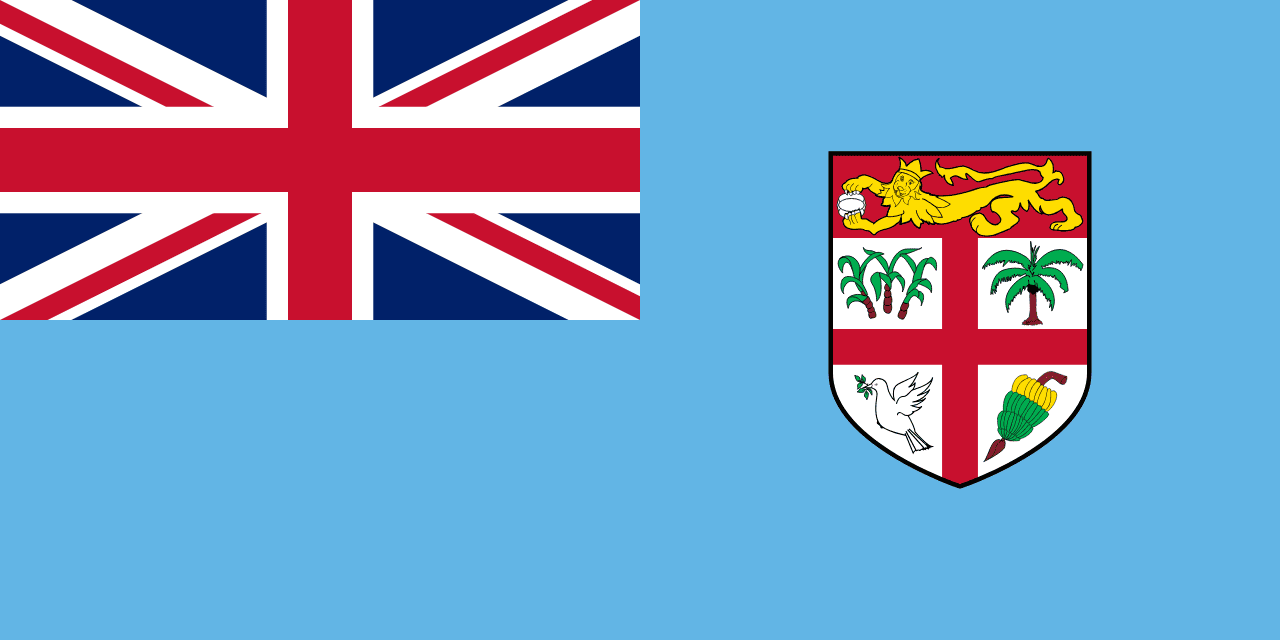
This makes Fiji a natural marketing draw as a place to "see tomorrow first," and it adds a quirky bit of trivia to the country's identity. Combined with its central location among Pacific nations, this position has long made Fiji a crossroads of trade, travel, and communication in the region. You can spot its distinctive design in our piece on the Fijian flag.
Frequently Asked Questions
What is the capital of Fiji?
The capital of Fiji is Suva, located on the southeastern coast of the main island of Viti Levu. It is the largest urban center in the South Pacific outside Australia and New Zealand, and serves as the nation's political, commercial, and educational hub.
What is Fiji famous for?
Fiji is famous for its stunning tropical islands, white-sand beaches, and world-class coral reef diving, often called the "soft coral capital of the world." It is equally known for the warmth of its people, the ubiquitous "bula" greeting, the kava ceremony, and its champion rugby sevens team.
Why is Fiji one of the first countries to see the new day?
Fiji sits near the 180th meridian and just west of the International Date Line, placing it among the earliest spots on the planet to enter each new calendar day. This is why Fiji is sometimes promoted as the place "where you can see tomorrow first."
Conclusion
Fiji is far more than a postcard. It is a nation of hundreds of islands, two intertwined cultures, three languages, and a spirit of generosity captured in a single word: bula. From firewalkers and kava circles to Olympic rugby glory and reefs alive with color, Fiji rewards anyone willing to look beyond the beach. These ten facts are only the beginning of a country that has perfected the art of making visitors feel at home.