
Among the world's national flags, Fiji's stands out for a single, immediately recognizable quality: its color. While most countries reach for deep navy, fiery scarlet, or solemn green, Fiji chose a soft, sky-tinted light blue that seems to glow against the horizon. That hue is no accident of aesthetics. It is a deliberate portrait of the South Pacific itself, the warm ocean that surrounds the archipelago's hundreds of islands. Adopted in 1970 as the nation emerged from British rule, the flag tells a layered story of independence, agriculture, and a colonial past that Fiji chose to fold into its identity rather than erase.
A Flag the Color of the Pacific
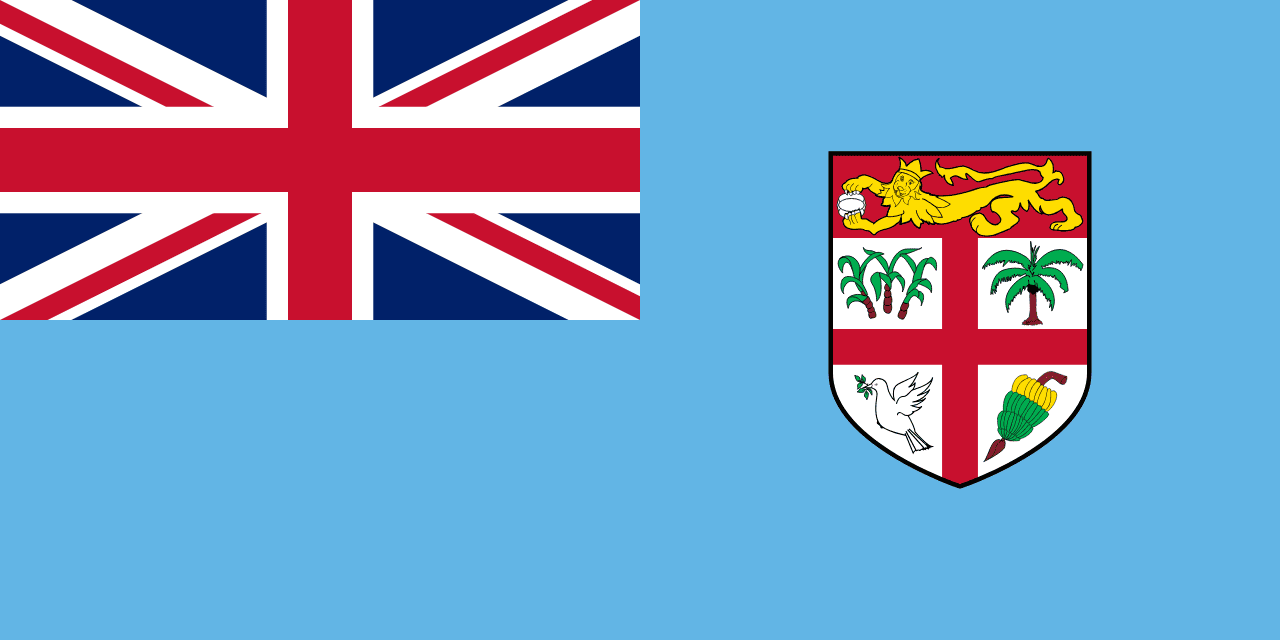
The first thing anyone notices about Fiji's flag is its pale, luminous blue field. This light blue is the design's emotional and visual anchor, chosen specifically to represent the Pacific Ocean that defines life in Fiji. As a maritime nation scattered across more than three hundred islands, Fiji's relationship with the sea is total: it shapes the climate, the economy, the diet, and the routes between communities. By selecting a lighter shade rather than the heavy royal blue common to many ensigns, Fijian designers gave the flag a tropical, sun-washed character that mirrors the shallow lagoons and clear coastal waters of the islands. It is one of the few national flags in the world whose blue is unmistakably bright rather than dark.
Reading the Colors and the Coat of Arms
Three colors carry the meaning of the flag: light blue, white, and red. The light blue field stands for the Pacific Ocean, while the white and red appear within the coat of arms placed toward the flag's right side. That shield is where Fiji packs the bulk of its symbolic content. It is divided by the red cross of Saint George on a white background, and its quarters display the agricultural backbone of the islands: sugar cane, coconut palms, and bananas, along with a peaceful dove. Crowning the shield is a British lion holding a cocoa pod, a reminder of the colonial relationship under which the modern Fijian state took shape.
This combination of local produce and imperial heraldry is the flag's defining tension and its honesty. The crops are unmistakably Fijian, the products of volcanic soil and tropical sun. The lion and the cross are unmistakably British. Together they record a moment in history when a young, self-governing nation drew a line under one era while acknowledging the institutions that had governed it.
Design and Layout
Structurally, Fiji's flag follows the British ensign tradition. The design is a light blue ensign with a canton in the upper hoist corner and an emblem placed in the fly. In the canton sits the Union Jack, the flag of the United Kingdom, signaling Fiji's continued membership in the Commonwealth and its monarchy-linked heritage. Toward the right half of the flag floats the Fijian shield, presented on its own rather than as part of the full coat of arms with supporters, which keeps the design clean and legible at a distance.
The ensign layout means the flag reads in two halves: the historical and constitutional story concentrated in the top-left canton, and the national, agricultural identity expressed in the floating shield. The generous expanse of light blue between and around these elements is not empty space but the ocean itself, the connective tissue that binds the whole composition together.
From Colony to Nation
Fiji's flag was adopted in 1970, the year the islands gained independence from Britain after nearly a century as a Crown colony. Like many former British territories in the Pacific, Fiji had flown colonial ensigns that placed the Union Jack against a darker field. When independence arrived, the country faced the familiar question of how much of the imperial past to carry forward. Rather than discarding British symbolism entirely, Fiji modified and softened it: the lighter blue field replaced the older darker tone, and the national shield took its place in the fly.
The result was a flag that felt continuous rather than revolutionary, reflecting a peaceful, negotiated transition to self-rule. Over the following decades, Fiji's political life saw considerable turbulence, including changes in government and constitutional structure, yet the flag itself proved remarkably durable. Periodic public debates have raised the idea of removing the Union Jack to create a more distinctly Pacific emblem, but the 1970 design has so far endured as the recognized national flag. For a fuller picture of the country's geography and history, the fiji country guide offers helpful context.
How It Compares to Similar Flags
Fiji belongs to a small but distinctive family of light blue ensigns, and comparing it to its relatives reveals what makes it special. Tuvalu, another Pacific nation, also flies a light blue ensign with a Union Jack canton, but it fills its fly with nine yellow stars representing its islands rather than a heraldic shield. The contrast is instructive: Tuvalu emphasizes geography through stars, while Fiji emphasizes economy and heritage through its coat of arms.
Against the broader world of national flags, Fiji's light blue is its clearest distinguishing feature. Many countries use the British ensign template, including Australia and New Zealand, but those nations chose dark navy fields. Fiji's pale shade sets it apart instantly. And while the Union Jack canton links it visually to a whole network of Commonwealth flags, the specific shield, with its cane, coconuts, bananas, and dove, ensures no other flag could be mistaken for it.
National Identity and Modern Life
For Fijians, the flag is woven into the public rhythm of the nation. It flies over government buildings, schools, and ceremonies, and it appears most proudly during national celebrations such as Fiji Day, which marks the anniversary of independence. The light blue and white turn up in the jerseys and supporters' gear that surround Fijian sport, especially rugby, a national passion in which Fiji competes far above the weight its population might suggest. When Fijian teams take the field internationally, the flag becomes a portable symbol of island pride carried by fans around the world.
The flag's imagery also reinforces a national self-image rooted in the land and sea. The crops on the shield are not abstract decorations; sugar cane and coconuts have long been central to Fiji's livelihood, and seeing them enshrined on the national emblem connects ordinary work to collective identity. The ocean blue, meanwhile, speaks to every Fijian's daily reality of living among the waves.
Interesting Facts About Fiji's Flag
- The light blue field was chosen specifically to symbolize the Pacific Ocean surrounding Fiji's islands.
- The shield on the flag displays sugar cane, coconuts, and bananas, three crops central to the Fijian economy.
- The flag was adopted in 1970, the year Fiji became independent from Britain.
- A British lion holding a cocoa pod crowns the coat of arms, a nod to the colonial era.
- The red cross of Saint George divides the shield on a white background.
- Fiji's light blue ensign closely resembles Tuvalu's, another Pacific nation, though Tuvalu uses stars instead of a shield.
- The Union Jack in the canton reflects Fiji's ongoing ties to the Commonwealth.
Frequently Asked Questions
When was the flag of Fiji adopted?
Fiji's national flag was adopted in 1970, the same year the country gained independence from Britain. The design has remained the recognized national flag ever since, despite occasional public discussion about modernizing it.
What do the colors of the Fiji flag mean?
The light blue field represents the Pacific Ocean that surrounds Fiji's islands. White and red appear within the coat of arms, where the red cross of Saint George sits on a white background, and the shield's quarters depict local crops alongside heraldic symbols.
What continent is Fiji on?
Fiji is located in Oceania, in the South Pacific Ocean. It is an archipelago of more than three hundred islands, which is exactly why the ocean is given such prominence in the flag's light blue background.
How is Fiji's flag different from similar flags?
Fiji's flag shares the British ensign layout with countries like Tuvalu, Australia, and New Zealand, all of which feature a Union Jack canton. What distinguishes Fiji is its bright light blue field and its unique shield showing sugar cane, coconuts, bananas, and a dove, imagery found on no other national flag.