
Scattered like a constellation across more than a million square miles of the western Pacific, the Federated States of Micronesia is a country that exists mostly as ocean. Its land is tiny, but the stories packed into its volcanic peaks, sunken cities, and coral atolls are anything but small. Here are ten genuinely fascinating facts about one of the planet's most remote and remarkable island nations.
1. It Is Four Countries Wearing One Flag
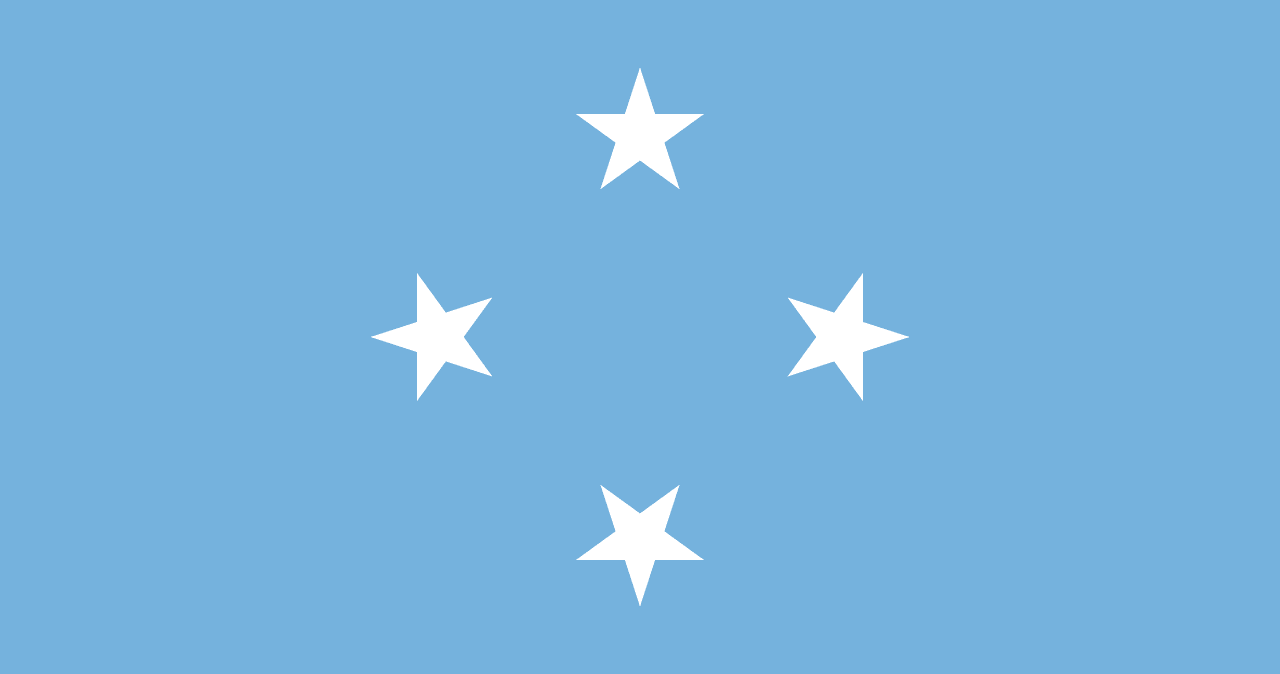
The Federated States of Micronesia is not a single homogenous place but a federation of four wildly different island states: Yap, Chuuk, Pohnpei, and Kosrae. Each state has its own language, culture, governor, and fierce local identity, strung out across roughly 607 islands. Chuuk holds about half the nation's people, while Kosrae is a single compact volcanic island. The distances are staggering, more than 1,700 miles separate the westernmost and easternmost points, meaning a flight across your own country can feel like crossing an ocean. This federal patchwork is reflected in the four white stars on the national flag, one for each state floating on a field of Pacific blue.
2. Palikir Is One of the World's Quietest Capitals
The capital, Palikir, sits in the jungle interior of Pohnpei Island and is so low-key that the country's largest and busiest town, Kolonia, lies just a few miles away and frequently gets mistaken for the capital. Palikir was purpose-built as an administrative center, becoming the seat of government in 1989. Surrounded by dense tropical greenery and dramatic ridgelines, it houses the national congress and government ministries but has none of the bustle of a typical capital city. With the entire country home to only around 100,000 to 114,000 people, Palikir feels less like a power center and more like a peaceful village that happens to run a nation.
3. Nan Madol Is the "Venice of the Pacific"
Off the coast of Pohnpei lies one of the most astonishing archaeological sites on Earth: Nan Madol, a sprawling city of about 100 artificial islets built atop a coral reef and laced with canals. Constructed largely between the 12th and 13th centuries from enormous basalt logs, some weighing many tons, it served as the ceremonial and political seat of the Saudeleur dynasty. How ancient builders moved and stacked these colossal stones without modern machinery remains a genuine mystery. A UNESCO World Heritage Site since 2016, Nan Madol is the only ancient city ever built atop a coral reef, and locals still regard parts of it as sacred and spiritually charged.
4. On Yap, Money Can Weigh More Than a Car
The island of Yap is famous for one of the strangest currencies in human history: rai stones. These are giant carved limestone discs with a hole in the center, some standing over 12 feet tall and weighing several tons. The limestone was quarried hundreds of miles away in Palau and ferried back on rafts and outrigger canoes, an extraordinarily dangerous journey that gave each stone its value. Because the largest stones are impossible to move, ownership simply transfers through community agreement while the stone stays put. Economists love rai stones as an early example of an abstract ledger of value, and they are still used ceremonially on Yap today.
5. Chuuk Lagoon Is the World's Greatest Wreck Diving Site
Beneath the calm surface of Chuuk Lagoon lies a sunken fleet. During Operation Hailstone in February 1944, an American air assault sank dozens of Japanese ships and aircraft that had used the lagoon as a major naval base. Today the seabed is a vast underwater museum, with around 60 wrecks blanketed in coral and teeming with fish. Divers swim past intact cargo holds still holding trucks, tanks, aircraft, and personal artifacts. It is considered by many the finest wreck diving destination on the planet, a haunting and beautiful collision of wartime history and thriving marine life that draws enthusiasts from around the world.
6. The Ocean Is Bigger Than the Land by a Mile
The total land area of Micronesia is only around 270 square miles, smaller than many cities. Yet its Exclusive Economic Zone stretches across roughly 1.1 to 2.6 million square miles of ocean, making the country one of the largest in the world by sea territory. This immense maritime domain is the nation's true wealth. Tuna swim through these waters in vast numbers, and licensing fees paid by foreign fishing fleets form a crucial pillar of the economy. For Micronesians, the line between "land" and "country" has always been generous, the sea is home, highway, larder, and heritage all at once.
7. A Language for Almost Every Island
For a nation of barely 100,000 people, Micronesia is astonishingly multilingual. English serves as the official language and lingua franca, but it shares the islands with a rich array of indigenous tongues, including Chuukese, Pohnpeian, Kosraean, Yapese, and several others, many of them mutually unintelligible. Some smaller islands speak languages and dialects all their own, such as Ulithian and Woleaian. This linguistic diversity reflects centuries of separate island development across enormous oceanic distances. The result is a country where crossing a stretch of water can mean entering an entirely different linguistic and cultural world, all under one federal roof.
8. Master Navigators Who Read the Stars and Waves
Long before GPS, Micronesian seafarers crossed thousands of miles of open ocean using only the stars, swell patterns, bird behavior, and the feel of the waves against the hull. This sophisticated wayfinding tradition, especially strong in the outer islands of Yap, has been passed down orally for generations and is among the most advanced non-instrument navigation systems ever developed. Navigators memorized star compasses and could sense islands beyond the horizon by reading how ocean swells bent around them. This living knowledge connects modern Micronesians directly to the ancestors who first settled these scattered specks of land thousands of years ago.
9. Sakau, the Ceremonial Drink of Pohnpei
On Pohnpei, social and ceremonial life often centers on sakau, a mildly sedative drink made from the pounded roots of the kava plant mixed with water and strained through hibiscus bark. Prepared in a slow, rhythmic ritual on a flat basalt stone, sakau produces a relaxing, numbing effect and is shared at gatherings, reconciliations, and important community events. The pounding itself is almost musical, and offering sakau to a chief or guest is a deep gesture of respect. Alongside sakau, Micronesian cuisine leans on reef fish, breadfruit, taro, yams, and coconut, frequently cooked in traditional earth ovens for feasts.
10. Independence Is Surprisingly Recent
The Federated States of Micronesia has been independent for only a few decades. After centuries of foreign control passing from Spain to Germany to Japan, the islands became part of the United Nations Trust Territory of the Pacific Islands administered by the United States after World War II. Micronesia adopted its constitution in 1979 and gained full sovereignty in 1986 under a Compact of Free Association with the United States. That compact still shapes the country profoundly, providing economic aid and allowing citizens to live and work freely in the US while America handles defense, a unique and pragmatic arrangement for a young Pacific nation.
Frequently Asked Questions
What is the capital of Micronesia?
The capital is Palikir, located in the interior of Pohnpei Island. It became the seat of government in 1989 and is a quiet, jungle-surrounded administrative center, while the nearby town of Kolonia remains the country's main commercial hub. You can learn more in our full country guide.
What is Micronesia famous for?
Micronesia is best known for the ancient stone city of Nan Madol on Pohnpei, the world-class World War II shipwrecks of Chuuk Lagoon, and the giant stone money discs of Yap. It is also celebrated for its pristine coral reefs and its tradition of master ocean navigation.
Do people in Micronesia really use giant stone money?
Yes. On the island of Yap, enormous carved limestone discs called rai stones have served as a form of currency for centuries. Some are too heavy to move, so ownership simply changes by community agreement while the stone stays in place, and they are still exchanged ceremonially today.
Conclusion
The Federated States of Micronesia proves that a country measured in tiny dots of land can hold oceans of history, ingenuity, and culture. From the mysterious basalt canals of Nan Madol to stone money fortunes and star-reading navigators, this Pacific federation rewards anyone willing to look closer. Its land may be small, but its story is vast, and there is always more to discover beneath those endless blue horizons.
