
Scattered across nearly 1,000 islands in the southwestern Pacific, the Solomon Islands is one of the least-visited yet most ecologically and culturally astonishing nations on Earth. It was the stage for some of World War II's bloodiest battles, it harbors people with naturally blond hair and dark skin, and its reefs sit inside the most biodiverse ocean on the planet. Here are ten genuinely surprising facts about this Melanesian archipelago.
1. Nearly a Thousand Islands, Six That Really Matter
The Solomon Islands comprises roughly 900 to 1,000 islands stretching across about 1,500 kilometres of ocean, yet the bulk of life is concentrated on six large volcanic islands: Guadalcanal, Malaita, Makira, Santa Isabel, Choiseul, and New Georgia. Guadalcanal is the largest and hosts the capital, while Malaita is the most populous. The land is rugged and densely forested, with mist-shrouded mountains rising sharply from the coast. Many of the smaller islands are coral atolls and raised limestone formations, some barely poking above the waves. This dispersed geography means that travel between islands still relies heavily on boats and small aircraft, and dozens of communities remain genuinely remote.
2. Honiara Was Born From a Battlefield
Honiara, the capital on Guadalcanal, only became the seat of government because of World War II. The original administrative centre was Tulagi, but it was devastated during the fighting, so the British relocated to the area where American forces had built infrastructure, including the airfield now known as Henderson International Airport. The city's name comes from a local phrase meaning roughly "facing the east wind." Today Honiara is a lively, somewhat chaotic port town of around 80,000 people, home to the bustling Central Market, the national museum, and a patchwork of communities from across the islands. You can read more in our country guide.
3. One of the Most Linguistically Diverse Places on Earth
For a nation of roughly 858,000 people, the Solomon Islands packs in an extraordinary amount of language. More than 70 distinct languages are spoken across the archipelago, the legacy of communities historically separated by mountains and sea. Because no single indigenous tongue could serve everyone, most Solomon Islanders communicate using Pijin, an English-based creole that grew out of plantation-era contact. English is the official language used in government and schools, but Pijin is the true national glue, spoken in markets, homes, and on the radio. Hearing Pijin is a delight for English speakers, who can often half-understand phrases that sound playfully familiar yet entirely their own.
4. Home to People With Naturally Blond Hair
One of the Solomon Islands' most striking traits is that a significant portion of its dark-skinned Melanesian population has naturally blond or golden hair, especially in childhood. For years outsiders assumed this came from European ancestry or sun exposure, but a 2012 genetic study found the trait arises from a local mutation in a gene called TYRP1, entirely independent of the genetics behind European blondness. The combination of deep brown skin and bright blond curls is uniquely Melanesian and remains one of the great curiosities of human biology in the Pacific.
5. The Cradle of the Guadalcanal Campaign
Few places shaped the outcome of WWII in the Pacific as decisively as Guadalcanal. From August 1942, American and Allied forces fought a brutal six-month land, sea, and air campaign against Japan here, marking the first major Allied offensive against Japanese expansion. The waters off the north coast saw so many warships sunk that they earned the grim nickname "Ironbottom Sound." Today those wrecks make the area a world-class destination for wreck divers, and rusting tanks, guns, and memorials across Guadalcanal draw history pilgrims from around the globe. The campaign turned the tide of the war in the Pacific.
6. Heart of the Coral Triangle
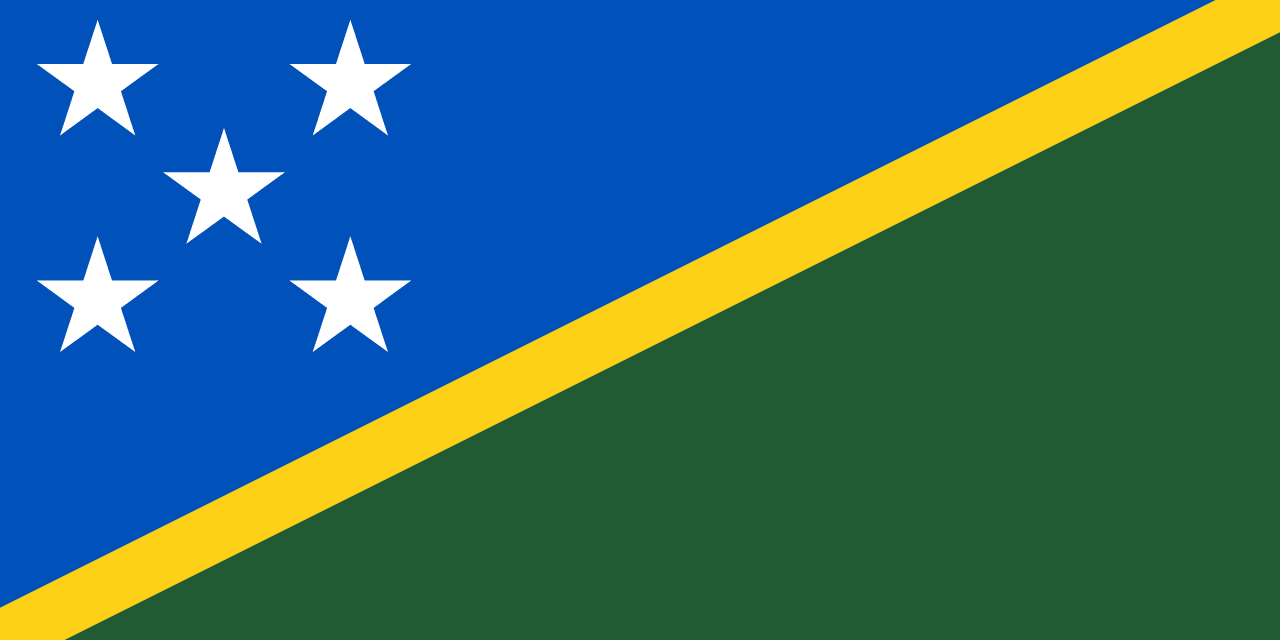
The Solomon Islands sits within the Coral Triangle, the most biodiverse marine region on the planet. Its reefs shelter hundreds of coral species and thousands of fish species, alongside dugongs, sea turtles, sharks, and dolphins. Marovo Lagoon in New Georgia is one of the largest saltwater lagoons in the world, a UNESCO-tentative-listed maze of islands and coral. The country's relative lack of mass tourism means many reefs remain pristine, and diving here is regarded as among the finest and least crowded anywhere. Learn more about national symbols in our piece on the flag of the Solomon Islands.
7. Saltwater Money and Shell Currency
Long before banknotes arrived, communities in the Solomon Islands used elaborate shell money, strings of carefully ground and polished shell discs, as currency and as a marker of wealth and obligation. On Malaita especially, shell money is still produced and remains culturally essential. It plays a central role in bride-price payments, compensation settlements, and ceremonies, sitting comfortably alongside the modern Solomon Islands dollar. The craft of drilling, shaping, and stringing thousands of tiny discs is painstaking, and a single long strand can represent enormous value, blending art, economy, and tradition.
8. The Earth Oven and a Sea-and-Garden Diet
Food in the Solomon Islands revolves around the garden and the reef. Staples include taro, yam, sweet potato (kumara), cassava, and the all-important coconut, paired with abundant fresh fish and seafood. A beloved cooking method is the motu, an earth oven where food is wrapped in leaves and slow-cooked over hot stones buried in the ground. A signature dish is poi, a paste made from pounded taro, while fish in coconut milk appears at countless meals. The cuisine is fresh, simple, and deeply tied to the seasons, with feasting central to weddings, funerals, and community celebrations.
9. Custom, Wantok, and a Living Tradition
Solomon Islanders place enormous value on kastom (custom) and the wantok system, a word from Pijin meaning "one talk," referring to networks of people who share a language and look after one another. This web of mutual obligation underpins social life, from sharing resources to resolving disputes. Traditional culture thrives through panpipe music, especially the famous bamboo panpipe ensembles of Malaita and Guadalcanal, intricate wood carvings inlaid with nautilus shell, and ceremonial dance. Land is overwhelmingly held under customary ownership rather than by the state, a fact that profoundly shapes the nation's economy and politics.
10. A Young Nation Where Most Live Off the Land
The Solomon Islands gained independence from Britain in 1978 and remains a constitutional monarchy within the Commonwealth. It is a strikingly rural country: the large majority of people live in villages and rely on subsistence farming and fishing rather than wage employment. The economy leans on timber, fisheries, palm oil, and increasingly gold mining, though logging has raised serious environmental concerns. With one of the youngest and fastest-growing populations in the Pacific, the country balances deep tradition with the pressures of development, climate change, and rising seas threatening its lowest-lying atolls.
Frequently Asked Questions
What is the capital of the Solomon Islands?
The capital is Honiara, located on the northern coast of Guadalcanal, the country's largest island. It is the nation's main port, commercial centre, and seat of government, with a population of roughly 80,000 people.
What are the Solomon Islands famous for?
The Solomon Islands is famous for its decisive WWII battles, especially the Guadalcanal Campaign and the wreck-filled "Ironbottom Sound," as well as its world-class coral reefs within the Coral Triangle, its enormous linguistic diversity, and traditional shell money.
Why do some Solomon Islanders have blond hair?
A notable share of the dark-skinned Melanesian population has naturally blond hair due to a local genetic mutation in the TYRP1 gene. Research has confirmed it evolved independently of the genes responsible for blond hair in Europeans.
Conclusion
The Solomon Islands defies easy summary: it is a place of a thousand islands and seventy languages, of sunken warships and untouched reefs, of shell money and earth ovens, and of people whose very hair color rewrote a chapter of genetics. For travellers and geography lovers alike, it offers some of the Pacific's most authentic and least crowded wonders, a reminder of just how much variety our world still holds.
