
Tunisia is the northernmost country in Africa, a slim wedge of Mediterranean coast, ancient ruins, and golden desert that has been fought over, settled, and celebrated for nearly three thousand years. It is a place where Roman amphitheatres sit beside whitewashed seaside towns, where the Sahara begins just a few hours from the beach, and where a single act of protest in 2010 changed the entire Arab world. Here are ten genuinely fascinating facts about this small but extraordinary nation.
1. It Is the Smallest Country in North Africa, Yet Packed With Variety
Covering roughly 163,000 square kilometres, Tunisia is the smallest of the Maghreb nations, dwarfed by neighbours Algeria and Libya. But what it lacks in size it makes up for in astonishing diversity. In the north you find fertile plains, cork-oak forests, and a rugged extension of the Atlas Mountains. The central belt rolls into semi-arid steppe and olive groves, while the south dissolves into the dunes and salt flats of the Sahara. You can stand on a Mediterranean beach in the morning and watch the sun set over desert sand the same evening. This compact range of landscapes makes Tunisia one of the most geographically varied countries of its size anywhere on Earth.
2. Carthage Once Rivalled Rome for Control of the Mediterranean
Just outside modern Tunis lie the ruins of Carthage, a city founded by Phoenician traders around 814 BC that grew into one of antiquity's great superpowers. Under the general Hannibal, Carthage famously marched war elephants across the Alps to threaten Rome itself during the Punic Wars. Rome eventually destroyed the city in 146 BC, then rebuilt it as a thriving Roman capital. Today the UNESCO-listed site is a layered archive of history, with Punic tombs, Roman baths, and Byzantine churches scattered across the hillside. Walking through Carthage is a reminder that this corner of Africa once shaped the destiny of the entire ancient world.
3. Tunis Blends an Ancient Medina With a Modern Capital
Tunis, the capital and largest city, is home to well over two million people in its greater metropolitan area. Its beating heart is the medina, a UNESCO World Heritage maze of covered souks, mosques, and merchant houses dating back to the 8th century. Just beyond it lies the Ville Nouvelle, a French colonial-era district with wide boulevards and café-lined avenues. The Bardo Museum in Tunis holds one of the world's finest collections of Roman mosaics. You can explore more about the country's regions and cities in our country guide.
4. The Star Wars Planet Tatooine Was Named After a Tunisian Town
One of cinema's most iconic settings is rooted in Tunisian soil. George Lucas filmed parts of the original Star Wars in southern Tunisia, and Luke Skywalker's desert homeworld, Tatooine, took its name from the real town of Tataouine. The distinctive dome-shaped dwelling where Luke grew up is actually the Hotel Sidi Driss in the village of Matmata, where locals have lived in underground "troglodyte" homes carved into the earth for centuries. Several original film sets still stand in the desert and have become pilgrimage destinations for fans, making Tunisia a galaxy far, far away that you can actually visit.
5. Around 12 Million People Share Arab and Berber Roots
Tunisia is home to roughly 12 million people, the overwhelming majority of whom live along the more temperate northern and coastal regions. The population is predominantly Arab-Berber, reflecting waves of Berber (Amazigh) inhabitants who were the land's original people, followed by Arab settlers who arrived from the 7th century onward. Tunisians are widely regarded as among the most cohesive and well-educated populations in the region. The country has long invested heavily in schooling, and its literacy and university enrolment rates are among the highest in North Africa, shaping a young, ambitious, and socially progressive society.
6. Arabic Is Official, But French Is the Language of Business
The official language is Arabic, and most Tunisians speak a distinctive local dialect known as Tunisian Arabic, or Derja, which mixes in Berber, French, and Italian words. French is widely spoken and remains essential in business, higher education, science, and the media, a lasting legacy of the French protectorate that lasted from 1881 to 1956. A growing number of young Tunisians also speak English. The Berber Tamazight language still survives in a handful of southern villages. This multilingual blend reflects Tunisia's role as a crossroads where Africa, Europe, and the Arab world have met and mingled for millennia.
7. The Arab Spring Began Here in 2010
In December 2010, a young street vendor named Mohamed Bouazizi set himself alight in the town of Sidi Bouzid after authorities confiscated his goods. His desperate act ignited mass protests that toppled Tunisia's long-ruling president within weeks and sparked a wave of uprisings across the Middle East and North Africa known as the Arab Spring. Tunisia is widely considered the only country where that revolution led to a relatively peaceful democratic transition. In 2015, the Tunisian National Dialogue Quartet, a coalition of civil-society groups, was awarded the Nobel Peace Prize for steering the nation through that fragile and historic transition.
8. Olives Are the Backbone of the Land and the Table
Tunisia is one of the world's largest producers and exporters of olive oil, frequently ranking among the top nations globally. Vast olive groves blanket the central plains, some planted on land first cultivated in Roman times. The crop is central to both the economy and the kitchen. Tunisian cuisine is famous for its fiery flavour, anchored by harissa, a fierce chilli-and-garlic paste that accompanies almost every meal. Other beloved dishes include brik (a crisp fried pastry wrapped around egg and tuna), couscous, and lablabi, a hearty chickpea soup eaten with day-old bread. Tourism and textiles also drive the economy alongside agriculture.
9. The Sahara, Salt Lakes, and Flamingos Define Its Wild Side
Southern Tunisia opens onto the Grand Erg Oriental, a sea of towering Saharan dunes that draws desert trekkers and camel caravans. Near the desert's edge lies Chott el Djerid, an immense salt lake that shimmers with surreal pink, white, and violet hues and is largely dry for much of the year. To the north, Ichkeul National Park is a vital wetland and UNESCO site where tens of thousands of migratory birds, including flamingos, geese, and storks, gather each winter. The country is also home to fennec foxes, Barbary sheep, and nesting sea turtles along its coasts, a surprising range of wildlife for such a small nation.
10. The Coliseum of El Djem Is One of the Largest in the World
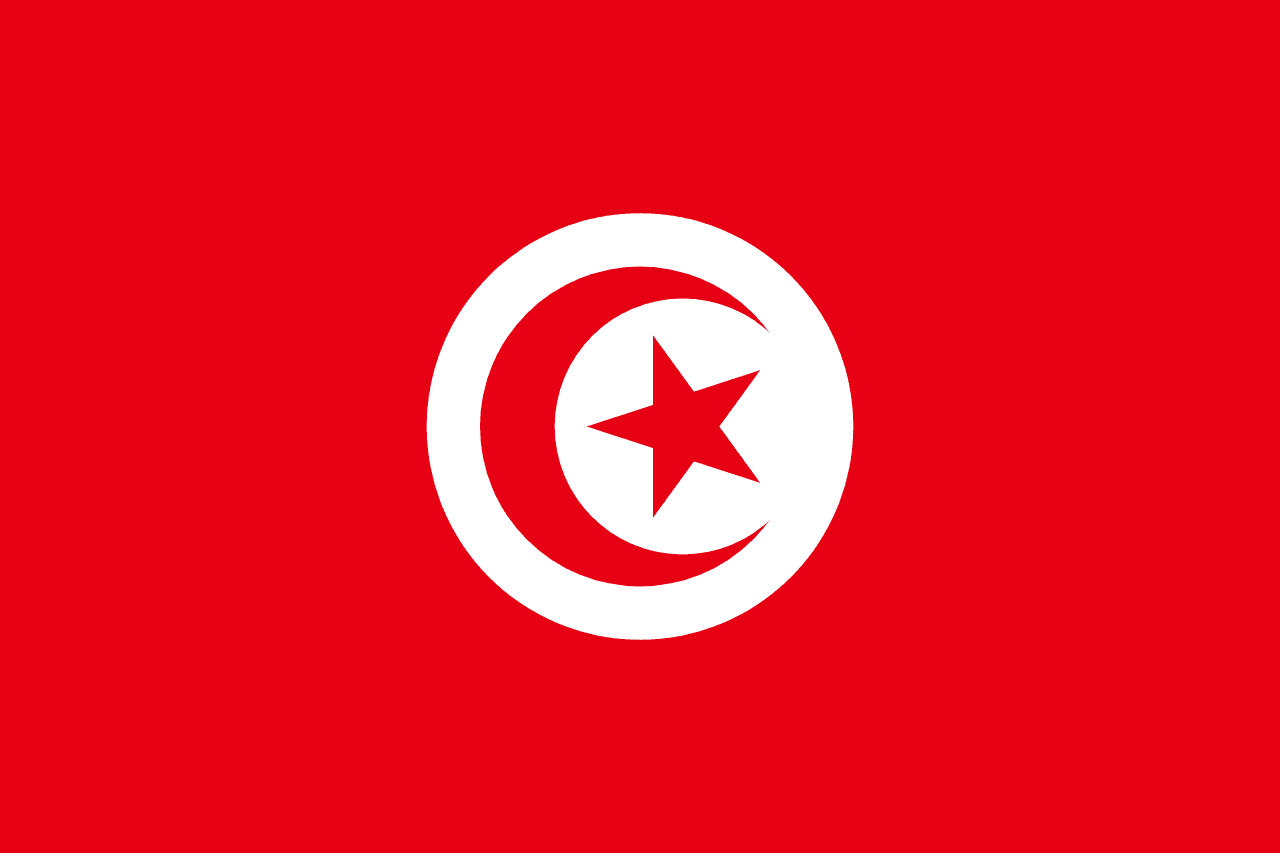
In the small inland town of El Djem stands a Roman amphitheatre so vast it could seat an estimated 35,000 spectators, making it one of the largest in the entire Roman Empire and rivalling the Colosseum in Rome. Built in the 3rd century AD from sandy-gold limestone, it remains remarkably well preserved, with much of its arched façade and underground passages still intact. Today it hosts a popular summer classical music festival and has appeared in films including Gladiator. The flag flying over such sites is itself a national emblem, and you can read about its origins in our piece on the Tunisian flag.
Frequently Asked Questions
What is the capital of Tunisia?
The capital of Tunisia is Tunis, located on the country's northern Mediterranean coast. It is the largest city and the political, cultural, and economic centre, famous for its ancient UNESCO-listed medina and its proximity to the ruins of ancient Carthage.
What is Tunisia most famous for?
Tunisia is best known for the ancient ruins of Carthage, its golden Mediterranean beaches, the Sahara Desert in the south, and for sparking the Arab Spring in 2010. It is also celebrated for its olive oil, the fiery harissa paste, and as a filming location for Star Wars.
Can you really visit the Star Wars sets in Tunisia?
Yes. Several original sets survive in the southern desert, including Luke Skywalker's home at the Hotel Sidi Driss in Matmata and the exterior of Mos Espa near Tozeur. They remain popular destinations for film fans and adventurous travellers exploring the Tunisian Sahara.
Conclusion
For such a compact country, Tunisia carries an outsized story, from Carthaginian war elephants and towering Roman ruins to desert film sets and a revolution that reshaped a region. Its mix of Mediterranean coast, Saharan dunes, layered history, and warm, welcoming culture makes it one of North Africa's most rewarding places to discover. These ten facts are only the beginning of what this remarkable nation has to offer.
