
Turkmenistan is one of the world's most secretive and surreal countries, a desert nation where a gleaming white-marble capital rises out of the sand and a fiery pit has been burning for over half a century. Tucked between the Caspian Sea and the steppes of Central Asia, it guards vast riches beneath its dunes while preserving traditions older than the Silk Road itself. Here are ten genuinely fascinating facts that reveal why this enigmatic country deserves your attention.
1. Roughly 80 Percent of the Country Is Desert
The Karakum Desert, whose name means "Black Sand," sprawls across about four-fifths of Turkmenistan, making it one of the most arid nations on Earth. This sea of shifting dunes and dry plains dominates the interior, leaving most of the population clustered along the fertile fringes near rivers and oases. To bring water to this parched land, the Soviets built the Karakum Canal, one of the longest irrigation canals in the world, channeling water from the Amu Darya river across hundreds of miles of desert to nourish cotton fields. The desert's harsh beauty has shaped Turkmen life for millennia, from nomadic herders to the camel caravans that once crossed it. You can learn more in our country guide.
2. The "Door to Hell" Has Burned for Over 50 Years
Deep in the Karakum Desert lies the Darvaza gas crater, a fiery pit nicknamed the "Door to Hell" or "Gates of Hell." The story goes that in 1971 a Soviet drilling rig collapsed into a natural gas cavern, and engineers set the escaping gas alight expecting it to burn out within days. Instead, it has blazed continuously ever since, a roaring 230-foot-wide crater of orange flames glowing fiercely against the night sky. It has become Turkmenistan's most iconic and otherworldly attraction, drawing intrepid travelers who camp at its rim. In recent years, the government has floated plans to extinguish it, both to curb wasted gas and methane emissions.
3. Ashgabat Holds a World Record for White Marble
The capital, Ashgabat, is unlike any other city on the planet. Rebuilt and lavishly expanded since independence, it holds the Guinness World Record for the highest concentration of white-marble-clad buildings in the world. Gleaming government palaces, fountains, and gold-domed monuments line broad, almost empty boulevards, giving the city a futuristic, dreamlike quality. Ashgabat was largely flattened by a devastating earthquake in 1948 that killed tens of thousands, and the modern city represents a deliberate reinvention. Quirky records abound here too, including some of the world's largest indoor Ferris wheels and architectural oddities shaped like everything from a giant book to a flame.
4. The Akhal-Teke Horse Is a National Treasure
Turkmenistan is the homeland of the Akhal-Teke, one of the oldest and most striking horse breeds in existence. Famous for a coat that shimmers with an almost metallic, golden sheen, these elegant "golden horses" have been bred for around 3,000 years and were prized for their speed and endurance across desert distances. The Akhal-Teke appears on the national emblem and is celebrated each spring with a dedicated public holiday. Turkmen culture reveres these animals so deeply that prized horses are treated as members of the family and sometimes given as state gifts to visiting dignitaries, a tradition that echoes the legendary "heavenly horses" of ancient China.
5. It Sits on the World's Fourth-Largest Gas Reserves
Beneath those endless dunes lies extraordinary wealth. Turkmenistan holds some of the largest natural gas reserves on the planet, ranking among the top four nations globally. The colossal Galkynysh field is among the biggest gas fields ever discovered. This energy wealth funds the country's marble monuments and exports flow primarily eastward to China through major pipelines. Alongside gas, cotton, or "white gold," remains a vital crop sustained by desert irrigation. Despite this resource bounty, the economy remains tightly state-controlled and relatively closed to the outside world.
6. One of the World's Most Isolated Nations
Turkmenistan is frequently described as one of the most closed and tightly controlled countries on Earth, sometimes compared to North Korea in its isolation. Tourism is heavily restricted, with most visitors required to travel on guided tours, and internet access is among the most limited and censored anywhere. For years the country was governed by a famous personality cult: the first president, Saparmurat Niyazov, styled himself "Turkmenbashi" (Leader of the Turkmen), renamed the months of the year after himself and his mother, and authored a spiritual guidebook called the Ruhnama that was once mandatory reading in schools and even for driving tests.
7. Turkmen Is a Turkic Language Tied to a Nomadic Past
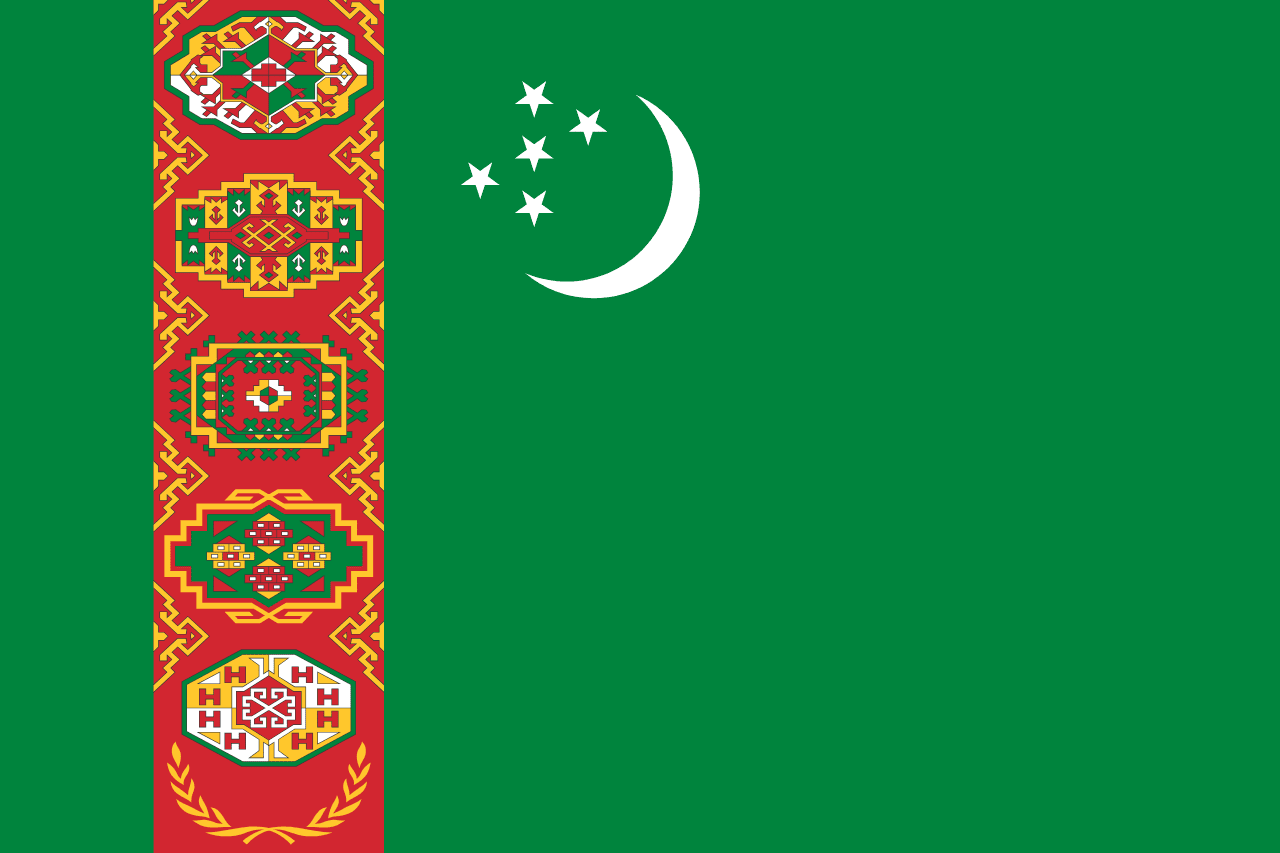
The official language, Turkmen, belongs to the Turkic family and is closely related to Turkish and Azerbaijani, reflecting the country's deep roots among the Oghuz Turkic peoples. Russian remains widely understood as a legacy of the Soviet era, though its use has declined. Since independence, Turkmen has been written in a Latin-based alphabet, replacing the Cyrillic script used under Soviet rule. The language carries a rich oral tradition of poetry and epic storytelling, much of it tied to the country's nomadic heritage. The national identity is built around tribal confederations whose symbols are even woven into the flag, which you can explore in our piece on the flag of Turkmenistan.
8. Carpets Are Woven Into the National Soul
The Turkmen carpet is far more than a floor covering; it is a symbol of national identity. Each major tribe traditionally has its own distinctive "gul" motif, a repeating geometric medallion, and these emblematic designs are so revered that five of them appear on the national flag, the only flag in the world to feature carpet patterns. Turkmenistan celebrates a national Carpet Day, maintains a dedicated carpet museum in Ashgabat displaying some of the largest hand-woven rugs ever made, and the art of Turkmen carpet weaving is recognized by UNESCO as intangible cultural heritage. For centuries these deep-red rugs were a nomad's most valuable portable possession.
9. Hospitality and Hearty Cuisine Bring People Together
Turkmen cuisine reflects a meat-and-bread culture shaped by nomadic life and Silk Road trade. The national dish is plov (also called palaw), a fragrant rice pilaf cooked with lamb, carrots, and onions, often prepared in enormous cauldrons for celebrations. Other staples include gutap, a fried flatbread stuffed with greens or meat, and dograma, a hearty stew of crumbled bread, boiled meat, and onions. Round flatbread known as chorek is treated with near-sacred respect and never wasted. Green tea is the drink of choice, served generously to guests, as hospitality is a cornerstone of Turkmen tradition where welcoming visitors warmly is considered a point of honor.
10. It Borders the Caspian, the World's Largest Inland Body of Water
Turkmenistan's western edge meets the Caspian Sea, the largest enclosed body of water on Earth, technically the world's biggest lake. Along this coast sits the resort zone of Awaza, an ambitious string of luxury hotels the government built to attract tourism. The Caspian region is also central to the country's energy ambitions and offshore reserves. Nearby, the dramatic Yangykala Canyon reveals layered cliffs of pink, white, and red rock, remnants of an ancient seabed, creating one of the most spectacular and underrated natural landscapes in Central Asia. Together with the Karakum, these features showcase Turkmenistan's surprising geographic variety.
Frequently Asked Questions
What is the capital of Turkmenistan?
The capital is Ashgabat, a city of around one million people in the south of the country near the Iranian border. It is renowned for its extravagant white-marble architecture, gold-domed buildings, and grand fountains, and holds a Guinness World Record for the highest density of white-marble buildings anywhere in the world.
What is Turkmenistan most famous for?
Turkmenistan is best known for the flaming Darvaza gas crater (the "Door to Hell"), its enormous natural gas reserves, the golden-coated Akhal-Teke horse, and intricate hand-woven Turkmen carpets. It is also famous for being one of the most isolated and tightly controlled countries in the world.
Can tourists actually visit Turkmenistan?
Yes, but it is not easy. Turkmenistan has some of the strictest tourism rules anywhere, with most independent travelers required to obtain visas and travel with a state-approved guide. Transit visas allow brief crossings, but the bureaucracy and limited internet access make it one of the least-visited nations on Earth.
Conclusion
From a desert crater that has burned for over half a century to a marble capital that looks like a film set, Turkmenistan defies easy description. It is a land of golden horses, ancient carpets, vast gas riches, and fiercely guarded traditions, all wrapped in an aura of mystery. These ten facts only hint at the depth of this remarkable Central Asian nation, and the more you explore, the more surprising it becomes.
