

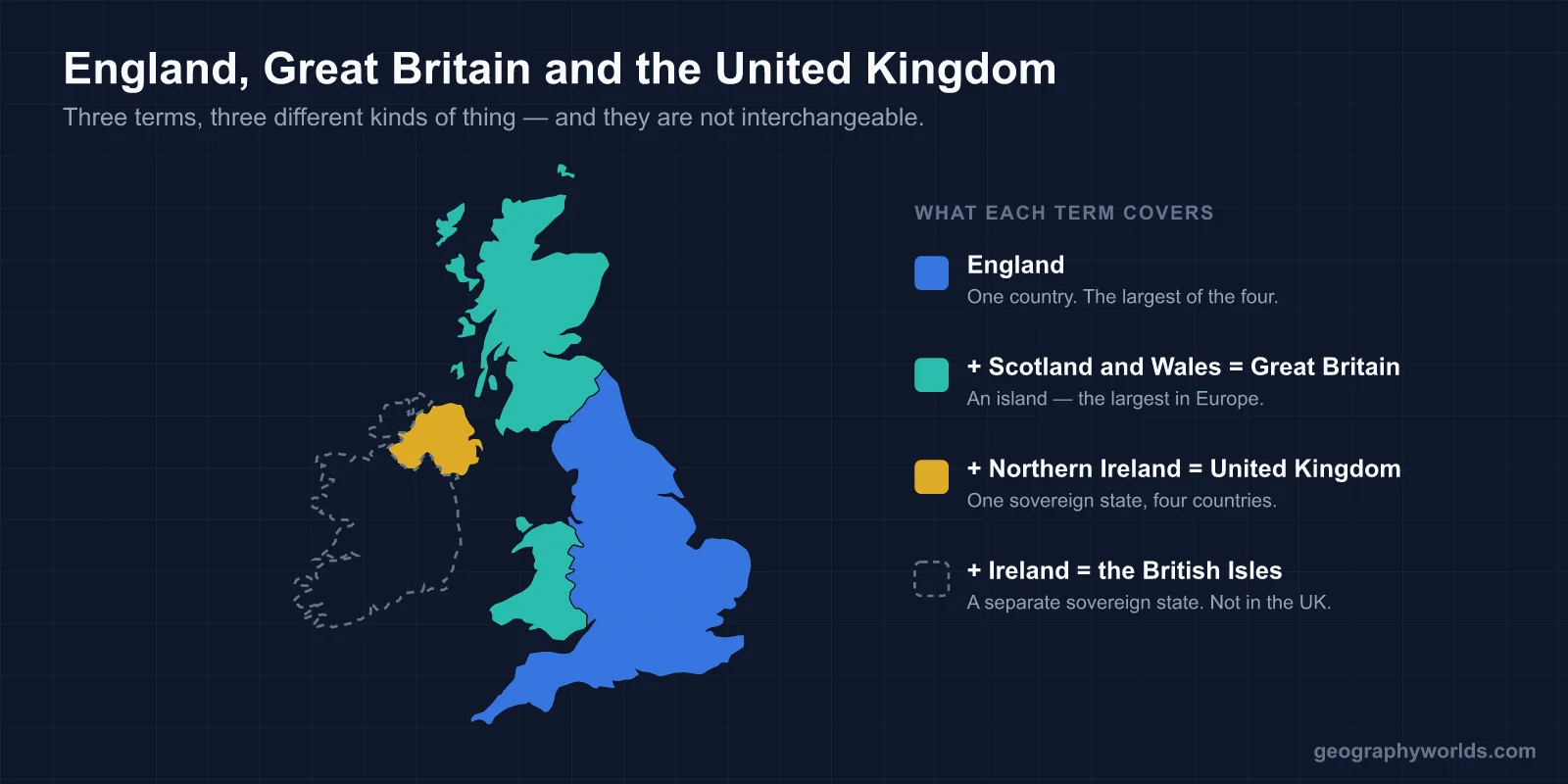
England is a country, Great Britain is an island, and the United Kingdom is a sovereign state. England is one of four countries inside the UK; Great Britain is the island that holds three of them (England, Scotland and Wales); and the UK is the political union of all four, adding Northern Ireland.
Few geography questions get answered wrongly as often as this one — including by people who live there. The confusion is understandable, because the three terms are not three names for the same place, and they are not even the same category of thing. One is a political country, one is a landmass, and one is an internationally recognised state. Once you see which category each word belongs to, the whole thing untangles in about a minute.
The Three Terms, Defined in One Line Each
Before the detail, here are the three definitions stripped to their essentials:
- England — a country. One of the four constituent countries of the United Kingdom, occupying the southern and central portion of the island of Great Britain.
- Great Britain — an island. The largest island in Europe and the ninth-largest in the world, containing England, Scotland and Wales.
- The United Kingdom — a sovereign state. Its full legal name is the United Kingdom of Great Britain and Northern Ireland, and it is the entity that holds a seat at the United Nations, issues passports and conducts foreign policy.
The key insight is that these terms are nested, but imperfectly. England sits inside Great Britain, which sits inside the United Kingdom — but the United Kingdom also reaches beyond the island of Great Britain to include Northern Ireland, which is on a different island entirely. That single fact is the source of most of the confusion.
Great Britain: An Island, Not a Country
Great Britain is a physical, geographic feature. You could point to it from space. It covers roughly 209,000 square kilometres, making it comfortably the largest island in Europe and, by most reckonings, the ninth-largest island on Earth. It stretches about 1,000 kilometres from the north coast of Scotland to the south coast of England.
Three countries share this island: England in the south and centre, Scotland in the north, and Wales on the western peninsula. There is no fourth country on Great Britain, and Northern Ireland is not on it.
Why "Great"?
The "Great" in Great Britain is not a boast about importance. It is a size distinction, used historically to separate the larger island of Britain from Brittany — the region of north-western France known in Latin as Britannia Minor, or "Lesser Britain". Great Britain was simply the bigger of the two Britains. The name has nothing to do with empire, power or prestige, even though it was often later read that way.
What Great Britain Does Not Include
Strictly speaking, "Great Britain" refers to the single main island. It does not include the thousands of smaller islands around the coast, though in everyday and even official usage the term often stretches to cover them. When the distinction matters, the phrase used is "Great Britain and its adjacent islands" — a mouthful that explains why most people just say "Britain".
The United Kingdom: One Sovereign State, Four Countries
The United Kingdom is the political unit. It is the state recognised in international law, and it is made up of four constituent countries:
- England — the largest by area and by far the largest by population
- Scotland — the second-largest by area, occupying the northern third of Great Britain
- Wales — the smallest of the three Great Britain countries
- Northern Ireland — the only part of the UK not on the island of Great Britain
Together these four cover roughly 243,000 square kilometres and hold a population in the high 60 millions. The UK is a unitary state with devolution rather than a federation: sovereignty rests with the UK Parliament at Westminster, which has devolved substantial powers to the Scottish Parliament, the Senedd in Wales, and the Northern Ireland Assembly.
The England Anomaly
There is a quirk worth noting: Scotland, Wales and Northern Ireland each have their own devolved legislature, but England does not. English matters are legislated directly by the UK Parliament, in which MPs from all four countries sit. This is one reason England and the UK get conflated so easily — institutionally, they overlap more than the other three do.
England: The Largest of the Four
England accounts for a little over half the land area of the UK — about 130,000 square kilometres — but roughly 84% of its population, somewhere near 57 million people. It is, in population terms, overwhelmingly the dominant partner in the union, which is precisely why "England" so often gets used loosely to mean the whole country.
Using "England" when you mean the UK is not merely imprecise; in Scotland, Wales and Northern Ireland it tends to land badly, because it erases three of the four countries. It is the mistake most worth avoiding.
England's capital, London, is also the capital of the United Kingdom as a whole — another overlap that blurs the line between the two. Scotland's capital is Edinburgh, Wales's is Cardiff, and Northern Ireland's is Belfast.
Where Ireland and the British Isles Fit In
Ireland is a second, separate island to the west of Great Britain, and it is politically divided in two:
- Northern Ireland — part of the United Kingdom, occupying the north-east of the island
- The Republic of Ireland — a fully independent sovereign state covering roughly five-sixths of the island. It is not part of the UK, and unlike the UK it remains a member of the European Union.
"The British Isles" is a purely geographic term for the whole archipelago — Great Britain, Ireland, the Isle of Man, the Hebrides, Orkney, Shetland and thousands of smaller islands. Because the label implies a Britishness that many in the Republic of Ireland reject, it is politically contested there, and alternatives such as "these islands" or "Britain and Ireland" are often preferred.
The Crown Dependencies
The Isle of Man, Jersey and Guernsey are Crown Dependencies. They are possessions of the Crown, defended by the UK and represented internationally by it, but they are not part of the United Kingdom. They have their own parliaments, their own tax systems and, in the Channel Islands' case, their own currency issues. If you are counting the parts of the UK, they do not go on the list.
UK vs Great Britain vs England: Side-by-Side Comparison
Laying the three next to each other makes the differences obvious:
- Type of entity — England: a constituent country. Great Britain: an island. UK: a sovereign state.
- Approximate area — England: about 130,000 km². Great Britain: about 209,000 km². UK: about 243,000 km².
- Approximate population — England: roughly 57 million. Great Britain: roughly 65–66 million. UK: roughly 68–69 million.
- Includes Scotland? — England: no. Great Britain: yes. UK: yes.
- Includes Northern Ireland? — England: no. Great Britain: no. UK: yes.
- Has a UN seat? — Only the UK.
- Issues the passport? — Only the UK. Its cover reads "United Kingdom of Great Britain and Northern Ireland".
A useful test: if the thing you are describing has an army, an embassy or a seat at an international summit, you mean the UK. If it has a coastline you could trace on a physical map, you mean Great Britain. If it has a national football team but no foreign ministry, you probably mean England.
The Sporting Exceptions
Sport cheerfully ignores all of this, which adds to the muddle. In football, England, Scotland, Wales and Northern Ireland each field separate national teams. At the Olympics, by contrast, athletes compete as a single team branded "Team GB" — even though the team includes competitors from Northern Ireland, which is not in Great Britain. In rugby union, Ireland fields one team drawn from both Northern Ireland and the Republic. None of these arrangements are geographic errors so much as historical accidents of how each sport's governing body was founded.
How the Union Was Assembled — and Why the Names Still Confuse
The three terms exist in their current form because the state was built up in stages over several centuries, and each stage left its name behind.
- 1535–1542 — the Laws in Wales Acts formally incorporated Wales into the Kingdom of England.
- 1707 — the Acts of Union merged the Kingdom of England (including Wales) and the Kingdom of Scotland into a single Kingdom of Great Britain. This is the moment "Great Britain" became a political name as well as a geographic one.
- 1801 — a further Act of Union added the Kingdom of Ireland, creating the United Kingdom of Great Britain and Ireland.
- 1922 — most of Ireland left to become the Irish Free State, later the Republic of Ireland. Six northern counties remained, and in 1927 the state was renamed the United Kingdom of Great Britain and Northern Ireland — the name it still carries.
So "Great Britain" is a leftover from the 1707–1801 state, and the awkward modern name is the 1922 settlement written into the title. The British Empire then exported all three terms worldwide, often interchangeably, which is why the confusion is global rather than local.
One last practical note on "Britain" and "British". "Britain" is widely used as shorthand for the United Kingdom, including by the UK government itself, even though it is technically the island. And "British" is the nationality adjective for citizens of the whole UK — including people in Northern Ireland, who are not from Great Britain. Language is not tidy here, but the underlying geography is: one island, four countries, one state.
If you want to test how well the distinction has stuck, try placing all four UK countries and their capitals on a map — or explore the wider picture in our guide to the countries of Europe and our simplified UK guide for younger readers.
Test Your Knowledge!
Can you place all four UK countries on the map? Try our geography games!
Play Geography Games →