
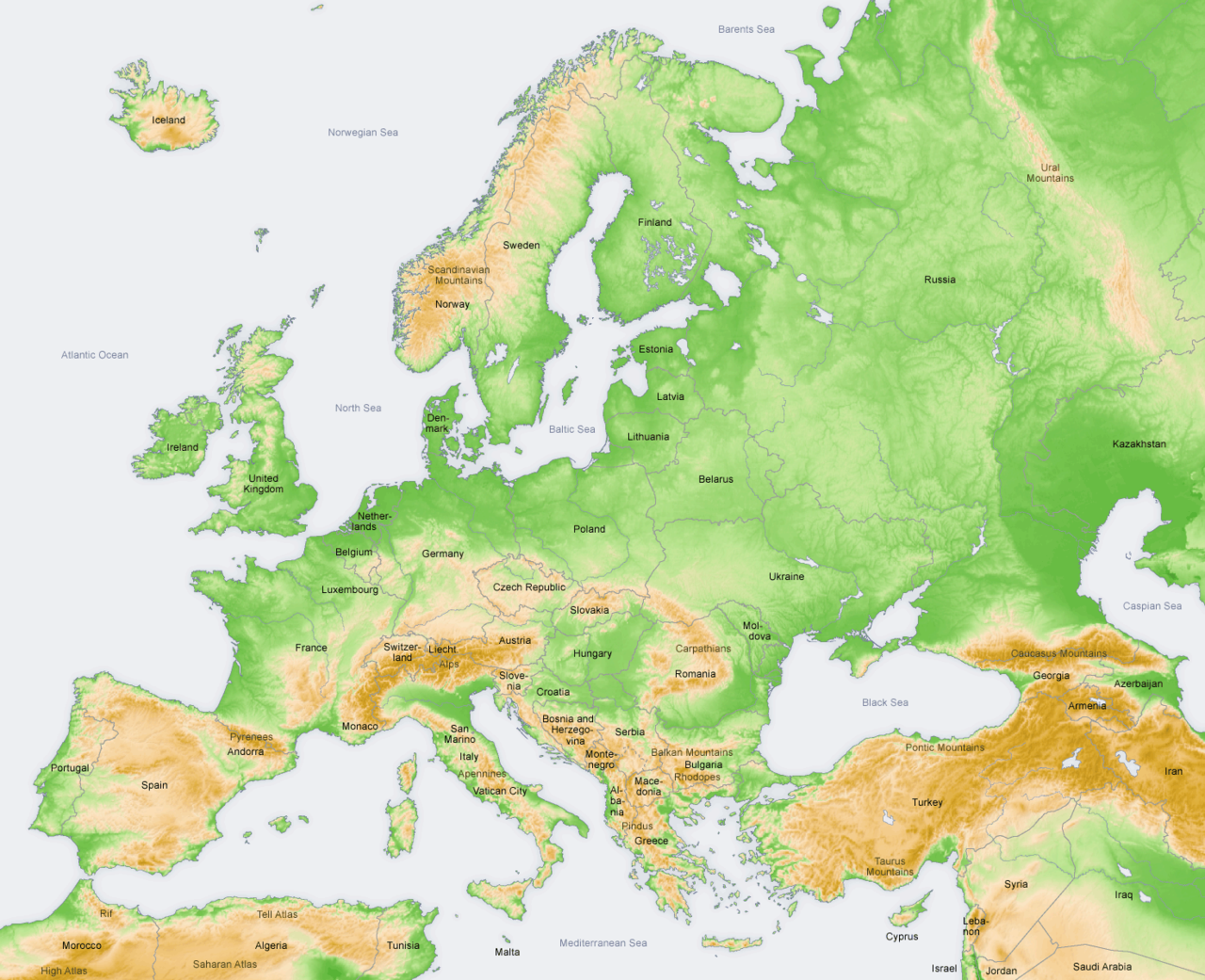
There are 44 internationally recognized countries in Europe, 27 of which are members of the European Union. Europe is the second-smallest continent by area yet the second-most politically divided after Africa, packing dozens of distinct nations, languages, and cultures into roughly 10.2 million square kilometres. Below you will find the complete, up-to-date list of all 44 European countries with their capitals, populations, and EU membership status, followed by regional breakdowns and the key facts students and travellers most often look for.

How Many Countries Are in Europe?
Europe has 44 internationally recognized countries. Of these, 27 belong to the European Union, 30 form part of the European Economic Area (EEA), and 26 sit inside the Schengen free-travel zone, where you can cross internal borders without passport checks. The figure of 44 is the most widely cited count, but the exact number depends on how Europe's eastern and southern boundaries are drawn.
Several countries complicate the tally. Russia and Turkey are transcontinental, holding territory in both Europe and Asia, though only the small European corner of Turkey (around Istanbul and Thrace) usually earns it a place on European lists. Kazakhstan is occasionally included because a sliver of its territory lies west of the Ural River. Cyprus is geographically in Asia but is politically and culturally European and is an EU member. Kosovo declared independence in 2008 and is recognized by over 100 UN members, but not by Russia, China, or Serbia, which is why some lists put the European total at 43 or 45 instead of 44.
Complete List of All 44 European Countries
The table below lists every European country alphabetically alongside its capital city, an approximate population, and its relationship to the European Union.
| Country | Capital | Population (est.) | EU Member |
|---|---|---|---|
| Albania | Tirana | 2.8 million | No (candidate) |
| Andorra | Andorra la Vella | 80,000 | No |
| Austria | Vienna | 9.1 million | Yes |
| Belarus | Minsk | 9.2 million | No |
| Belgium | Brussels | 11.7 million | Yes |
| Bosnia and Herzegovina | Sarajevo | 3.2 million | No (candidate) |
| Bulgaria | Sofia | 6.5 million | Yes |
| Croatia | Zagreb | 3.9 million | Yes |
| Czech Republic | Prague | 10.9 million | Yes |
| Denmark | Copenhagen | 5.9 million | Yes |
| Estonia | Tallinn | 1.3 million | Yes |
| Finland | Helsinki | 5.6 million | Yes |
| France | Paris | 68.2 million | Yes |
| Germany | Berlin | 84.5 million | Yes |
| Greece | Athens | 10.4 million | Yes |
| Hungary | Budapest | 9.6 million | Yes |
| Iceland | Reykjavik | 383,000 | No (EEA) |
| Ireland | Dublin | 5.1 million | Yes |
| Italy | Rome | 58.9 million | Yes |
| Kosovo | Pristina | 1.8 million | No |
| Latvia | Riga | 1.8 million | Yes |
| Liechtenstein | Vaduz | 39,000 | No (EEA) |
| Lithuania | Vilnius | 2.8 million | Yes |
| Luxembourg | Luxembourg City | 660,000 | Yes |
| Malta | Valletta | 535,000 | Yes |
| Moldova | Chisinau | 2.6 million | No (candidate) |
| Monaco | Monaco | 39,000 | No |
| Montenegro | Podgorica | 620,000 | No (candidate) |
| Netherlands | Amsterdam | 17.8 million | Yes |
| North Macedonia | Skopje | 1.8 million | No (candidate) |
| Norway | Oslo | 5.5 million | No (EEA) |
| Poland | Warsaw | 37.7 million | Yes |
| Portugal | Lisbon | 10.3 million | Yes |
| Romania | Bucharest | 19.0 million | Yes |
| Russia | Moscow | 144.2 million | No |
| San Marino | San Marino | 34,000 | No |
| Serbia | Belgrade | 6.6 million | No (candidate) |
| Slovakia | Bratislava | 5.4 million | Yes |
| Slovenia | Ljubljana | 2.1 million | Yes |
| Spain | Madrid | 48.0 million | Yes |
| Sweden | Stockholm | 10.5 million | Yes |
| Switzerland | Bern | 8.8 million | No (EFTA) |
| Ukraine | Kyiv | 37.0 million | No (candidate) |
| United Kingdom | London | 67.7 million | No (left 2020) |
| Vatican City | Vatican City | ~800 | No |
Note that this list of 44 does not separately count Cyprus, which is geographically Asian but politically European and an EU member; including it pushes some tallies to 45.
Europe by Region
Geographers usually divide Europe into five broad regions. The exact lines are debated, but the groupings below reflect the most common cultural and political divisions.
Western Europe: France, Germany, Netherlands, Belgium, Luxembourg, Switzerland, Austria, Liechtenstein, and Monaco. This is the economic engine of the continent, home to the EU's founding members and to major financial centres such as Frankfurt, Zurich, and Luxembourg City.
Northern Europe: United Kingdom, Ireland, Iceland, Norway, Sweden, Denmark, Finland, Estonia, Latvia, and Lithuania. The region is known for high living standards, Viking heritage, dramatic fjords, and the Nordic welfare model that consistently tops global happiness rankings.
Southern Europe: Spain, Portugal, Italy, Greece, Malta, Cyprus, Andorra, San Marino, and Vatican City. Mediterranean climates, the cradle of ancient Greek and Roman civilizations, and some of the world's most visited tourist destinations define this area.
Eastern Europe: Poland, Czech Republic, Slovakia, Hungary, Romania, Bulgaria, Moldova, Ukraine, Belarus, and Russia. This region has undergone rapid transformation since the fall of communism between 1989 and 1991, with many states joining the EU and NATO.
Southeastern Europe (the Balkans): Serbia, Croatia, Bosnia and Herzegovina, Montenegro, North Macedonia, Kosovo, Albania, and Slovenia. A mosaic of ethnicities and faiths with a complex 20th-century history, the Balkans are now the main frontier of EU enlargement.
The European Union and Other Alliances
The European Union is the most influential of Europe's many overlapping organisations. It began in 1957 as the European Economic Community among six founding members (France, West Germany, Italy, Belgium, the Netherlands, and Luxembourg) and has since grown to 27 member states. The euro is the official currency of 20 of those members, a group known as the eurozone.
Not every European country is in the EU, and not every EU member uses the euro. Norway, Iceland, and Liechtenstein participate in the single market through the European Economic Area, while Switzerland trades via bilateral agreements as part of EFTA. The United Kingdom left the EU in 2020 following the 2016 Brexit referendum. Several Balkan states plus Ukraine and Moldova hold official candidate status and are working toward accession.
Notable Records and Superlatives
Europe's nations span an enormous range of sizes and populations, from continental giants to tiny microstates you could cross on foot.
- Largest country: Russia, whose European portion alone covers about 3.97 million km². The largest entirely European country is Ukraine at 603,500 km².
- Smallest country: Vatican City, at just 0.44 km², the smallest sovereign state on Earth.
- Most populous: Russia, with 144 million people in total. Germany is the most populous entirely European country at 84.5 million.
- Least populous: Vatican City, with a resident population of roughly 800.
- Highest point: Mount Elbrus in Russia (5,642 m), or Mont Blanc (4,808 m) if the Caucasus is excluded.
- Longest river: The Volga (3,530 km), which flows entirely within Europe.
Key Facts
- Number of countries: 44, of which 27 are EU members.
- Most populous entirely European nation: Germany (84.5 million).
- Smallest country: Vatican City, also the smallest in the world.
- Schengen Area: 26 countries allow passport-free travel across internal borders.
- Total land area: about 10.2 million km², the second-smallest continent.
- Common currency: the euro, used by 20 EU member states.
- Most densely populated: Monaco, at roughly 26,000 people per km².
Fun Facts About Europe
- Europe is the only continent with no true desert, though parts of southeastern Spain are classified as semi-arid.
- Istanbul is the only major city in the world that physically spans two continents, straddling the Bosphorus between Europe and Asia.
- The longest official place name in Europe belongs to a Welsh village: Llanfairpwllgwyngyllgogerychwyrndrobwllllantysiliogogogoch.
- San Marino claims to be the world's oldest surviving republic, founded in the year 301.
For more on individual nations, explore our guides to the United Kingdom and its flag and the symbolism behind the flag of Bosnia and Herzegovina, or read about the tiny mountain capital of Andorra la Vella.
Frequently Asked Questions
How many countries are in Europe in total?
There are 44 internationally recognized countries in Europe. The exact figure can shift to 43 or 45 depending on whether you count disputed Kosovo or geographically Asian but politically European Cyprus.
How many of Europe's countries are in the European Union?
27 of Europe's 44 countries are EU member states. Of those, 20 use the euro as their currency, and 26 European countries (including some non-EU members) belong to the passport-free Schengen Area.
What is the smallest and largest country in Europe?
Vatican City is the smallest at just 0.44 km², while Russia is the largest, even counting only its European portion of about 3.97 million km². Among entirely European countries, Ukraine is the largest by area.
Is Russia considered a European country?
Russia is a transcontinental country with land in both Europe and Asia. About 25 percent of its territory and roughly 110 million of its people lie west of the Ural Mountains in European Russia, so it is usually included on lists of European countries.
Test Your Knowledge!
Think you know your geography? Try our interactive quizzes and games!
Play Geography Games →