
Introduction
Vietnam 🇻🇳 and the Philippines 🇵🇭 are both Southeast Asian heavyweights with populations above 100 million, but the way each country meets the map could hardly be more different. Vietnam is a long mainland country stitched to its neighbours by land borders; the Philippines is an archipelago scattered across thousands of islands with no land border at all. That single distinction ripples through almost everything else compared below.
Whether you are studying geography, planning a trip, or simply curious about how the two stack up, this side-by-side look at Vietnam and the Philippines gathers the key facts and figures in one place.
Size & Geography
| Feature | Vietnam 🇻🇳 | Philippines 🇵🇭 |
|---|---|---|
| Area | 331,212 km² | 300,000 km² |
| Continent | Asia | Asia |
| Region | Southeast Asia | Southeast Asia |
| Land Borders | China, Laos, Cambodia | None (island nation) |
| Landscape | low, flat delta in south and north; central highlands; hilly, mountainous in far north and northwest | 7,641 islands; mountainous with narrow coastal lowlands |
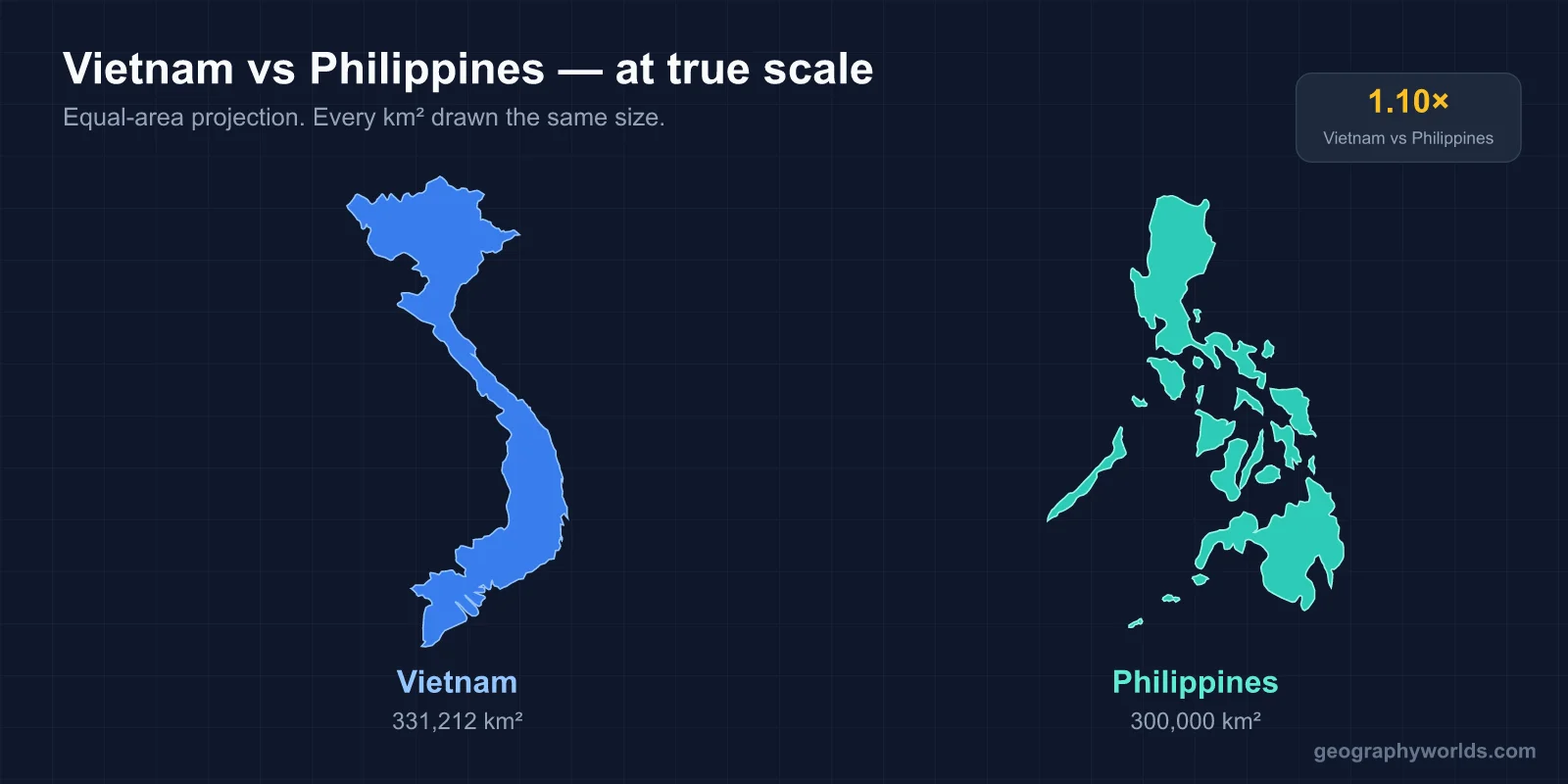
On paper the two are close in size: Vietnam covers 331,212 km² and the Philippines 300,000 km², making Vietnam only about 1.1 times larger. The likeness ends there. Vietnam is a single connected landmass, with low, flat deltas in the south and north, central highlands, and hilly to mountainous terrain in the far north and northwest, and it shares land frontiers with China, Laos, and Cambodia. The Philippines, by contrast, is broken into 7,641 islands, mountainous with only narrow coastal lowlands, and shares no land border with anyone, surrounded entirely by sea.
Population & Demographics
| Metric | Vietnam 🇻🇳 | Philippines 🇵🇭 |
|---|---|---|
| Population | 102.2 million | 117.7 million |
| Population Density | 308.5 per km² | 392.4 per km² |
Here the near-equal in area separate. The Philippines is home to 117.7 million people against Vietnam's 102.2 million, about 1.2 times as many, packed into slightly less land. The result is a real gap in density: the Philippines averages 392.4 people per km² while Vietnam sits at 308.5, a difference of roughly 83.9 people per km². Both are densely settled by world standards, but the island nation feels the squeeze more acutely, especially given how much of its terrain is mountainous and how little is flat coastal ground.
Capital Cities
Vietnam runs its affairs from Hanoi in the north, while the Philippines is governed from Manila. Both capitals fall within Southeast Asia. Each is a major hub for its country, and in keeping with the maritime character of the region, both sit close to water rather than deep in a landlocked interior.
Language, Currency & Culture
| Aspect | Vietnam 🇻🇳 | Philippines 🇵🇭 |
|---|---|---|
| Languages | Vietnamese (official) | Filipino (Tagalog) and English (both official) |
| Currency | Vietnamese Dong (VND) | Philippine Peso (PHP) |
Vietnam is linguistically unified around a single official language, Vietnamese, which is written in a Latin-based script. The Philippines is officially bilingual, recognising both Filipino, based on Tagalog, and English, a pairing that traces back to its long history of American influence and makes English widely useful across the islands. The currencies are distinct as well: Vietnam uses the Vietnamese Dong (VND), and the Philippines the Philippine Peso (PHP).
Climate & Natural Features
| Aspect | Vietnam 🇻🇳 | Philippines 🇵🇭 |
|---|---|---|
| Climate | tropical in south; monsoonal in north | tropical marine; monsoons |
| Key Features | Ha Long Bay, Mekong Delta, Central Highlands | Chocolate Hills, Mayon Volcano, Palawan, rice terraces |
| Economy | manufacturing, agriculture, technology, seafood | services (BPO), remittances, agriculture, electronics |
Vietnam's long north-south reach gives it a split climate, tropical in the south and more monsoonal in the north, so the weather you meet depends heavily on where you are. The Philippines has a tropical marine climate shaped by monsoons across its islands. Their famous sights reflect those settings: Vietnam offers the limestone seascape of Ha Long Bay, the sprawling Mekong Delta, and the Central Highlands, while the Philippines counts the Chocolate Hills, Mayon Volcano, the island of Palawan, and its terraced rice fields. The economies diverge too. Vietnam has built strength in manufacturing, agriculture, technology, and seafood, whereas the Philippines leans on services such as business process outsourcing, on remittances from workers abroad, and on agriculture and electronics.
What Makes Each Country Unique
Vietnam is celebrated for Ha Long Bay, its beloved pho noodle soup, an irrepressible motorbike culture, and a deep imperial heritage. It is also an agricultural powerhouse in one specific niche: Vietnam is the world's second-largest coffee exporter after Brazil, specialising in robusta beans.
The Philippines is famous for its dazzling island beaches, the Chocolate Hills of Bohol, the colourful jeepney, and a reputation for warm hospitality. It also lays claim to a festive record, hosting the longest Christmas season on Earth, with celebrations starting in September and running all the way to January.
Key Differences at a Glance
- Area: Vietnam (331,212 km²) vs Philippines (300,000 km²) — Vietnam is 1.1x larger
- Population: Vietnam (102.2 million) vs Philippines (117.7 million) — Philippines is 1.2x more populous
- Capitals: Hanoi vs Manila
- Currency: Vietnamese Dong (VND) vs Philippine Peso (PHP)
- Continents: Asia vs Asia
- Density: Philippines is more densely populated (difference of ~83.9 people per km²)
- Languages: Vietnamese (official) vs Filipino (Tagalog) and English (both official)
Verdict
Vietnam and the Philippines line up as Southeast Asian peers of almost matching size, yet the comparison keeps returning to one fact: Vietnam is mainland, the Philippines is islands. Vietnam edges ahead on area by about 1.1 times, but the Philippines carries the larger population, around 1.2 times bigger, and squeezes it into slightly less and far more fragmented land, which is why its density runs roughly 83.9 people per km² higher.
From there the personalities part ways. Vietnam stretches between a tropical south and a monsoonal north, its name tied to Ha Long Bay and a manufacturing-driven economy. The Philippines, scattered across 7,641 islands under a tropical marine climate, is known for places like the Chocolate Hills and leans on services, remittances, and electronics. One country is unified around a single language; the other is officially bilingual in Filipino and English.
Compared together, they show how two nations of similar dimensions can take entirely different shapes on the map. Whether you are planning a visit, studying the region, or just satisfying your curiosity, weighing Vietnam against the Philippines rounds out a clearer view of Southeast Asia.
Test Your Knowledge!
Think you know your countries? Try our interactive geography quiz!
Play Geography Games →