
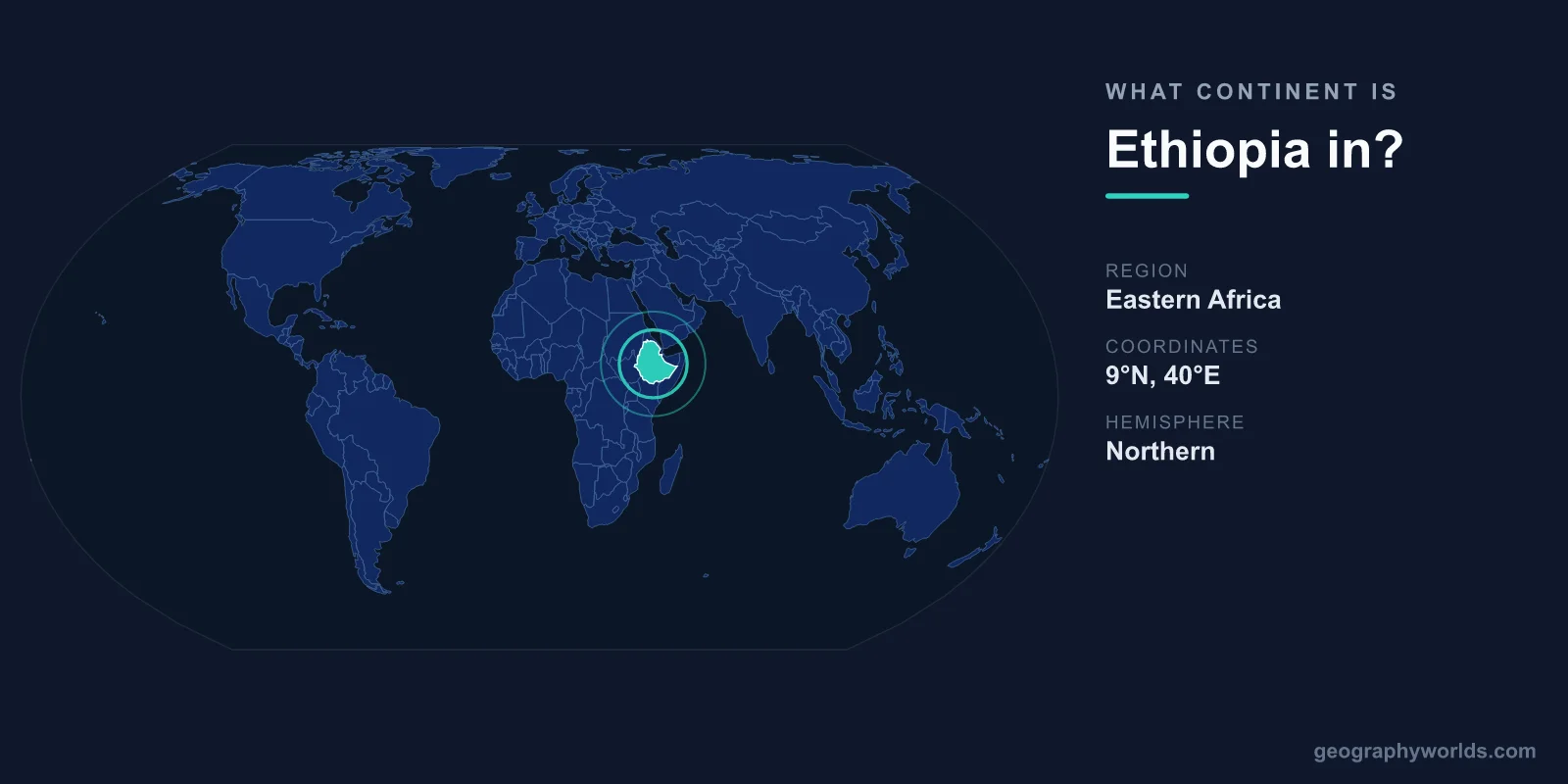
Ethiopia is in Africa, located in the Horn of Africa within the broader region of East Africa. It is the second-most populous country on the continent after Nigeria, the largest landlocked nation in Africa, and one of the oldest continuously independent states in the world. Sitting on a vast elevated plateau, Ethiopia is frequently called the "Roof of Africa," and its capital, Addis Ababa, is home to the headquarters of the African Union.
Where Exactly Is Ethiopia in Africa?
Ethiopia occupies a strategic position in the northeastern corner of the African continent, the region geographers call the Horn of Africa. It lies just north of the equator, roughly between 3 and 15 degrees north latitude, which gives it a tropical position softened dramatically by high altitude. The country covers approximately 1,104,300 square kilometers, making it one of the ten largest countries in Africa by land area and slightly larger than France and Spain combined.
Although Ethiopia is sometimes loosely grouped with the Middle East because of historic trade and cultural ties across the Red Sea, it is unambiguously part of the African continent. Its neighbors are all African nations, and it shares no border with Asia or any other continent. The confusion is understandable: ancient maritime routes linked the Ethiopian highlands to the Arabian Peninsula, southern Arabia, and the Indian Ocean world for thousands of years. Yet geographically, politically, and culturally, Ethiopia sits at the heart of Africa's story. You can explore its position and that of its neighbors in our geography games.
Neighboring Countries and Borders
Ethiopia is landlocked, sharing borders with six countries, all of them African:
- Eritrea to the north
- Djibouti to the northeast
- Somalia to the east and southeast
- Kenya to the south
- South Sudan to the west
- Sudan to the northwest
Because Ethiopia has no coastline of its own, it depends heavily on neighboring ports for international trade. The vast majority of its imports and exports pass through the small but strategically vital port of Djibouti, connected to Addis Ababa by a modern electrified railway that opened in 2018. This reliance on coastal neighbors is a defining feature of Ethiopia's regional relationships and economy, and it shapes diplomacy across the entire Horn. Ethiopia has periodically sought alternative outlets to the sea through ports in Somaliland and elsewhere, underscoring how central the question of coastal access remains to national strategy.
The Ethiopian Highlands and Physical Geography
What makes Ethiopia stand out within Africa is its dramatic elevation. The Ethiopian Highlands form a rugged plateau with an average elevation of around 2,500 meters, the largest continuous area of high ground on the entire continent. This is why the country earned the nickname the "Roof of Africa." The highest peak, Ras Dashen (Ras Dejen), rises to about 4,550 meters in the Simien Mountains, where rare wildlife such as the gelada baboon and the Ethiopian wolf survive in alpine grasslands found almost nowhere else on Earth.
The Great Rift Valley slices through Ethiopia from the northeast to the southwest, splitting the highlands and creating a chain of lakes, escarpments, and volcanic features. At the opposite extreme from the cool mountains lies the Danakil Depression in the northeast, one of the lowest, hottest, and most geologically active places on Earth, with parts lying more than 100 meters below sea level. Its bubbling sulfur springs, salt flats, and the permanent lava lake of Erta Ale draw scientists and adventurers alike. This contrast between snow-cool peaks and searing salt flats gives Ethiopia one of the most varied landscapes of any African country.
Ethiopia is also a crucial source of water for the region. The Blue Nile rises from Lake Tana in the northern highlands and contributes the majority of the Nile River's total flow during the rainy season, linking Ethiopia's geography directly to the lives of millions of people downstream in Sudan and Egypt. The Grand Ethiopian Renaissance Dam on the Blue Nile has made this hydrological dominance a major issue in continental politics.
A Unique Place in African History
Ethiopia holds a distinctive position in the history of the African continent. It is one of the very few African nations never to be formally colonized by a European power. Aside from a brief and bitterly resisted Italian occupation between 1936 and 1941, Ethiopia maintained its sovereignty throughout the colonial era. Its decisive victory over Italian forces at the Battle of Adwa in 1896 became a powerful symbol of African independence and resistance, inspiring anti-colonial movements far beyond its own borders.
This long independence helps explain why Addis Ababa was chosen as the seat of the African Union (and earlier the Organization of African Unity). Ethiopia's deep history, ancient Christian and Islamic heritage, its own Ge'ez-derived writing system, and a unique 13-month calendar all reinforce its central cultural role in Africa. The country is also widely regarded as one of the cradles of humankind: the famous 3.2-million-year-old hominin fossil "Lucy" was discovered in the Afar region. To learn more about the nation as a whole, see our ethiopia country guide.
Climate Across the Continent's Roof
Despite sitting in the tropics, Ethiopia's climate is shaped far more by altitude than by latitude. The highlands enjoy a temperate, spring-like climate year-round, with mild days and cool nights, while the lowland fringes and the Danakil region can be intensely hot. Ethiopians traditionally divide their land into climate zones based on elevation: the hot lowlands known as the kolla, the temperate middle elevations called woina dega, and the cool high country, or dega. This altitude-driven variety supports everything from highland barley and teff, the grain used to make injera, to the country's world-famous coffee, which originated in the forests of the southwestern highlands. The main rainy season, the kiremt, falls between June and September and is vital to both farming and the Nile downstream.
Key Facts
- Continent: Africa
- Region: East Africa / Horn of Africa
- Capital: Addis Ababa (seat of the African Union)
- Land area: About 1,104,300 square kilometers
- Coastline: None — landlocked, relying mainly on the port of Djibouti
- Highest point: Ras Dashen, about 4,550 meters
- Bordering countries: Eritrea, Djibouti, Somalia, Kenya, South Sudan, Sudan
Frequently Asked Questions
Is Ethiopia in Africa or the Middle East?
Ethiopia is firmly in Africa. It lies in the Horn of Africa in East Africa and borders only African countries. While it has historic trade and cultural connections across the Red Sea to the Arabian Peninsula, it is not part of the Middle East or Asia.
What region of Africa is Ethiopia in?
Ethiopia is in East Africa, specifically in the subregion known as the Horn of Africa, which also includes Eritrea, Djibouti, and Somalia. It is the largest and most populous country in the Horn.
Is Ethiopia landlocked?
Yes. Ethiopia is the most populous landlocked country in Africa. It lost its direct access to the Red Sea coast when Eritrea became independent in 1993, and it now relies mainly on the port of Djibouti for sea trade.
Why is Ethiopia called the "Roof of Africa"?
The nickname comes from the Ethiopian Highlands, a massive plateau averaging about 2,500 meters in elevation, the largest continuous highland area on the continent. Its towering mountains and high plains genuinely sit above most of the rest of Africa.