
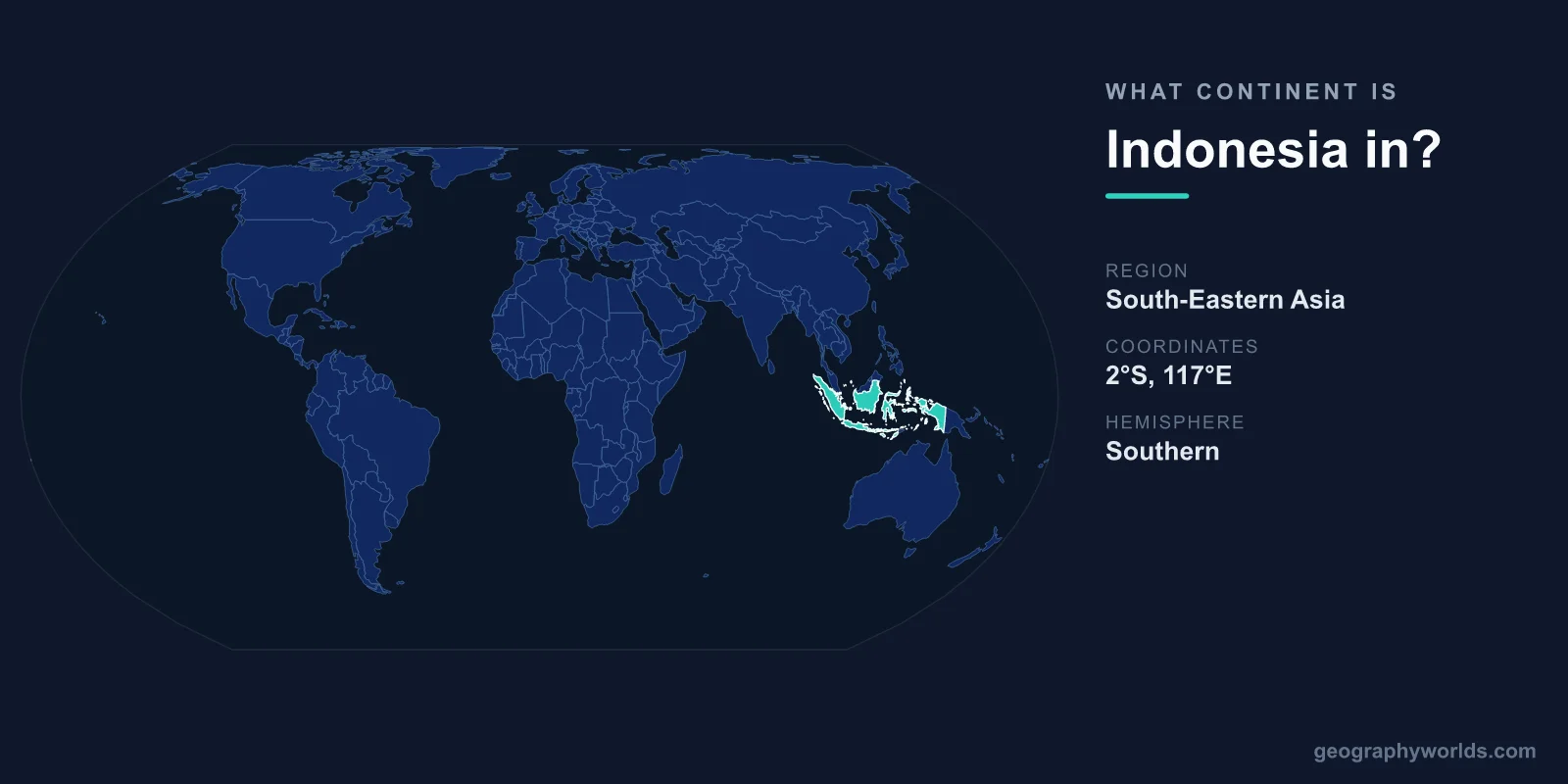
Indonesia is located in Asia, specifically in the region of Southeast Asia. It is the world's largest archipelagic nation, made up of more than 17,000 islands scattered across the equator between the Indian and Pacific Oceans. Despite a handful of its easternmost islands lying close to Oceania, Indonesia is firmly classified as an Asian country by the United Nations and in every standard continental model.
Why Indonesia Is an Asian Country
Continental classification is based partly on tectonics and geography and partly on political and cultural convention. By all of these measures, Indonesia belongs to Asia. The vast majority of its land area and population sit on islands that fall within the Southeast Asian region, alongside neighbors such as Malaysia, Singapore, Thailand, and the Philippines. Indonesia is a founding member of ASEAN (the Association of Southeast Asian Nations), reinforcing its political identity as a Southeast Asian state.
The country covers an area of roughly 1,904,569 km², making it the largest nation in Southeast Asia and the 14th largest in the world. Its capital is Jakarta, on the island of Java, though the government is gradually relocating the administrative capital to a new city called Nusantara on the island of Borneo. With more than 270 million people, Indonesia is also the fourth-most populous country on Earth, behind India, China, and the United States.
A Country That Spans Two Oceans
Indonesia stretches more than 5,000 km from west to east — roughly the same distance as London to Baghdad, or wider than the continental United States. This enormous east-to-west spread means the country is divided into three official time zones. The major islands include Sumatra, Java (the most populous island on the planet), Borneo (shared with Malaysia and Brunei), Sulawesi, and the western half of New Guinea.
Because the archipelago straddles the equator, Indonesia has territory in both the Northern and Southern Hemispheres. It is one of the few countries to occupy both hemispheres so substantially. The nation's coastline runs an astonishing 54,716 km — among the longest in the world — and the seas between its islands are some of the busiest and most strategically important shipping lanes on the globe.
Where Asia Meets Oceania
The reason people sometimes ask which continent Indonesia belongs to is that its territory brushes right up against Oceania. The province of Papua, on the western half of the island of New Guinea, shares that island with the independent country of Papua New Guinea, which is considered part of Oceania (Melanesia). Some geographers describe Indonesia as a "transcontinental" country for this reason.
This boundary is reflected in nature, too. The famous Wallace Line, identified by naturalist Alfred Russel Wallace, runs through the Indonesian archipelago and marks an abrupt divide between Asian and Australasian wildlife. West of the line you find Asian species such as orangutans, tigers, and elephants; east of it the fauna shifts toward marsupials and birds related to those of Australia. Even so, the country as a whole is universally counted as part of Asia.
Geography Shaped by the Ring of Fire
Indonesia sits squarely on the Pacific Ring of Fire, where several tectonic plates collide. This gives the country around 130 active volcanoes — more than any other nation on Earth. Mount Merapi on Java and Mount Bromo are among the most active, and the catastrophic 1883 eruption of Krakatoa was one of the deadliest volcanic events in recorded history. The same geology produces frequent earthquakes and, occasionally, devastating tsunamis.
- Continent: Asia (Southeast Asia)
- Capital: Jakarta (administrative capital moving to Nusantara)
- Area: approximately 1,904,569 km²
- Islands: over 17,000
- Highest point: Puncak Jaya, 4,884 m
- Climate: tropical
That volcanic activity also makes Indonesian soil extraordinarily fertile, supporting dense agriculture and one of the highest concentrations of biodiversity anywhere. The country is home to creatures found nowhere else, including the Komodo dragon — the world's largest living lizard. To explore more about the country's regions, cities, and culture, see our indonesia country guide.
Frequently Asked Questions
Is Indonesia in Asia or Oceania?
Indonesia is in Asia, within the Southeast Asia region. Although its easternmost province of Papua lies on the island of New Guinea and borders Oceania, the country as a whole is officially classified as Asian.
Is Indonesia part of Southeast Asia?
Yes. Indonesia is the largest country in Southeast Asia by both land area and population, and it is a founding member of ASEAN, the regional bloc of Southeast Asian nations.
Which countries border Indonesia?
Indonesia shares land borders with Malaysia (on Borneo), Papua New Guinea (on New Guinea), and Timor-Leste (on Timor). It also has maritime borders with Australia, the Philippines, Singapore, Vietnam, and several others.
Is Indonesia in the Northern or Southern Hemisphere?
Both. Indonesia straddles the equator, so its islands lie in both the Northern and Southern Hemispheres, giving the entire country a warm, tropical climate year-round.