
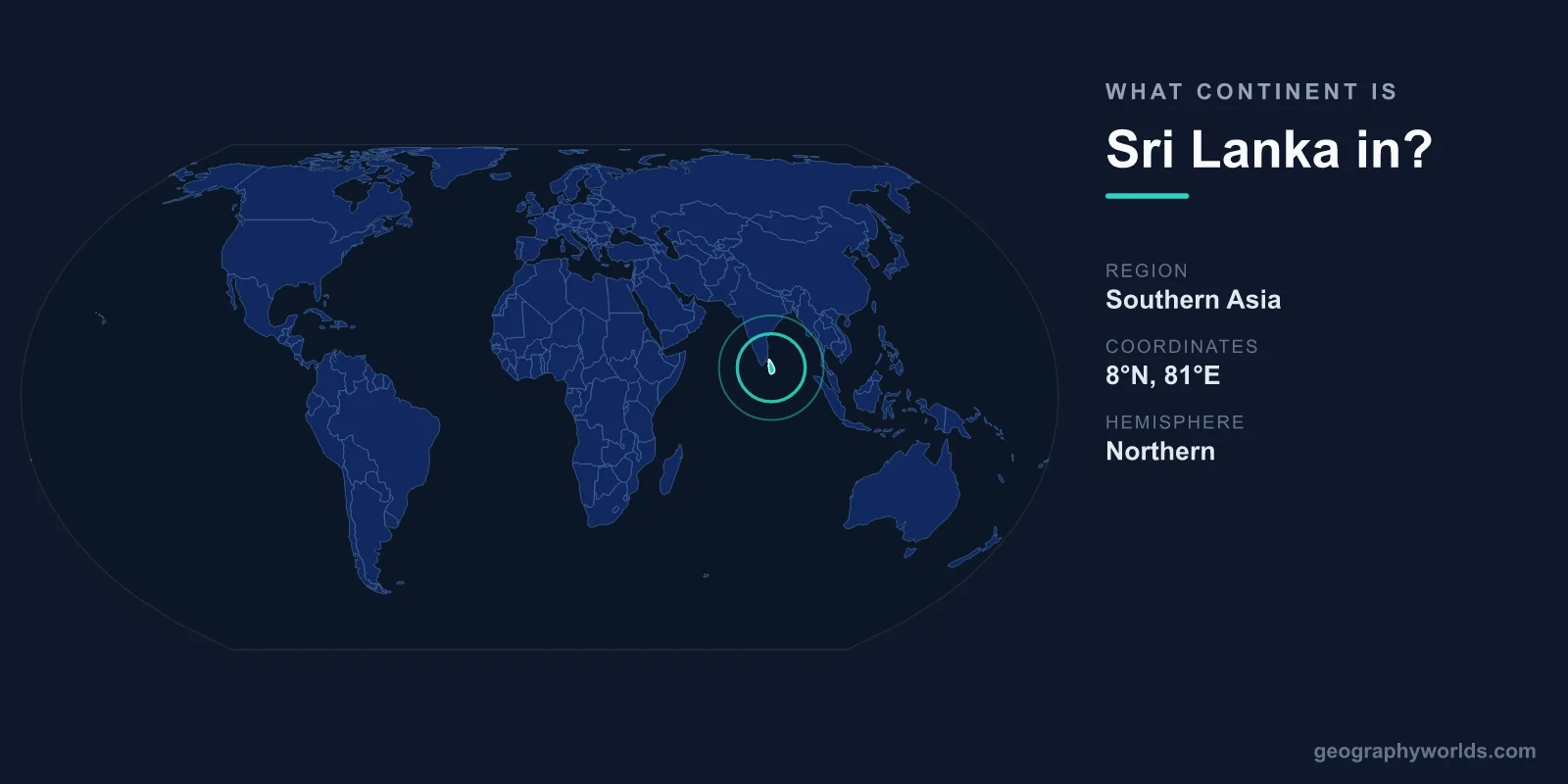
Sri Lanka is in Asia, more precisely in the South Asia region of the continent. It is an island nation sitting in the northern Indian Ocean, just off the southeastern coast of India, and it is firmly counted among the countries of the Asian landmass even though no land border physically connects it to the mainland.
Why Sri Lanka Belongs to Asia
Although Sri Lanka is surrounded by water, its continental identity is not in doubt. The island rests on the Indian tectonic plate and sits on the Asian continental shelf, the same submerged platform that extends outward from peninsular India. Geologists consider Sri Lanka a continental island — a fragment of the larger Asian landmass separated by relatively shallow seas — rather than an oceanic island formed in isolation like Hawaii or Iceland.
The United Nations geoscheme places Sri Lanka in Southern Asia, grouping it with India, Pakistan, Bangladesh, Nepal, Bhutan, the Maldives, Afghanistan, and Iran. Culturally, historically, and politically, Sri Lanka has always been bound to this part of the world, and it is a founding member of the South Asian Association for Regional Cooperation (SAARC).
How Close Is Sri Lanka to the Asian Mainland?
Sri Lanka lies remarkably close to India. The narrow Palk Strait, only about 50 kilometres (roughly 30 miles) wide at its slimmest, separates the island's northwest from the Indian state of Tamil Nadu. Just south of the strait lies the Gulf of Mannar.
Between the two countries stretches Adam's Bridge — also called Rama's Bridge or Rama Setu — a chain of limestone shoals and sandbanks that very nearly links Sri Lanka to India. These shoals are so shallow that the two coasts were almost certainly joined by a land connection in the geologically recent past, which helps explain why Sri Lanka shares so many plants and animals with the Indian subcontinent. In Hindu tradition, this causeway is said to have been built by Lord Rama and his army, a story told in the epic Ramayana.
Key Geographic Facts
- Continent: Asia (South Asia)
- Capital: Sri Jayawardenepura Kotte (the commercial hub is Colombo)
- Area: approximately 65,610 km²
- Coastline: about 1,340 km
- Highest point: Pidurutalagala, at 2,524 metres
- Major rivers: the Mahaweli (the country's longest) and the Kelani
- Climate: tropical, shaped by two monsoon seasons
For an island of modest size, Sri Lanka packs in extraordinary variety. Central highlands cloaked in tea plantations rise above coastal plains; the dry zone dominates the north and east, while lush tropical rainforests blanket the wetter southwest. The mountains intercept monsoon winds, feeding the rivers and creating the emerald landscapes that gave the island its nickname, the "Pearl of the Indian Ocean."
Neighbours and Strategic Position
Sri Lanka has no land borders, but its closest neighbour is India, just across the Palk Strait to the northwest. The Maldives, another Asian nation, lie to the southwest. To the south there is nothing but open ocean until the distant shores of Antarctica.
This location placed Sri Lanka squarely on the ancient maritime trade routes of the Indian Ocean. For centuries, ships carrying spices, gems, silk, and tea passed its harbours while travelling between East Asia, Southeast Asia, the Middle East, and Africa. That same strategic position keeps the island commercially important today, sitting astride some of the world's busiest shipping lanes. To explore more about the island's history, culture, and geography, see our sri lanka country guide.
From Ceylon to Sri Lanka
The island was known to the wider world as Ceylon for much of the colonial era, a name that survives in the global tea trade — "Ceylon tea" remains a celebrated export. The country adopted the name Sri Lanka in 1972, drawn from Sanskrit roots meaning "resplendent island." Its long recorded history includes the Sri Maha Bodhi tree at Anuradhapura, planted in 288 BC and considered the oldest living tree planted by human hands with a known planting date. None of these changes alter its continental status: through every name and era, Sri Lanka has remained an Asian nation.
Frequently Asked Questions
Is Sri Lanka in Asia or Africa?
Sri Lanka is in Asia. It is sometimes confused with island nations off the African coast, but it lies in the northern Indian Ocean just south of India, firmly within South Asia.
Is Sri Lanka part of India?
No. Sri Lanka is a fully independent country with its own government, languages, and culture. It is separated from India by the Palk Strait and gained independence from British rule in 1948.
What ocean surrounds Sri Lanka?
Sri Lanka is surrounded by the Indian Ocean, with the Bay of Bengal to the northeast, the Gulf of Mannar and Palk Strait to the northwest, and the Laccadive Sea to the southwest.
Is Sri Lanka considered South Asian?
Yes. Sri Lanka is classified as part of South Asia and is a member of SAARC alongside India, Pakistan, Bangladesh, Nepal, Bhutan, the Maldives, and Afghanistan.