
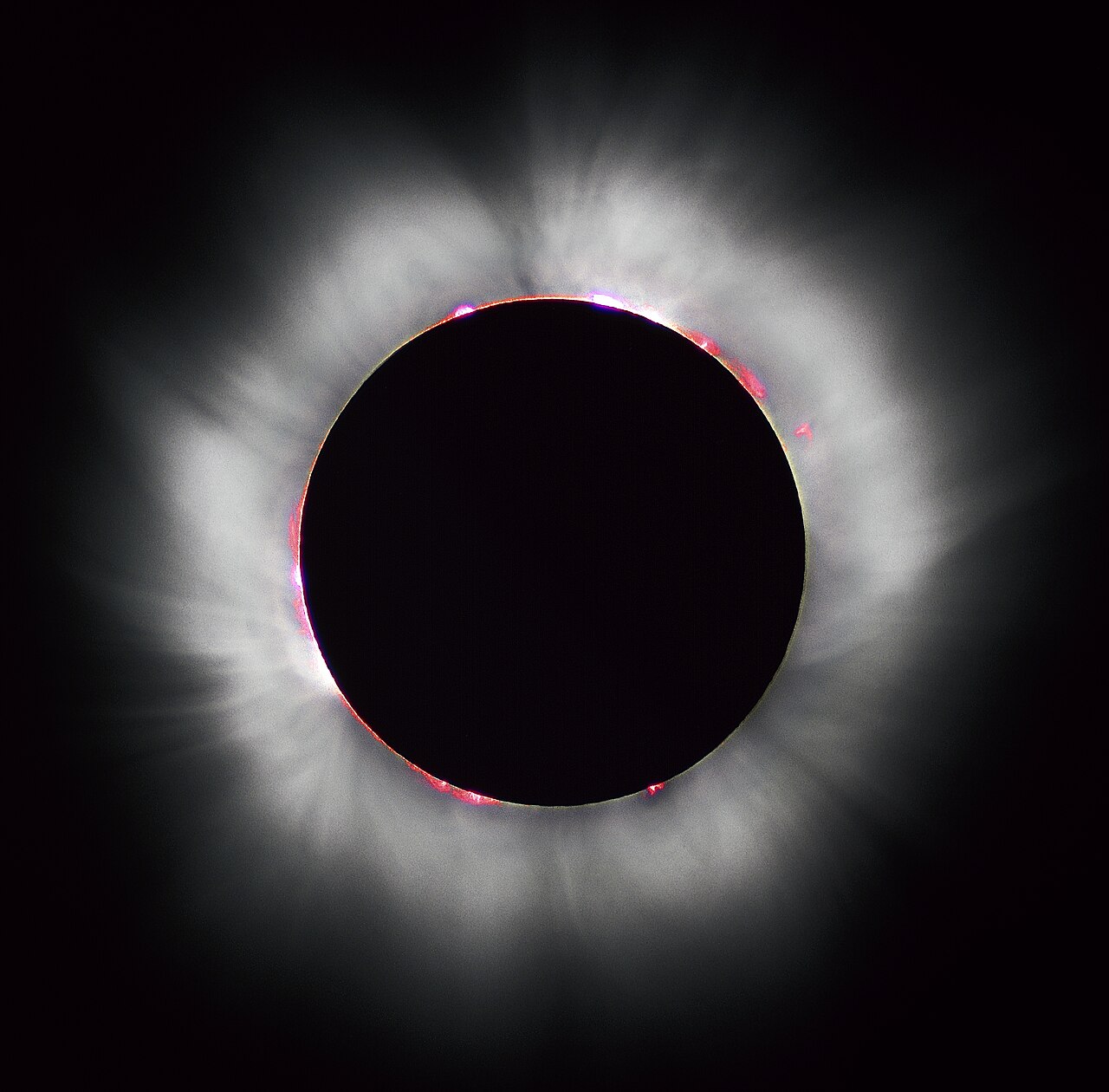
An eclipse is one of astronomy's most spectacular and accessible phenomena. A total solar eclipse, when day briefly becomes night and the Sun's corona appears around a black disk in the sky, has stopped wars, scared kings, and inspired entire civilizations. A lunar eclipse turns the Moon blood-red. Both involve the same simple geometry — and yet are among the most awe-inspiring sights humans can witness.
The Short Answer
An eclipse happens when one celestial body passes into the shadow of another, blocking light from a more distant body. The two main types are: solar eclipse (Moon passes between Sun and Earth, blocking sunlight), and lunar eclipse (Earth passes between Sun and Moon, casting Earth's shadow on the Moon). Eclipses only happen when the Sun, Moon, and Earth are aligned closely enough.
Solar Eclipses
A solar eclipse occurs when the Moon passes directly between the Sun and Earth, blocking the Sun's light. There are four types:
- Total solar eclipse: The Moon completely covers the Sun. Day turns to twilight, the Sun's corona appears, stars become visible. Lasts from seconds up to about 7.5 minutes at any one location.
- Annular solar eclipse: The Moon is too far from Earth to completely cover the Sun, leaving a bright "ring of fire" around the dark Moon. Lasts up to about 12 minutes.
- Partial solar eclipse: The Moon covers only part of the Sun. Visible over a wider area but less dramatic.
- Hybrid solar eclipse: Rare; transitions between total and annular along its path.
How Solar Eclipses Work
The Moon's shadow has two parts:
- Umbra: The dark inner shadow where the Moon completely blocks the Sun. Total eclipse visible inside this shadow.
- Penumbra: The lighter outer shadow where the Moon partly blocks the Sun. Partial eclipse visible here.
The umbra is small — only about 250 km wide at the surface during a total eclipse. The path of totality (where the umbra crosses Earth's surface) is a narrow strip, often only 100-300 km wide. The penumbra covers a much larger area, sometimes thousands of kilometers across.
Why Total Eclipses Are So Rare
Although the Moon orbits Earth every 29.5 days, total solar eclipses happen only about every 18 months somewhere on Earth, and any specific location sees one only about every 375 years on average. Why so rare?
- The Moon's orbit is tilted 5° relative to Earth's orbit around the Sun, so the Moon usually passes above or below the Sun as seen from Earth.
- An eclipse requires the Moon to be at a specific "node" — where its orbital plane crosses Earth's.
- The umbra is narrow, so totality only sweeps a thin path on Earth's surface.
The Coincidence That Makes Totality Possible
It's a striking coincidence that the Sun and Moon appear approximately the same size in our sky. The Sun is about 400 times larger than the Moon — but also about 400 times farther away. The result: their angular sizes match. This is why we can see total eclipses where the Moon perfectly covers the Sun, revealing the corona. Without this coincidence (which won't last forever as the Moon recedes), total eclipses wouldn't exist.
Lunar Eclipses
A lunar eclipse occurs when Earth passes between the Sun and Moon, casting Earth's shadow on the Moon. Three types:
- Total lunar eclipse: The Moon passes fully into Earth's umbra. The Moon turns reddish — the "blood moon." Visible from anywhere the Moon is above the horizon.
- Partial lunar eclipse: Only part of the Moon passes through Earth's umbra. The remainder is in penumbra or full sunlight.
- Penumbral lunar eclipse: The Moon passes only through Earth's penumbra. Subtle darkening, hard to see.
Why the Moon Turns Red
During a total lunar eclipse, the Moon doesn't go completely dark. Instead, it turns a coppery red. The reason: Earth's atmosphere bends some sunlight into the umbra. The bent light has had its blue wavelengths scattered away (same effect as sunsets being red), leaving the red wavelengths to faintly illuminate the Moon. The exact color and brightness depend on atmospheric conditions — particularly the amount of dust and volcanic aerosols in Earth's atmosphere. After major volcanic eruptions, lunar eclipses can be very dark or deep brown.
How Often Eclipses Happen
Eclipses happen more often than people realize:
- 2-5 solar eclipses occur each year (somewhere on Earth)
- 0-3 lunar eclipses occur each year
- Total eclipses (solar or lunar) average about once every 1.5 years globally
Lunar eclipses are visible from anywhere the Moon is above the horizon during the event — typically half the planet. Solar eclipses are only visible from a narrow path on Earth's surface, making them seem rarer.
Eclipse Seasons
Eclipses happen in "seasons" — periods of about 5 weeks during which any new or full moon will cause an eclipse. Eclipse seasons happen twice a year, about 6 months apart. The reason: only twice a year do the Sun, Earth, and Moon align with the Moon at a node (the point where its orbit crosses the ecliptic).
The Saros Cycle
Babylonian astronomers discovered that eclipses repeat in a cycle of about 18 years, 11 days, and 8 hours — called the "Saros cycle." After one Saros cycle, very similar eclipses occur. However, the geometry shifts about 120° west, so the same eclipse path doesn't return to the same location for three Saros cycles (about 54 years).
Famous Historical Eclipses
- May 28, 585 BCE: A total solar eclipse during a battle between the Lydians and Medes reportedly so frightened both sides that they made peace. Predicted by Thales of Miletus.
- 1919 solar eclipse: Used by Arthur Eddington to confirm Einstein's prediction that light bends in gravitational fields, validating general relativity.
- 1973 solar eclipse: Used by Concorde supersonic jet to extend totality observation to over an hour.
- 2017 "Great American Eclipse": Crossed the entire continental US, viewed by an estimated 215 million Americans.
- 2024 eclipse: Crossed Mexico, USA, and Canada with another massive viewership.
How to Safely View an Eclipse
Solar eclipses can permanently damage your eyes if viewed incorrectly:
- Never look directly at the Sun during a partial or annular eclipse without ISO 12312-2 certified solar glasses
- Regular sunglasses are not safe
- Pinhole projectors work safely — project Sun image through a small hole onto a flat surface
- Welding glasses must be #14 shade or darker
- During totality only (the brief moments when Sun is completely covered), it's safe to look directly
Lunar eclipses can be viewed safely with the naked eye — no special equipment needed.
What Happens During Totality
The total solar eclipse experience is hard to describe to those who haven't seen one:
- Daylight rapidly dims to twilight
- Temperature drops 5-15°F
- Animals behave strangely — birds may roost, crickets chirp
- The "diamond ring" effect appears as the Sun emerges and disappears behind the Moon's mountains
- Baily's beads (bright spots through lunar valleys) are visible briefly
- The corona — the Sun's atmosphere — extends millions of miles in delicate streamers
- Stars and planets become visible
- A 360° "sunset" surrounds the horizon
Eclipses on Other Planets
Other planets have eclipses too:
- Mars: Its tiny moons Phobos and Deimos produce transit-like eclipses, not true totalities.
- Jupiter: Its large moons produce frequent eclipses on each other and on Jupiter's cloud tops.
- Saturn: Multiple moons cast shadows on the planet and rings.
- Exoplanets: We detect many exoplanets by their transits — partial eclipses of their host stars.
The Future of Eclipses
The Moon is slowly receding from Earth (3.8 cm/year). About 600 million years from now, the Moon will be too far away to completely cover the Sun. Total solar eclipses will become impossible — only annular eclipses will occur. Until then, the rare coincidence of matched angular sizes will continue producing the most spectacular astronomical events visible from Earth.
Key Facts
- Solar eclipses occur when the Moon passes between Sun and Earth.
- Lunar eclipses occur when Earth passes between Sun and Moon.
- The Moon and Sun appear the same size due to coincidental geometry.
- Total solar eclipses last from seconds to about 7.5 minutes maximum.
- Total solar eclipses are visible from any single location only about every 375 years.
Fun Facts
- An eclipse in 585 BCE reportedly ended a war between the Lydians and Medes.
- The 1919 eclipse confirmed Einstein's general relativity by measuring light bending.
- Total eclipses won't exist forever — the Moon is moving away from Earth.
- The longest possible total solar eclipse is about 7.5 minutes.
- Animals often behave as if it were night during a total solar eclipse.
The Bottom Line
An eclipse is the simple geometry of one celestial body casting a shadow on another, but the result is one of nature's most awe-inspiring spectacles. Solar eclipses block the Sun during the day, sometimes revealing the corona and turning daylight to dusk. Lunar eclipses turn the Moon blood-red. Both phenomena have fascinated humans throughout history — from frightening ancient peoples to validating Einstein's relativity to drawing millions of modern eclipse-chasers across continents.