
Whakaari/White Island is a marine stratovolcano located 48 kilometers off the coast of New Zealand's North Island in the Bay of Plenty. It is New Zealand's most active cone volcano, with near-continuous volcanic unrest since 1826. Only about 30% of the volcano is above sea level; the rest is submerged.
Introduction
On December 9, 2019, a sudden phreatic (steam-driven) eruption occurred while 47 tourists and guides were on the island. Twenty-two people were killed and 25 severely injured, making it New Zealand's deadliest volcanic disaster in over a century and triggering fundamental questions about risk management at active volcanoes.
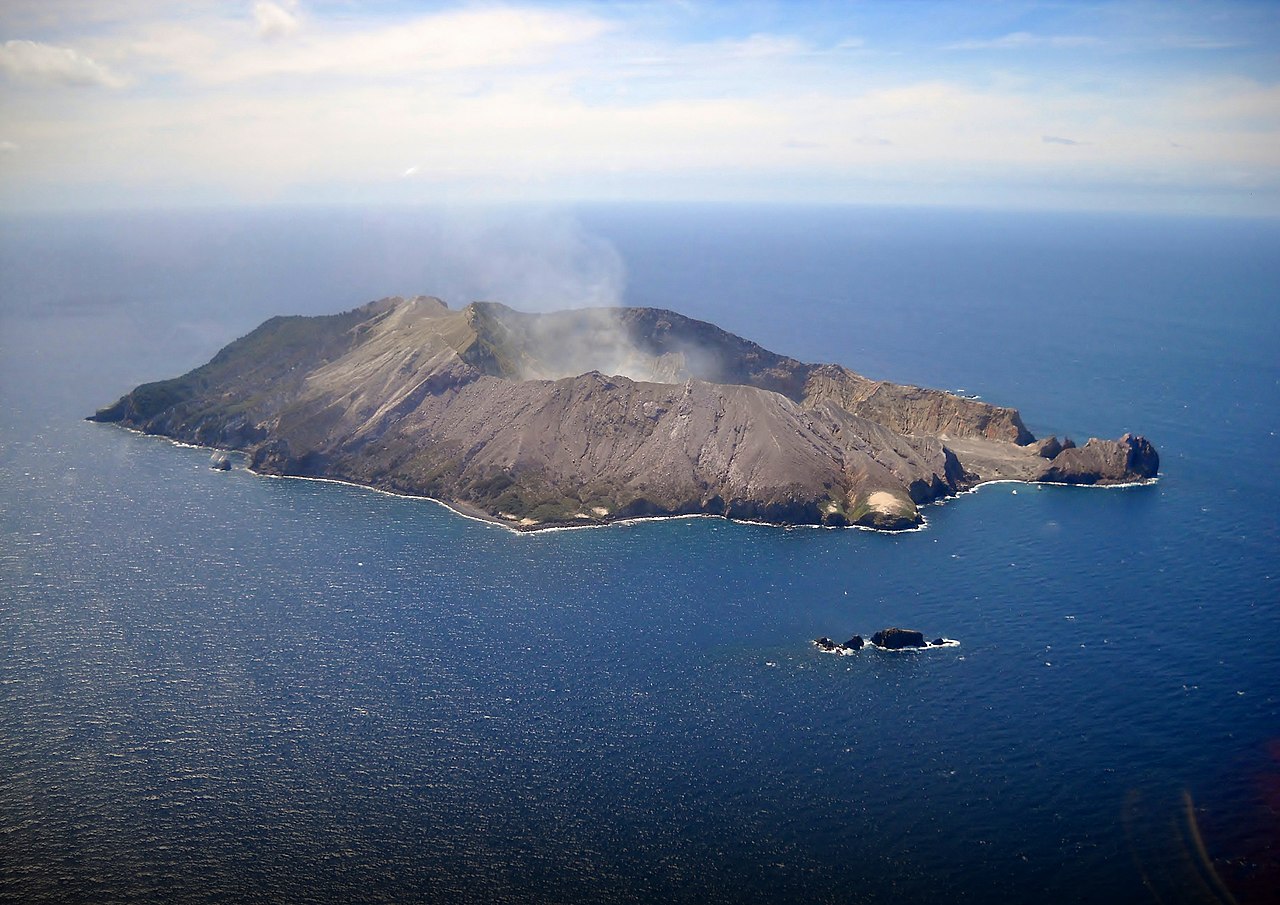
Geography & Location
- Location: Bay of Plenty, New Zealand (37.52°S, 177.18°E)
- Height: 321 m above sea level (~1,600 m from seafloor)
- Type: Stratovolcano (andesitic-dacitic)
White Island is the emergent summit of a large submarine volcano. The visible island measures approximately 2 km by 2.4 km, with a breached crater open to the sea on the southeastern side. The main crater floor sits near sea level and contains fumaroles, hot springs, a crater lake, and active vents.
The volcano sits at the northern end of the Taupo Volcanic Zone, New Zealand's most active volcanic region. It is privately owned by the Buttle family (descendants of early settlers), though the surrounding seafloor and waters fall under government jurisdiction.
Volcanic Activity
- Eruption Style: Phreatic and phreatomagmatic
- Activity Level: Near-continuous unrest since 1826
- Volcanic Alert Level: Frequently elevated
White Island's volcanic activity is dominated by phreatic and phreatomagmatic eruptions — steam-driven explosions caused by the interaction of hot volcanic fluids and groundwater. These events can occur with little warning and produce violent explosions, ballistic projectiles, and base surges.
The volcanic system includes a shallow hydrothermal reservoir, acid crater lake, and multiple active fumaroles emitting sulfur dioxide and hydrogen sulfide. Gas emissions often exceed 1,000 tonnes per day of SO₂, making the air toxic without respiratory protection.
Eruption History
- December 9, 2019: Phreatic eruption killed 22, injured 25
- 1914: Lahar destroyed sulfur mining camp, 11 killed
- 2012-2013: Series of eruptions (no casualties)
The 2019 eruption occurred at 2:11 PM while a tour group from the cruise ship Ovation of the Seas and several local tour operators were on the island. A sudden phreatic explosion from the main vent area sent a surge of hot gas, steam, and rock across the crater floor where tourists were walking.
The 1914 disaster killed 11 sulfur miners when part of the crater wall collapsed, generating a lahar that swept through their camp. Mining operations had been conducted since the 1880s, and the entire mining camp was destroyed. A solitary cat, later named Peter the Great, was the only survivor found.
Surrounding Ecosystem
- Marine Life: Rich fishing grounds around the volcano
- Bird Colony: Australasian gannets nest on outer cliffs
- Crater Environment: Extremely acidic, hostile to most life
The outer slopes and cliffs of White Island support one of New Zealand's largest Australasian gannet colonies. The surrounding waters are productive fishing grounds, enriched by volcanic nutrients. Pohutukawa trees cling to the outer slopes despite the acidic volcanic environment.
Within the crater, conditions are extremely hostile: acidic pools, sulfurous gases, and temperatures exceeding 800°C at fumarole vents. Despite this, extremophile microorganisms have been found in the crater's hot springs, adapted to the high temperatures and extreme acidity.
Cultural Significance
- Maori Name: Whakaari ("that which can be made visible")
- Tourism: Was a major tourist attraction before 2019
- Legal Aftermath: Criminal charges filed after 2019 disaster
The Maori name Whakaari means "that which can be made visible" or "to make visible," referring to the dramatic volcanic plume often visible from the mainland. The volcano holds significance in Maori tradition as a place of great spiritual power.
After the 2019 disaster, WorkSafe New Zealand filed criminal charges against the island's owners, tour operators, and the national monitoring agency GNS Science. The trial raised critical questions about the responsibility of tour operators in bringing visitors to active volcanic environments.
Key Facts
- Whakaari/White Island is New Zealand's most active cone volcano.
- The December 9, 2019, phreatic eruption killed 22 tourists and guides.
- Only ~30% of the volcano is above sea level; it rises ~1,600 m from the seafloor.
- The 1914 lahar killed 11 sulfur miners and destroyed the entire mining camp.
- Criminal charges were filed against tour operators and the monitoring agency after the 2019 disaster.
Fun Facts
- After the 1914 disaster, the only survivor found at the camp was a cat named "Peter the Great."
- The crater lake's acidity is comparable to battery acid, with a pH near 0.
- Before the 2019 eruption, up to 10,000 tourists visited White Island per year.
- The iconic yellow and white sulfur deposits on the crater floor gave the island its English name when Captain Cook sighted it in 1769.
Final Thoughts
Whakaari/White Island's 2019 tragedy forced the world to confront a difficult question: should tourists be allowed on active volcanoes? The disaster revealed the tension between the allure of extreme natural experiences and the unpredictable danger of volcanic environments. It remains a cautionary tale about the limits of risk management in nature.
Test Your Volcano Knowledge!
Think you know the world's most powerful volcanoes? Try our interactive quiz!
Play Geographic Features Quiz →