
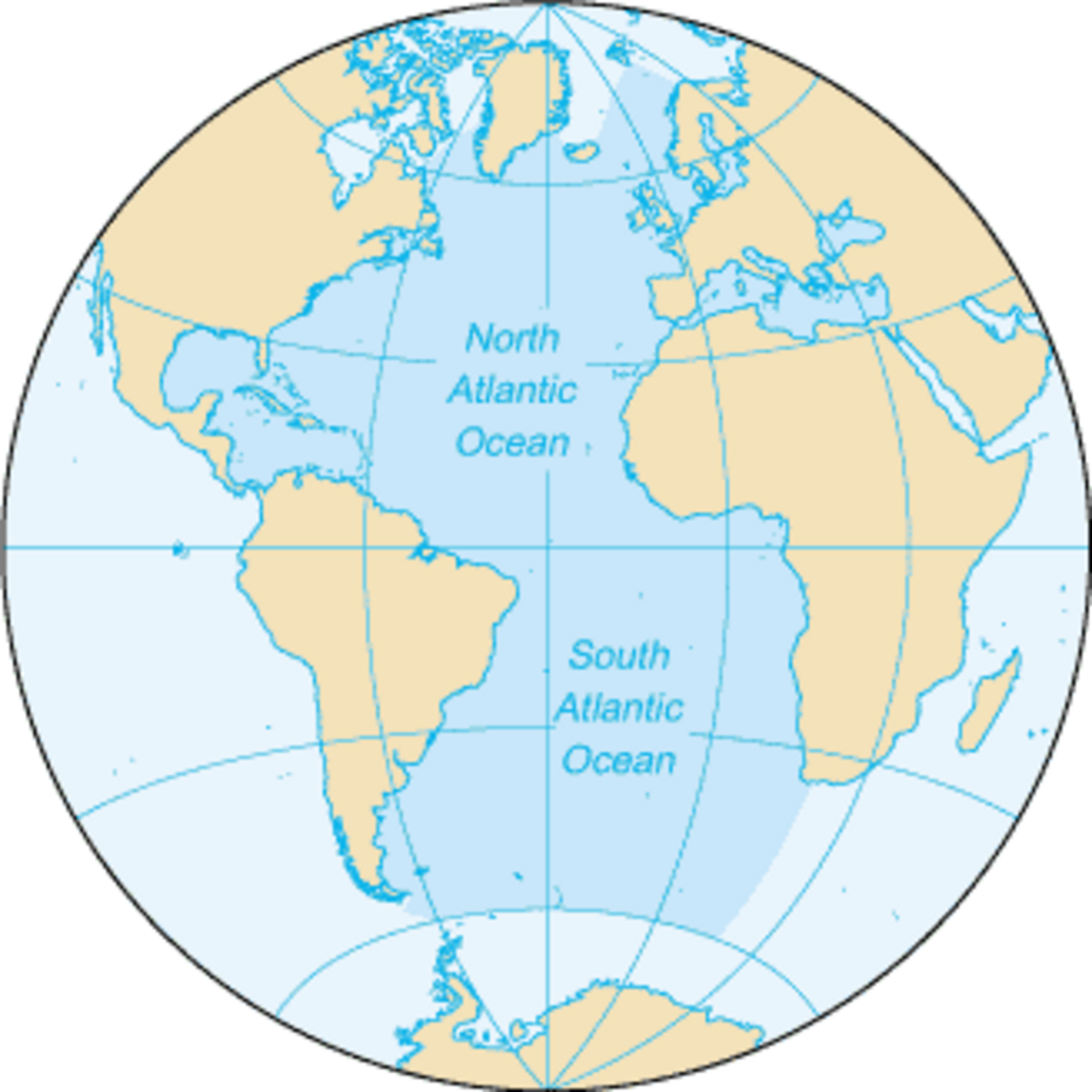
Introduction to the Atlantic Ocean
The Atlantic Ocean is the second-largest ocean on Earth, covering approximately 20% of the planet's surface and separating the Old World from the New. Its name derives from the Greek mythology of Atlas, the Titan who held up the sky. The Atlantic is the youngest of the major oceans, having formed during the Jurassic Period as the supercontinent Pangaea broke apart roughly 180 million years ago. It continues to widen by about 2.5 centimeters per year as tectonic plates diverge along the Mid-Atlantic Ridge. The Atlantic has played a pivotal role in human history, serving as the highway for exploration, colonization, trade, and cultural exchange between continents.

Key Facts
- Type: Ocean
- Location: Between the Americas, Europe, and Africa
- Area: 106,460,000 km²
- Maximum Depth: 8,376 m (Puerto Rico Trench)
- Average Depth: 3,646 m
- Bordering Regions: North America, South America, Europe, Africa, Antarctica
Geography and Formation
The Atlantic Ocean is dominated by the Mid-Atlantic Ridge, an underwater mountain range that runs north to south for approximately 16,000 km, making it the longest mountain range on Earth. Iceland sits atop this ridge and is one of the few places where it rises above sea level. The ocean's deepest point is the Puerto Rico Trench at 8,376 meters, located in the western Atlantic. The continental shelves along its margins are among the widest in the world, particularly off the coasts of Newfoundland and northwestern Europe, supporting rich fishing grounds like the Grand Banks. The Atlantic receives the drainage of the world's largest river systems, including the Amazon, Congo, Mississippi, and Niger, contributing to significant variations in salinity and nutrient levels.
Marine Life and Ecology
The Atlantic Ocean hosts an extraordinary diversity of marine life, from the productive fishing grounds of the North Atlantic to the tropical coral reefs of the Caribbean. The Grand Banks off Newfoundland were historically one of the world's richest fishing areas, supporting massive populations of Atlantic cod before overfishing caused their collapse in the 1990s. The Sargasso Sea, a unique region in the central North Atlantic bounded by ocean currents rather than land, provides critical habitat for juvenile sea turtles and is the only spawning ground for European and American eels. North Atlantic right whales, one of the most endangered large whale species, migrate along the eastern seaboard of North America. The deep Atlantic harbors bioluminescent organisms, giant squid, and communities of cold-water corals that can live for thousands of years.
Climate and Currents
The Atlantic Ocean drives some of the most important climate systems on the planet, including the Atlantic Meridional Overturning Circulation (AMOC), often called the "global conveyor belt," which transports warm water from the tropics northward and cold water southward at depth. The Gulf Stream, a powerful western boundary current, carries warm water from the Gulf of Mexico toward northwestern Europe, giving countries like the United Kingdom and Norway significantly milder climates than their latitudes would otherwise suggest. Atlantic hurricanes form off the coast of West Africa and can grow into devastating storms as they cross the warm tropical waters toward the Caribbean and North America. The Atlantic Multidecadal Oscillation influences rainfall patterns across Africa, Europe, and the Americas over cycles of 60 to 80 years. Climate scientists are closely monitoring signs that the AMOC may be weakening due to increased freshwater input from melting Arctic ice.
Human Significance
The Atlantic Ocean has been the most commercially and historically significant ocean in modern human history, serving as the primary route for European exploration and colonization of the Americas beginning in the late 15th century. The transatlantic slave trade forcibly transported an estimated 12.5 million Africans across the Atlantic between the 16th and 19th centuries, profoundly shaping the demographics, cultures, and economies of three continents. Today, the Atlantic remains one of the busiest shipping lanes in the world, with major ports like Rotterdam, New York, and Santos handling billions of tons of cargo annually. The North Atlantic is crisscrossed by undersea telecommunications cables that form the backbone of internet connectivity between North America and Europe. Offshore oil and gas reserves in the Gulf of Mexico, the North Sea, and along the Brazilian coast make the Atlantic a major center of energy production.
Interesting Facts About the Atlantic Ocean
- The Atlantic Ocean is growing wider by about 2.5 cm each year due to seafloor spreading at the Mid-Atlantic Ridge
- The Bermuda Triangle, a region in the western Atlantic, has become legendary for the alleged disappearance of ships and aircraft
- The Atlantic is the saltiest of the world's oceans, with average salinity of about 35.5 parts per thousand
- The first transatlantic telegraph cable was laid in 1858, reducing communication time between North America and Europe from weeks to minutes
- The wreck of the RMS Titanic lies at a depth of about 3,800 meters in the North Atlantic
Conclusion
The Atlantic Ocean remains one of the world's most significant bodies of water, shaping the climate, ecosystems, and human civilizations along its shores. From its unique marine life to its role in global trade and culture, this ocean continues to fascinate scientists, explorers, and travelers alike.