
Introduction
Austria 🇦🇹 and Hungary 🇭🇺 were once bound together as the twin pillars of the Austro-Hungarian Empire, and a century on they remain close neighbors of strikingly similar size. This comparison sets them side by side across area, population, capitals, climate, and the landscapes and economies that distinguish them today.
Whether you are studying geography, planning a trip through Central Europe, or simply curious how the two compare, the figures below give you the essentials.
Size & Geography
| Feature | Austria 🇦🇹 | Hungary 🇭🇺 |
|---|---|---|
| Area | 83,871 km² | 93,028 km² |
| Continent | Europe | Europe |
| Region | Western Europe | Eastern Europe |
| Land Borders | Germany, Czech Republic, Slovakia, Hungary, Slovenia, Italy, Switzerland, Liechtenstein | Austria, Slovakia, Ukraine, Romania, Serbia, Croatia, Slovenia |
| Landscape | mostly mountainous (Alps); flat along Danube River | mostly flat Great Hungarian Plain; hills in west |
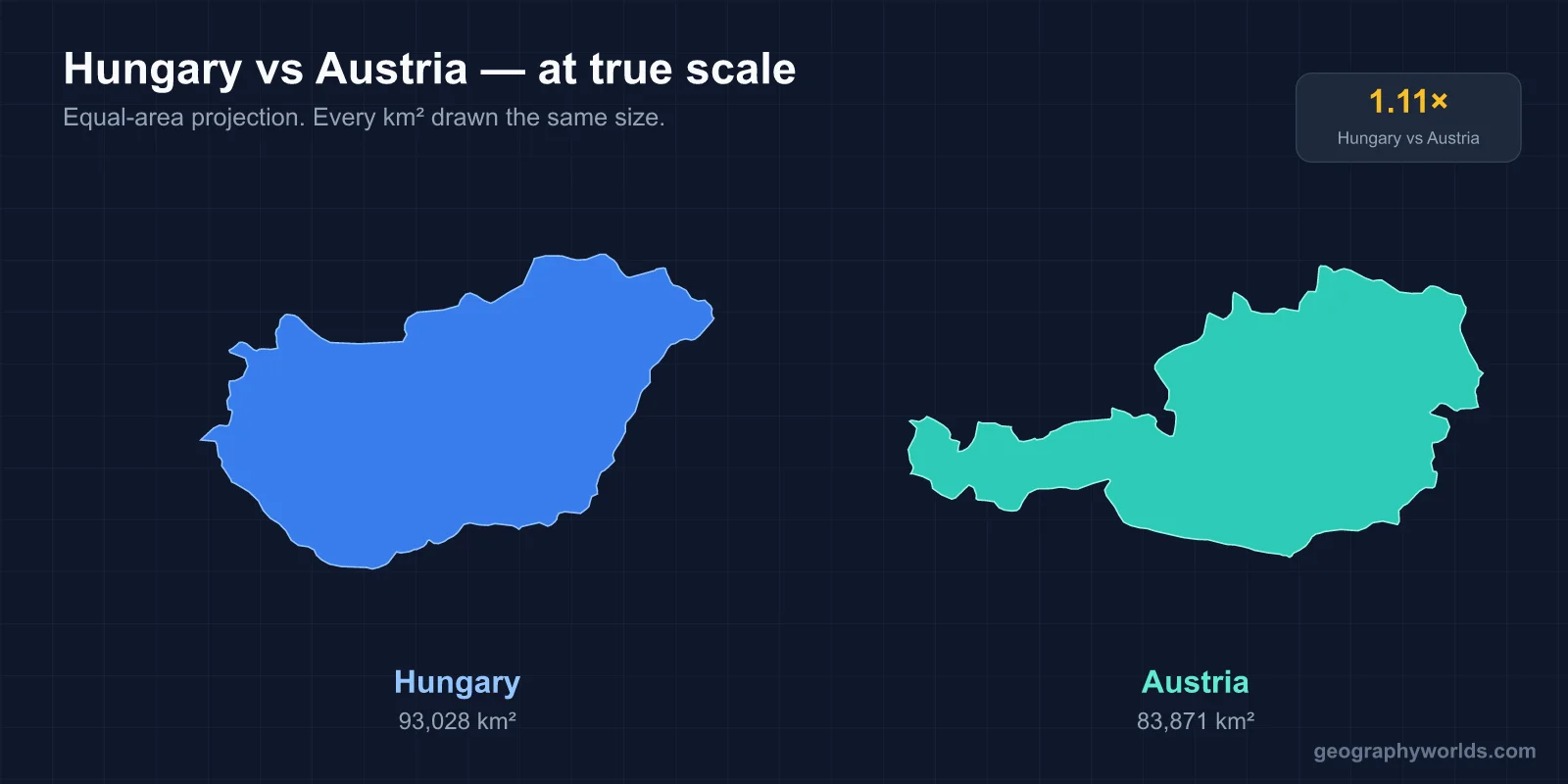
The two are nearly matched in size: Hungary is marginally the larger at 93,028 km² to Austria's 83,871 km², about 1.1 times the area. Where they differ is terrain. Austria is mostly mountainous, dominated by the Alps and flattening out only along the Danube, and it is famously well-connected, sharing borders with eight countries. Hungary is the opposite, defined by the broad, flat expanse of the Great Hungarian Plain with hills rising only in the west, and it too is a crossroads, bordered by seven neighbors. Both lie in Europe, with Austria classed as Western Europe and Hungary as Eastern Europe.
Population & Demographics
| Metric | Austria 🇦🇹 | Hungary 🇭🇺 |
|---|---|---|
| Population | 9.1 million | 9.6 million |
| Population Density | 108.6 per km² | 103.0 per km² |
Their populations are just as close. Hungary has the slight edge with 9.6 million people to Austria's 9.1 million, again about 1.1 times as many. Because Austria fits its slightly smaller population into a slightly smaller area, it ends up marginally the denser of the two at 108.6 people per km² against Hungary's 103.0, a gap of only about 5.5 per km². On these headline numbers, the two are about as evenly matched as neighboring countries get.
Capital Cities
Austria is governed from Vienna, the imperial capital on the Danube that was the heart of the old Habsburg monarchy, while Hungary's seat of government is Budapest, the great twin city of Buda and Pest that also straddles the Danube. Both capitals lie in Europe, Vienna in Western Europe and Budapest in Eastern Europe, and both rank among the most storied cities on the river.
Language, Currency & Culture
| Aspect | Austria 🇦🇹 | Hungary 🇭🇺 |
|---|---|---|
| Languages | German (official) | Hungarian/Magyar (official) |
| Currency | Euro (EUR) | Hungarian Forint (HUF) |
For all their similarities in size, the two are worlds apart in language. Austria speaks German, part of the wider Germanic family, while Hungary speaks Hungarian (Magyar), which is unrelated to the languages of any of its neighbors. Money differs too: Austria uses the Euro (EUR), having adopted the common currency, whereas Hungary keeps its own Hungarian Forint (HUF). These contrasts run deep into each country's distinct cultural history.
Climate & Natural Features
| Aspect | Austria 🇦🇹 | Hungary 🇭🇺 |
|---|---|---|
| Climate | temperate continental; cold winters, moderate summers | temperate continental; cold winters, warm summers |
| Key Features | Austrian Alps, Danube Valley, Wachau, Grossglockner | Lake Balaton, Danube River, Great Plain (Puszta) |
| Economy | tourism, manufacturing, services, forestry | automotive, electronics, agriculture, tourism |
Both share a temperate continental climate of cold winters and pleasant summers, the main difference being Austria's moderate summer warmth against Hungary's hotter ones on the open plain. Their landscapes reflect their terrain: Austria offers the Austrian Alps, the Danube Valley, the vineyards of the Wachau, and the Grossglockner, its highest peak, while Hungary draws visitors to Lake Balaton, the Danube, and the grassland expanse of the Great Plain, or Puszta. The Danube, fittingly, threads through both. Economically, Austria leans on tourism, manufacturing, services, and forestry, whereas Hungary's strengths lie in automotive production, electronics, agriculture, and tourism.
What Makes Each Country Unique
Austria is internationally renowned for classical music (Mozart, Strauss), Alpine skiing, the Sound of Music, and Viennese coffeehouse culture. Austria has produced more classical music composers per capita than any other nation — Mozart, Haydn, Schubert, and Strauss all called it home.
Hungary is best known for thermal baths of Budapest, goulash, the Danube River, and ruin bars. Hungarian (Magyar) is one of the most difficult languages for English speakers — it is unrelated to any neighboring language and has 18 grammatical cases.
Key Differences at a Glance
- Area: Austria (83,871 km²) vs Hungary (93,028 km²) — Hungary is 1.1x larger
- Population: Austria (9.1 million) vs Hungary (9.6 million) — Hungary is 1.1x more populous
- Capitals: Vienna vs Budapest
- Currency: Euro (EUR) vs Hungarian Forint (HUF)
- Continents: Europe vs Europe
- Density: Austria is more densely populated (difference of ~5.5 people per km²)
- Languages: German (official) vs Hungarian/Magyar (official)
Verdict
Austria and Hungary are former Austro-Hungarian partners that remain almost twins on paper. Hungary is fractionally larger in both area and population, each by about 1.1 times, while Austria is marginally the more densely settled. On the raw figures, few pairs of neighbors are so evenly balanced.
What truly separates them is character rather than scale. Austria is an Alpine country of mountains, music, and a Euro economy built on tourism, manufacturing, services, and forestry. Hungary is a country of the great plain, of Lake Balaton and Budapest's thermal baths, holding onto its forint and a distinctive Magyar language while its economy turns on automotive, electronics, agriculture, and tourism. Both rise on the banks of the Danube, yet each remains unmistakably itself.
Comparing them shows how a shared imperial past can leave behind two nations of equal size but separate identities. Whether you are planning a visit, studying world geography, or simply curious, the contrast rewards a closer look.
Test Your Knowledge!
Think you know your countries? Try our interactive geography quiz!
Play Geography Games →