
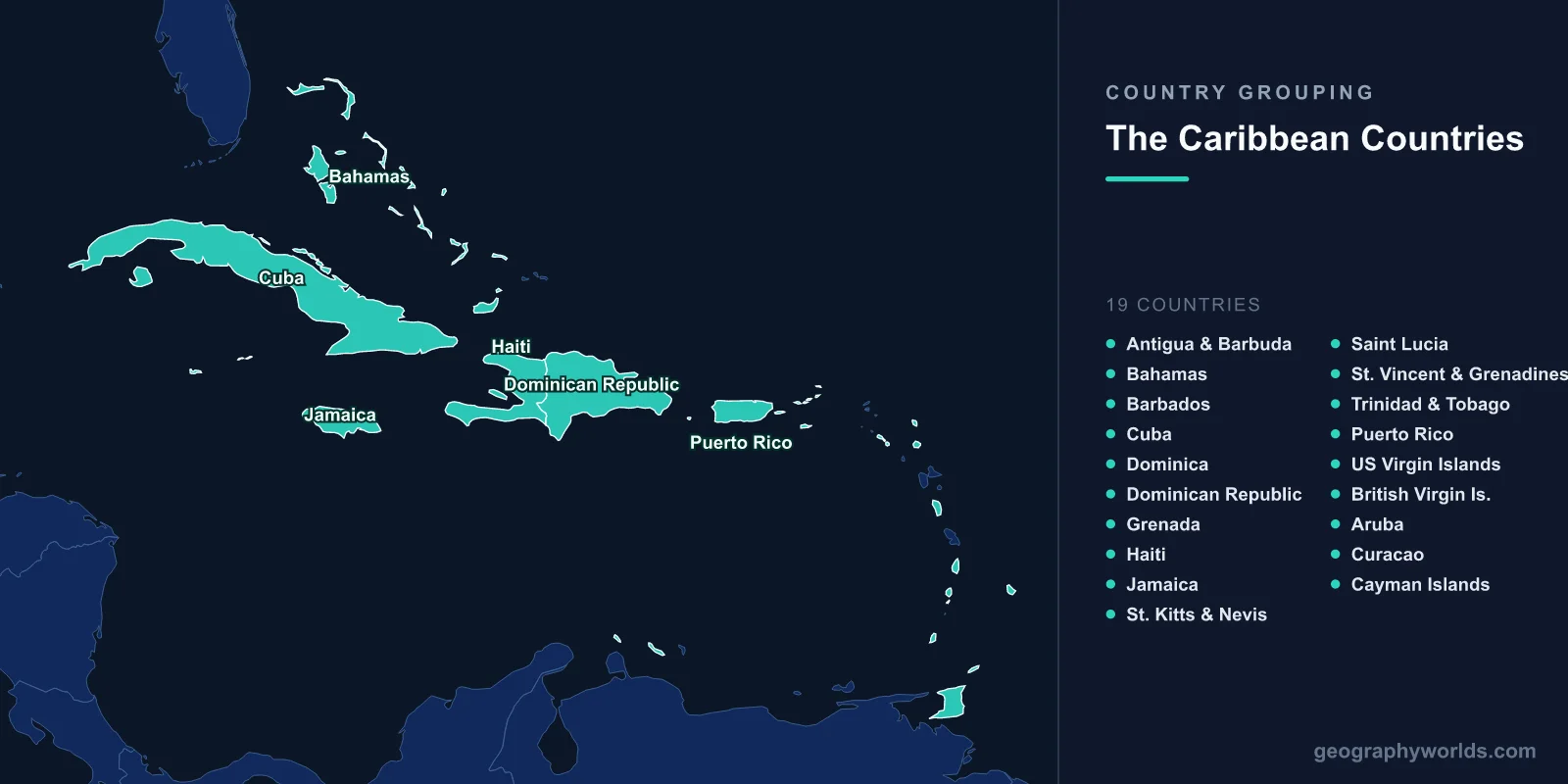
Introduction to The Caribbean Countries
The Caribbean is a vast archipelago of more than 7,000 islands, islets, reefs, and cays stretching in a sweeping crescent from the Bahamas near Florida southward to Trinidad just off the Venezuelan coast. This region is home to 13 sovereign nations and more than a dozen overseas territories belonging to the United States, United Kingdom, France, and the Netherlands. Despite their small size — the entire Caribbean land area is roughly equivalent to the state of Oregon — these islands have had an outsized impact on world history, music, cuisine, literature, and sport. The Caribbean's complex colonial past, shaped by Spanish, British, French, and Dutch empires and the brutal transatlantic slave trade, created a unique cultural mosaic blending African, European, Indigenous, and Asian traditions. Today the Caribbean is best known for its turquoise waters, white sand beaches, and world-famous music, but the region also faces serious challenges from hurricanes, climate change, economic vulnerability, and the lingering effects of colonialism. From Cuba's revolutionary history and Jamaica's reggae culture to Barbados's cricket traditions and Trinidad's spectacular Carnival, the Caribbean nations offer a richness and diversity that defies their modest geographic footprint.

Countries in The Caribbean Countries
- Antigua and Barbuda
- Bahamas
- Barbados
- Cuba
- Dominica
- Dominican Republic
- Grenada
- Haiti
- Jamaica
- Saint Kitts and Nevis
- Saint Lucia
- Saint Vincent and the Grenadines
- Trinidad and Tobago
- Puerto Rico
- US Virgin Islands
- British Virgin Islands
- Aruba
- Curacao
- Cayman Islands
Location: Caribbean Sea, an arc of islands between North America and South America
Shared Characteristics: Island geography, colonial history, tourism economies, Afro-Caribbean culture, hurricane vulnerability
History
The Caribbean was inhabited for thousands of years by Indigenous peoples, including the Taino (Arawak) in the Greater Antilles, the Kalinago (Carib) in the Lesser Antilles, and the Ciboney in Cuba and Haiti. Christopher Columbus's arrival in 1492 initiated a catastrophic period of European colonization that effectively destroyed these civilizations through disease, enslavement, and violence within a century. Spain, England, France, the Netherlands, and Denmark all established colonies across the Caribbean, transforming the islands into sugar plantations that became the most profitable real estate on Earth during the 17th and 18th centuries. This plantation economy was powered by the transatlantic slave trade, which forcibly transported an estimated 4 to 5 million Africans to the Caribbean between 1500 and 1870. Haiti made history in 1804 by becoming the first nation founded by formerly enslaved people after Toussaint Louverture and Jean-Jacques Dessalines led a successful revolution against France — the only successful large-scale slave revolt in history. Most British Caribbean colonies gained independence between the 1960s and 1980s, while Cuba's 1959 revolution under Fidel Castro created a socialist state that became a Cold War flashpoint with the Cuban Missile Crisis of 1962. Several islands remain overseas territories today: Puerto Rico and the US Virgin Islands belong to the United States, while the British Virgin Islands, Montserrat, and others remain British Crown dependencies.
Geography & Climate
The Caribbean islands are geologically divided into the Greater Antilles and the Lesser Antilles. The Greater Antilles — Cuba, Hispaniola (shared by Haiti and the Dominican Republic), Jamaica, and Puerto Rico — are the largest islands, with Cuba alone covering 110,000 square kilometers, larger than all other Caribbean islands combined. These islands feature diverse terrain including Cuba's Vinales Valley, the Dominican Republic's Pico Duarte (the Caribbean's highest peak at 3,098 meters), and Jamaica's Blue Mountains. The Lesser Antilles form a volcanic arc along the eastern Caribbean, stretching from the Virgin Islands in the north to Trinidad in the south. Many of these islands have active or dormant volcanoes — Montserrat's Soufriere Hills volcano erupted catastrophically in 1995-97, burying the capital Plymouth under ash. The Bahamas and Turks and Caicos are flat coral limestone formations sitting on shallow banks, while Trinidad, geologically part of South America, separated from the mainland only about 10,000 years ago. The Caribbean Sea itself is one of the world's largest seas, containing some of the planet's most extensive coral reef systems, including the Mesoamerican Barrier Reef (the second largest after Australia's). The entire region sits in the Atlantic hurricane belt, making it one of the most disaster-prone areas on Earth — hurricane season from June to November dominates the Caribbean calendar and shapes everything from architecture to agriculture.
Culture & Society
Caribbean culture is an extraordinary fusion born from the collision and blending of African, European, Indigenous, and Asian traditions under the crucible of colonialism and slavery. Music is the Caribbean's most powerful cultural export: Jamaica's reggae (and its global ambassador Bob Marley) has influenced music worldwide; Trinidad invented calypso, soca, and the steel pan (the only acoustic instrument invented in the 20th century); Cuba gave the world son, salsa, mambo, and cha-cha-cha; and the Dominican Republic's merengue and bachata are global dance sensations. Carnival, celebrated most spectacularly in Trinidad and Tobago, is one of the world's greatest festivals, featuring elaborate costumes, competitions, and days of non-stop music and dancing that attract visitors from around the world. Caribbean literature has produced two Nobel Prize winners — Derek Walcott of Saint Lucia and V.S. Naipaul of Trinidad — along with internationally acclaimed writers like Jamaica Kincaid, Edwidge Danticat, and Marlon James. The region's cuisine reflects its multicultural heritage: Jamaican jerk chicken, Trinidadian doubles and roti, Cuban ropa vieja, Haitian griot, Barbadian flying fish, and Dominican sancocho each tell the story of cultural exchange and adaptation. Cricket is a passionate obsession across the English-speaking Caribbean, while baseball dominates in Cuba, the Dominican Republic, and Puerto Rico, which have collectively produced hundreds of Major League players. Rastafari, originating in Jamaica in the 1930s, has become a globally recognized spiritual and cultural movement.
Economy
Tourism is the dominant economic engine across most Caribbean nations, with the region welcoming over 30 million stopover visitors and 30 million cruise passengers annually in pre-pandemic years. The Caribbean is the most tourism-dependent region in the world, with tourism directly or indirectly accounting for 15 to 50 percent of GDP in most island nations. Beyond tourism, economies vary significantly: Trinidad and Tobago has substantial oil and natural gas reserves that have made it the Caribbean's wealthiest nation per capita; the Dominican Republic has the region's largest and most diversified economy, with strong manufacturing, mining, and services sectors; Cuba's socialist economy relies on sugar, tobacco, nickel, pharmaceuticals, and the export of medical professionals; and several smaller islands have developed offshore financial services sectors. Remittances from Caribbean diaspora communities — particularly in the United States, Canada, and the United Kingdom — are a lifeline for many island economies, constituting over 20 percent of GDP in Haiti and Jamaica. The region faces profound economic challenges: extreme vulnerability to hurricanes (a single major hurricane can wipe out an island's GDP), dependence on food and energy imports, high public debt, and the existential threat of climate change and sea-level rise that could inundate low-lying coastal areas where most people live.
The Region Today
The Caribbean today stands at a critical juncture as it confronts the existential threat of climate change while working to build more resilient and diversified economies. Rising sea levels, intensifying hurricanes, and coral bleaching threaten the very existence of low-lying nations like the Bahamas and Barbuda, which was nearly entirely evacuated after Hurricane Irma in 2017. Several Caribbean nations, led by Barbados Prime Minister Mia Mottley, have become powerful voices in international climate negotiations, advocating for climate justice and financial mechanisms to help vulnerable nations adapt. The movement toward republicanism gained momentum when Barbados became a republic in November 2021, removing the British monarch as head of state. Reparations for slavery have emerged as a major diplomatic issue, with Caribbean nations through CARICOM presenting formal demands to former colonial powers. Meanwhile, Cuba's relationship with the United States remains complex following a brief thaw under President Obama. Digital innovation, renewable energy investment, and sustainable tourism are creating new economic opportunities, while creative industries — from reggaeton and dancehall music to Caribbean fashion and film — continue to amplify the region's global cultural influence.
Interesting Facts About The Caribbean Countries
- Jamaica has produced more Olympic sprinters per capita than any country, including the fastest human ever: Usain Bolt
- Trinidad's steel pan is the only acoustic musical instrument invented in the 20th century
- Cuba has a 99.8 percent literacy rate and exports doctors to over 60 countries worldwide
- The Dominican Republic and Haiti share the island of Hispaniola but speak different languages (Spanish and Creole French)
- Barbados became the world's newest republic in November 2021, ending nearly 400 years of British monarchical connection
- Dominica (not the Dominican Republic) is called the Nature Isle and has 365 rivers — one for each day of the year
Conclusion
The Caribbean Countries (Antigua and Barbuda, Bahamas, Barbados, Cuba, Dominica, Dominican Republic, Grenada, Haiti, Jamaica, Saint Kitts and Nevis, Saint Lucia, Saint Vincent and the Grenadines, Trinidad and Tobago, Puerto Rico, US Virgin Islands, British Virgin Islands, Aruba, Curacao, Cayman Islands) represent a fascinating regional grouping with shared history, cultural ties, and common challenges. Whether you're studying world geography, planning travel, or simply curious about how the world's nations connect, understanding these regional groupings provides valuable context for making sense of our complex and interconnected world.