
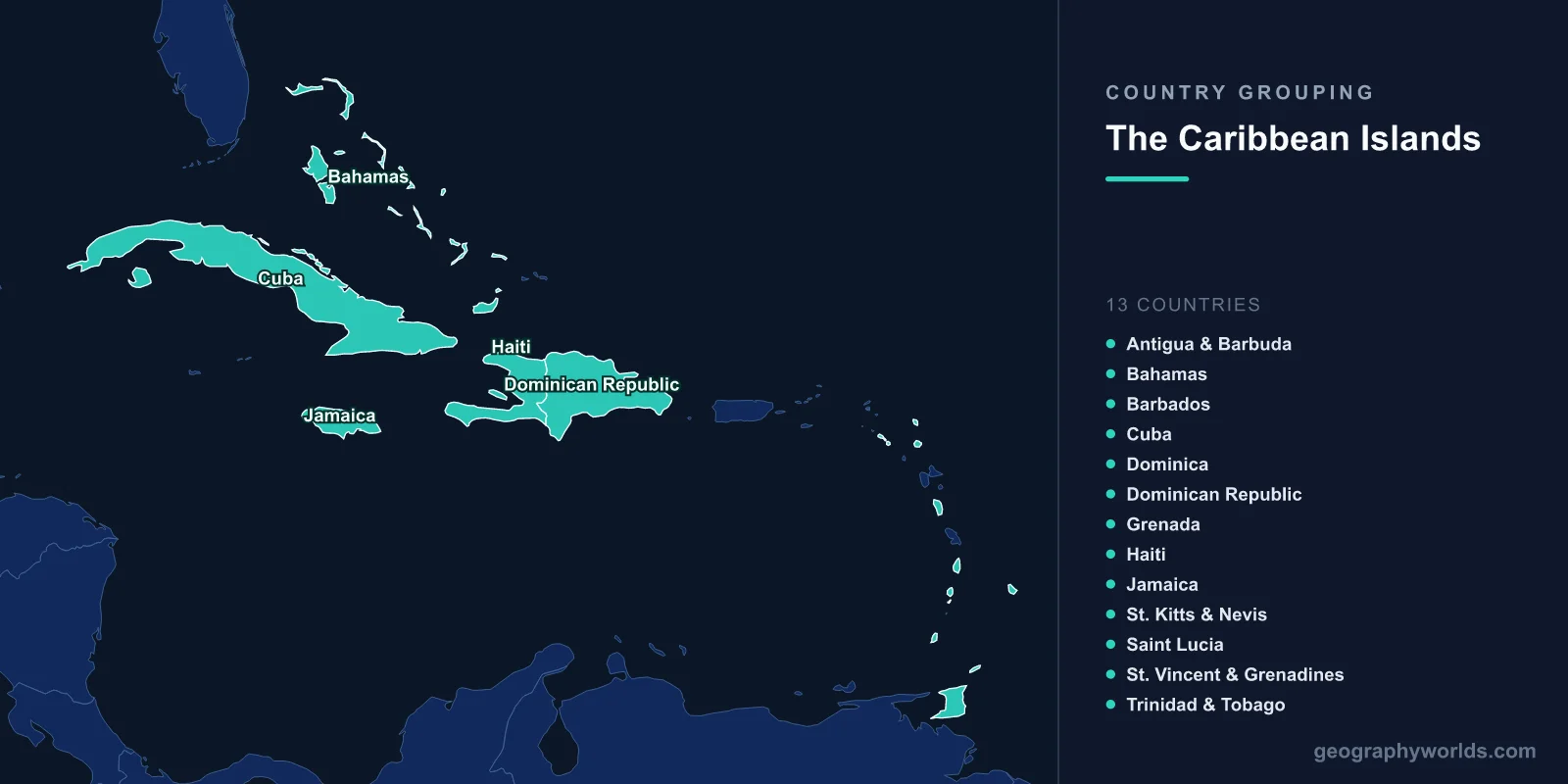
Introduction to The Caribbean Islands
The Caribbean is an archipelago of over 7,000 islands, islets, reefs, and cays stretching in a sweeping arc from the southern tip of Florida to the coast of Venezuela. Among these tropical jewels lie 13 independent nations, each with a unique blend of Indigenous, African, European, and Asian cultural influences born from one of history's most complex colonial legacies. From Cuba's vintage cars and revolutionary history to Jamaica's reggae rhythms and Trinidad's Carnival, the Caribbean radiates a cultural energy that far outweighs its small geographic size. Despite shared challenges of hurricanes, limited land area, and economic vulnerability, the Caribbean nations have produced Nobel laureates, Olympic champions, musical genres that have conquered the world, and some of the most resilient communities on Earth.

Countries in The Caribbean Islands
- Antigua and Barbuda
- Bahamas
- Barbados
- Cuba
- Dominica
- Dominican Republic
- Grenada
- Haiti
- Jamaica
- Saint Kitts and Nevis
- Saint Lucia
- Saint Vincent and the Grenadines
- Trinidad and Tobago
Location: Caribbean Sea, between North and South America
Shared Characteristics: Island geography, colonial history, tourism-driven economies, vibrant music and culture
History
The Caribbean was home to indigenous peoples — the Taino, Carib, and Arawak — for thousands of years before Christopher Columbus arrived in 1492, initiating one of the most transformative and devastating periods in human history. European colonization by Spain, Britain, France, the Netherlands, and Denmark led to the near-total destruction of indigenous populations through disease and violence. The plantation economy that replaced indigenous societies was built on the transatlantic slave trade, which forcibly brought millions of Africans to the Caribbean between the 16th and 19th centuries. Haiti made world history in 1804 by becoming the first nation founded by formerly enslaved people after a successful revolution against France. Independence movements gained momentum in the 20th century, with most British Caribbean colonies achieving nationhood between the 1960s and 1980s. Cuba's 1959 revolution under Fidel Castro created a socialist state that became a Cold War flashpoint.
Geography & Climate
The Caribbean islands are divided into the Greater Antilles (Cuba, Hispaniola, Jamaica, and Puerto Rico) and the Lesser Antilles, a chain of smaller islands forming an arc along the eastern edge of the Caribbean Sea. The islands vary dramatically in size and terrain: Cuba alone is larger than all other Caribbean islands combined, while some nations like Saint Kitts and Nevis are tiny volcanic specks. The Lesser Antilles are largely volcanic in origin, with active volcanoes on islands like Montserrat and Saint Vincent, while the Bahamas are low-lying coral formations. The region sits in the Atlantic hurricane belt, making it one of the most disaster-prone areas on Earth — hurricane season from June to November is a defining feature of Caribbean life. Warm tropical waters, coral reefs, and white sand beaches create the iconic Caribbean landscapes that attract millions of tourists annually.
Culture & Society
Caribbean culture is a dazzling fusion born from the encounter of African, European, Indigenous, and Asian traditions. Music is perhaps the Caribbean's greatest cultural export: reggae from Jamaica, calypso and soca from Trinidad, salsa and son from Cuba, merengue from the Dominican Republic, and zouk from the French Caribbean have all achieved global influence. Bob Marley remains one of the most recognized cultural figures worldwide. Carnival, celebrated most famously in Trinidad and Tobago, is one of the world's greatest street festivals, with elaborate costumes, steel pan music, and soca. Caribbean literature has produced Nobel laureates Derek Walcott (Saint Lucia) and V.S. Naipaul (Trinidad). The region's cuisine — jerk chicken, roti, ackee and saltfish, doubles, rice and peas — reflects its multicultural heritage. Cricket is a passionate obsession across the English-speaking Caribbean, while baseball dominates in Cuba and the Dominican Republic.
Economy
Tourism is the dominant economic driver across most Caribbean nations, with the region welcoming over 30 million visitors annually before the pandemic. The cruise ship industry is particularly significant, with Caribbean ports among the busiest in the world. Beyond tourism, economies vary: Trinidad and Tobago has significant oil and natural gas reserves, the Dominican Republic has a diversified economy including mining and manufacturing, and Cuba's economy is shaped by its socialist system with major exports of sugar, tobacco, and nickel. Remittances from Caribbean diaspora communities in North America and Europe are a critical income source for many island nations. The region faces significant economic challenges including vulnerability to natural disasters, dependence on food and energy imports, high debt levels, and the existential threat of climate change and rising sea levels.
The Region Today
The Caribbean today faces a pivotal moment as it grapples with climate change, economic diversification, and its relationship with global powers. Rising sea levels and increasingly intense hurricanes pose existential threats to low-lying island nations. Several Caribbean nations are leading international climate advocacy and legal efforts to hold major polluters accountable. The region is also navigating the shift from fossil fuel-dependent tourism to more sustainable economic models, with some islands investing in renewable energy and eco-tourism. The movement to replace the British monarchy with republican governments has gained momentum, with Barbados becoming a republic in 2021. Despite the challenges, Caribbean creativity, resilience, and cultural influence continue to resonate far beyond the region's shores.
Interesting Facts About The Caribbean Islands
- Jamaica's Usain Bolt is the fastest human ever recorded, and the tiny island produces a remarkable number of world-class sprinters
- Trinidad and Tobago's Carnival is one of the world's largest street parties, attracting over 40,000 masqueraders
- Cuba has one of the highest literacy rates in the world at over 99%, thanks to a massive post-revolution literacy campaign
- The Dominican Republic and Haiti share the island of Hispaniola but have very different cultures and languages
- Dominica (not the Dominican Republic) is called the "Nature Isle" and has one of the world's few boiling lakes
- Barbados became the world's newest republic in November 2021, removing Queen Elizabeth II as head of state
Conclusion
The Caribbean Islands (Antigua and Barbuda, Bahamas, Barbados, Cuba, Dominica, Dominican Republic, Grenada, Haiti, Jamaica, Saint Kitts and Nevis, Saint Lucia, Saint Vincent and the Grenadines, Trinidad and Tobago) represent a fascinating regional grouping with shared history, cultural ties, and common challenges. Whether you're studying world geography, planning travel, or simply curious about how the world's nations connect, understanding these regional groupings provides valuable context for making sense of our complex and interconnected world.