
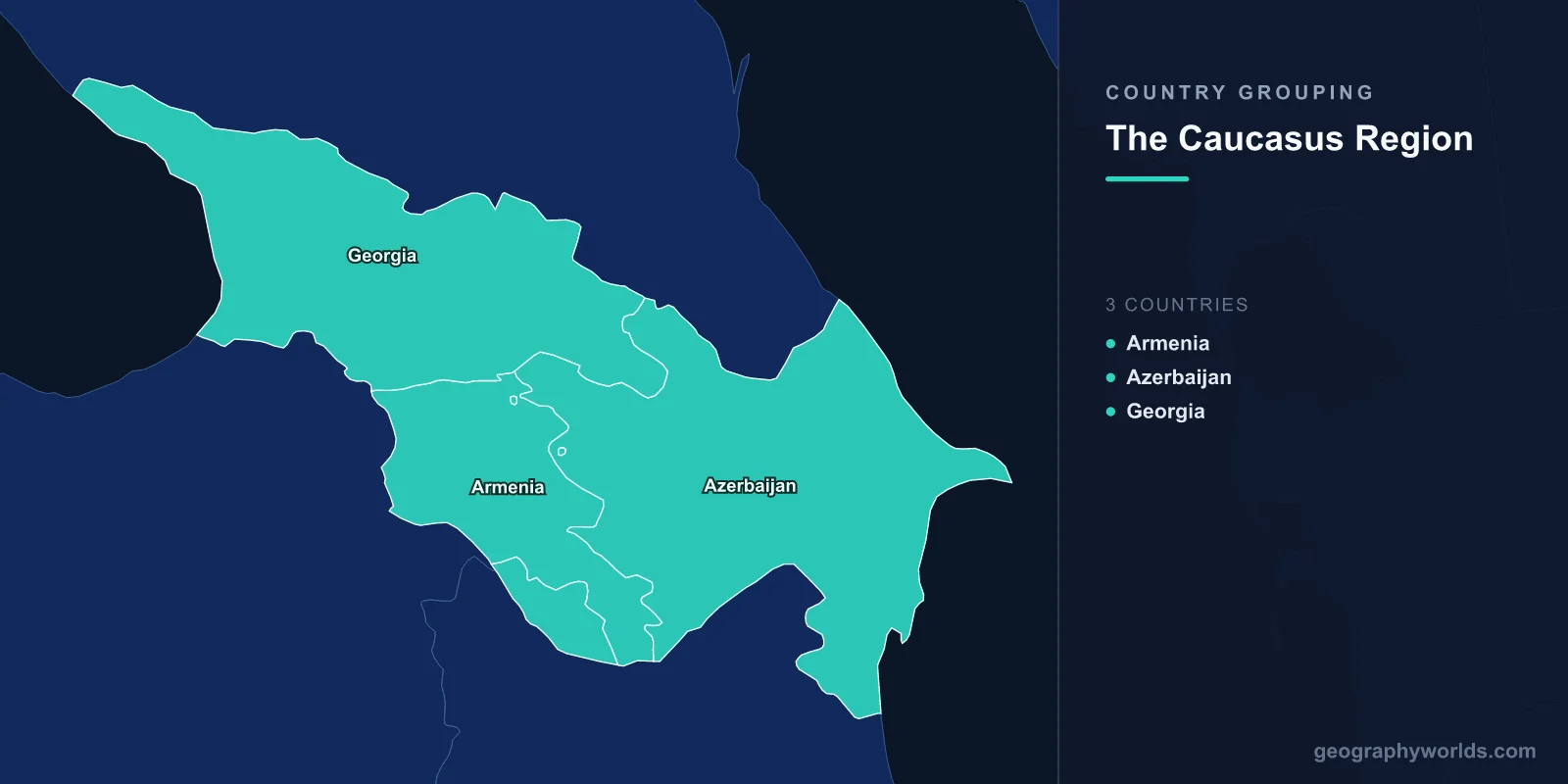
Introduction to The Caucasus Region
The Caucasus region, nestled between the Black Sea and the Caspian Sea, is one of the world's most geographically dramatic and culturally complex areas. The three independent nations of the South Caucasus — Armenia, Azerbaijan, and Georgia — occupy a narrow isthmus where Europe meets Asia, flanked by the towering Greater Caucasus mountain range whose peaks exceed 5,000 meters. Despite their small sizes and populations (roughly 17 million combined), these countries possess civilizations stretching back thousands of years, extraordinary linguistic diversity, and cultural traditions that have survived centuries of conquest by Romans, Persians, Arabs, Mongols, Ottomans, and Russians. Since gaining independence from the Soviet Union in 1991, the three nations have followed markedly different paths: Georgia has oriented toward Europe and NATO, Azerbaijan has leveraged its oil wealth, and Armenia has navigated the aftermath of genocide, diaspora, and territorial conflict.

Countries in The Caucasus Region
- Armenia
- Azerbaijan
- Georgia
Location: Between the Black Sea and Caspian Sea, at the junction of Europe and Asia
Shared Characteristics: Mountain geography, ancient Christian and Islamic heritage, post-Soviet independence, wine traditions
History
The Caucasus is among the world's oldest continuously inhabited regions. Armenia adopted Christianity as its state religion in 301 CE, making it the first nation to do so, and Georgia followed shortly after in 326 CE. Azerbaijan, while predominantly Muslim since the Arab conquests of the 7th-8th centuries, was also home to Zoroastrian fire temples that predated Islam. The medieval period saw the flourishing of Georgian and Armenian kingdoms that produced extraordinary architecture, literature, and art. The region was fought over by the Persian, Ottoman, and Russian empires, ultimately coming under Russian control in the 19th century. The Armenian Genocide of 1915, carried out by the Ottoman Empire, killed an estimated 1.5 million Armenians and remains a defining trauma for the Armenian nation. All three countries were incorporated into the Soviet Union and regained independence in 1991, but the transition was marred by conflicts: the Nagorno-Karabakh war between Armenia and Azerbaijan, and separatist conflicts in Georgia's Abkhazia and South Ossetia regions.
Geography & Climate
The Caucasus Mountains are the region's defining geographic feature, with the Greater Caucasus range forming the border between Russia and the South Caucasus nations. Mount Elbrus (5,642 m), on the Russian side, is Europe's highest peak by some definitions, while Mount Shkhara (5,193 m) in Georgia is the highest peak within the South Caucasus. The Lesser Caucasus range runs through southern Georgia, Armenia, and western Azerbaijan. Armenia is a high-altitude plateau country with Lake Sevan, one of the largest high-altitude lakes in the world, at 1,900 meters. Georgia's terrain drops dramatically from alpine peaks to subtropical Black Sea coastlines. Azerbaijan features the burning mountainsides of Yanar Dag (natural gas seeping through rock), the mud volcanoes of the Absheron Peninsula, and the Caspian Sea coastline. The region sits on major seismic faults, and devastating earthquakes have struck throughout history.
Culture & Society
Caucasian culture is characterized by fierce hospitality, ancient traditions, and remarkable diversity. Georgia is widely regarded as one of the birthplaces of wine — archaeological evidence of winemaking dates back 8,000 years, and traditional Georgian winemaking in clay qvevri vessels is UNESCO-listed. The Georgian supra (feast) is an elaborate ritual of toasting led by a tamada (toastmaster). Armenian culture revolves around its ancient Christian heritage, with medieval churches and monasteries dotting the landscape, and the Armenian alphabet (created in 405 CE) is a source of deep national pride. Azerbaijan blends Turkic, Persian, and Soviet influences, with mugham music (a UNESCO intangible heritage), carpet weaving, and a rich literary tradition. The region's cuisine features shared elements — grilled meats, fresh herbs, flatbreads, and walnut-based sauces — alongside distinctive national dishes like Georgian khachapuri (cheese bread), Armenian dolma, and Azerbaijani plov.
Economy
The three Caucasus economies differ significantly. Azerbaijan is the wealthiest, thanks to Caspian Sea oil and gas reserves that account for the majority of its export revenues and have funded the transformation of Baku into a gleaming modern capital. However, the country faces the challenge of diversifying beyond hydrocarbons. Georgia has pursued a pro-Western, free-market economic agenda, becoming known for ease of doing business, low corruption, and a booming tourism sector centered on its wine regions, mountains, and Black Sea coast. Armenia's economy is smaller and more constrained by its landlocked position and closed borders with Turkey and Azerbaijan, but it has developed a notable technology sector and benefits from the global Armenian diaspora's investment and remittances. All three countries are important transit routes for energy pipelines carrying Caspian oil and gas to European markets.
The Region Today
The modern Caucasus remains a geopolitically contested space. The 2020 Nagorno-Karabakh war saw Azerbaijan recapture most of the territory from Armenian control, fundamentally reshaping regional dynamics. Georgia's European aspirations face challenges from Russian-occupied territories and domestic political tensions. Azerbaijan has consolidated its post-war position and hosts the Southern Gas Corridor pipeline to Europe. Russia's influence remains significant across the region, though Turkey, Iran, and Western nations also play important roles. Tourism is growing rapidly, particularly in Georgia, which has become a favorite destination for travelers seeking affordable, culturally rich, and scenically stunning experiences. The region's young populations are increasingly connected globally while maintaining deep ties to their ancient cultural traditions.
Interesting Facts About The Caucasus Region
- Armenia was the first country to adopt Christianity as a state religion, in 301 CE
- Georgia is considered one of the birthplaces of wine, with evidence of winemaking dating back 8,000 years
- Azerbaijan is known as the "Land of Fire" due to natural gas flames that seep through the ground
- The Armenian alphabet was created in 405 CE by Mesrop Mashtots and is still used today with minimal changes
- Georgia's cave city of Vardzia, carved into a cliff face, once housed 50,000 people in the 12th century
- Azerbaijan's capital Baku hosted the first Formula 1 race on a street circuit around its medieval old city
Conclusion
The Caucasus Region (Armenia, Azerbaijan, Georgia) represent a fascinating regional grouping with shared history, cultural ties, and common challenges. Whether you're studying world geography, planning travel, or simply curious about how the world's nations connect, understanding these regional groupings provides valuable context for making sense of our complex and interconnected world.