
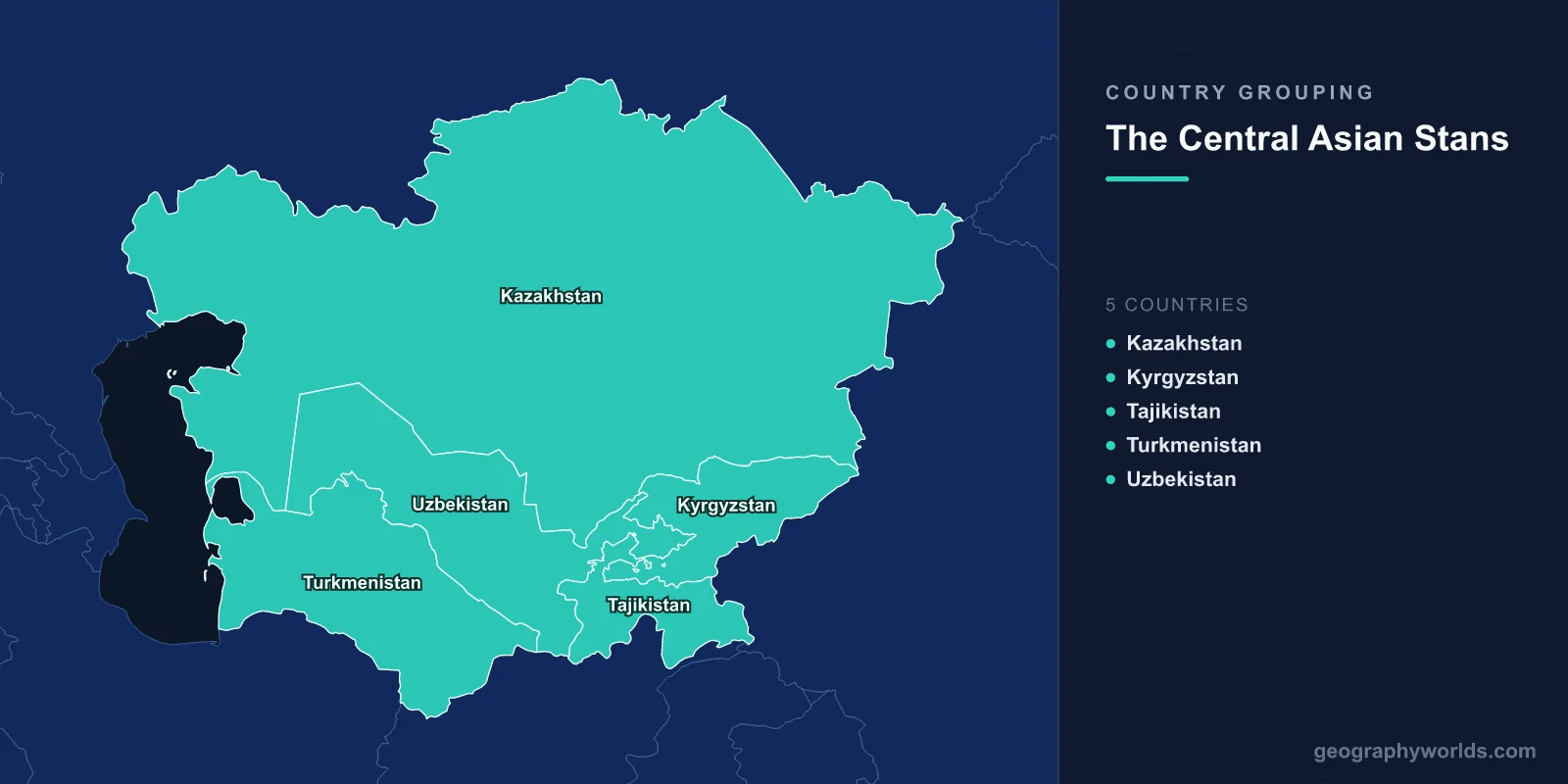
Introduction to The Central Asian Stans
The five Central Asian "Stans" — Kazakhstan, Kyrgyzstan, Tajikistan, Turkmenistan, and Uzbekistan — occupy a vast and strategically important swath of land at the heart of the Asian continent. Often overlooked by casual observers, these nations sit at the crossroads of civilizations where the ancient Silk Road once connected China to the Mediterranean. The suffix "-stan" comes from the Persian word for "land" or "place," and these lands encompass some of the most dramatic geography on Earth: from the endless Kazakh steppe to the soaring Pamir Mountains of Tajikistan, from the sun-baked deserts of Turkmenistan to the turquoise-domed cities of Uzbekistan. With a combined population of roughly 75 million people, the Central Asian states share Turkic or Persian linguistic roots, Islamic cultural traditions, and the common experience of Soviet rule and post-1991 independence.

Countries in The Central Asian Stans
- Kazakhstan
- Kyrgyzstan
- Tajikistan
- Turkmenistan
- Uzbekistan
Location: Central Asia, between Russia, China, and the Middle East
Shared Characteristics: Silk Road heritage, Turkic and Persian influences, post-Soviet independence, vast steppes
History
Central Asia has been at the crossroads of world history for millennia. The region was home to sophisticated civilizations long before the Silk Road brought it global fame — the cities of Samarkand, Bukhara, and Khiva were centers of learning, trade, and culture that rivaled anything in Europe or the Far East. Alexander the Great marched through Central Asia in the 4th century BCE, and the region later saw the rise of Turkic khanates and the devastating Mongol invasions of Genghis Khan in the 13th century. Timur (Tamerlane), born near Samarkand, built one of history's largest empires from his Central Asian base. The 19th-century "Great Game" between the British and Russian empires played out across Central Asian territories, and Russia ultimately absorbed the region into its empire. Soviet rule (1920s-1991) brought industrialization, literacy, and infrastructure but also brutal collectivization, environmental disasters like the Aral Sea crisis, and suppression of Islamic and nomadic traditions. Independence in 1991 created five new nations navigating the complex transition from Soviet republics to sovereign states.
Geography & Climate
Central Asia's geography is defined by extremes. Kazakhstan, the world's largest landlocked country and ninth-largest overall, features the vast Kazakh Steppe — one of the largest grassland ecosystems on Earth — along with the Altai Mountains and the shores of the Caspian Sea. Kyrgyzstan and Tajikistan are dominated by towering mountain ranges: the Tien Shan and Pamir Mountains respectively, with peaks exceeding 7,000 meters. Turkmenistan is mostly covered by the Karakum Desert, one of the world's largest sand deserts, though it also features the flaming Darvaza gas crater and the ancient oasis cities along the Silk Road. Uzbekistan straddles the transition between desert and irrigated agricultural land fed by the Amu Darya and Syr Darya rivers. The region's most infamous geographic feature is the Aral Sea — once the world's fourth-largest lake, it has shrunk to a fraction of its original size due to Soviet-era irrigation projects, becoming one of the planet's worst environmental disasters.
Culture & Society
Central Asian culture blends nomadic Turkic traditions with Persian high culture and Islamic spirituality, all filtered through the Soviet experience. Hospitality is paramount — guests are honored with elaborate meals featuring plov (rice pilaf, considered the national dish across the region), samsa (baked pastries), and kumis (fermented mare's milk in the nomadic cultures of Kazakhstan and Kyrgyzstan). The yurt remains a powerful cultural symbol, particularly in Kyrgyzstan where it appears on the national flag. Traditional crafts include intricate carpet weaving (Turkmen carpets are world-famous), silk production (Uzbekistan's ikat fabrics), and felt-making. The Kyrgyz epic poem Manas, with over half a million lines, is one of the longest literary works in human history. Music features instruments like the dombra (two-stringed lute) and the haunting throat-singing traditions of the steppe. Uzbekistan's architectural masterpieces — the Registan in Samarkand, the Kalyan Minaret in Bukhara — are among the most stunning Islamic monuments anywhere.
Economy
Central Asian economies are heavily dependent on natural resources, though diversification efforts vary. Kazakhstan is the regional economic powerhouse, with vast oil, gas, uranium (world's largest producer), and mineral reserves driving a GDP that accounts for roughly 60% of the region's total output. Its new capital, Astana (formerly Nur-Sultan), showcases ambitious modernization with futuristic architecture. Uzbekistan, the most populous country in the region, has liberalized its economy significantly since 2016, attracting foreign investment and boosting tourism to its Silk Road cities. Turkmenistan holds the world's fourth-largest natural gas reserves but maintains one of the world's most closed economies. Kyrgyzstan and Tajikistan are the region's poorest countries, heavily dependent on remittances from migrant workers in Russia and gold mining. All five nations face challenges including water scarcity, corruption, and the need to create jobs for young, growing populations.
The Region Today
The Central Asian states are increasingly asserting their independence on the world stage, balancing relationships with Russia, China, Turkey, and Western nations. China's Belt and Road Initiative has brought massive infrastructure investment to the region, while Turkey has strengthened cultural and economic ties through shared Turkic heritage. Kazakhstan positions itself as a regional leader and international mediator. Uzbekistan's reforms under President Mirziyoyev have opened the country to tourism and foreign investment. The region faces growing water tensions as climate change shrinks glaciers that feed vital rivers. Despite authoritarian governance in most countries, a young and increasingly connected population is slowly pushing for greater openness and opportunity.
Interesting Facts About The Central Asian Stans
- Kazakhstan is the world's largest landlocked country and is bigger than all of Western Europe combined
- Turkmenistan's Darvaza gas crater, known as the "Door to Hell," has been burning continuously since 1971
- Uzbekistan's Registan Square in Samarkand is considered one of the most beautiful public squares in the world
- The Kyrgyz epic Manas is over 500,000 lines long — roughly 20 times longer than Homer's Odyssey
- The Aral Sea has shrunk by over 90% since the 1960s, leaving ship graveyards in the desert
- Kazakhstan's Baikonur Cosmodrome is where the first human, Yuri Gagarin, launched into space in 1961
Conclusion
The Central Asian Stans (Kazakhstan, Kyrgyzstan, Tajikistan, Turkmenistan, Uzbekistan) represent a fascinating regional grouping with shared history, cultural ties, and common challenges. Whether you're studying world geography, planning travel, or simply curious about how the world's nations connect, understanding these regional groupings provides valuable context for making sense of our complex and interconnected world.