

When it is noon in Wellington, it is 12:45 pm on the Chatham Islands. The islands, a New Zealand territory about 800 km east of the South Island and roughly 840 km east of Christchurch, keep Chatham Standard Time, UTC+12:45, and switch to Chatham Daylight Time, UTC+13:45, from the last Sunday in September to the first Sunday in April. The 45-minute lead over mainland New Zealand dates back to 1868, holds all year round, and makes the Chathams one of only three places on Earth with a 45-minute offset and one of the first inhabited places to reach each new day.
Why 176°W Sits on New Zealand Time
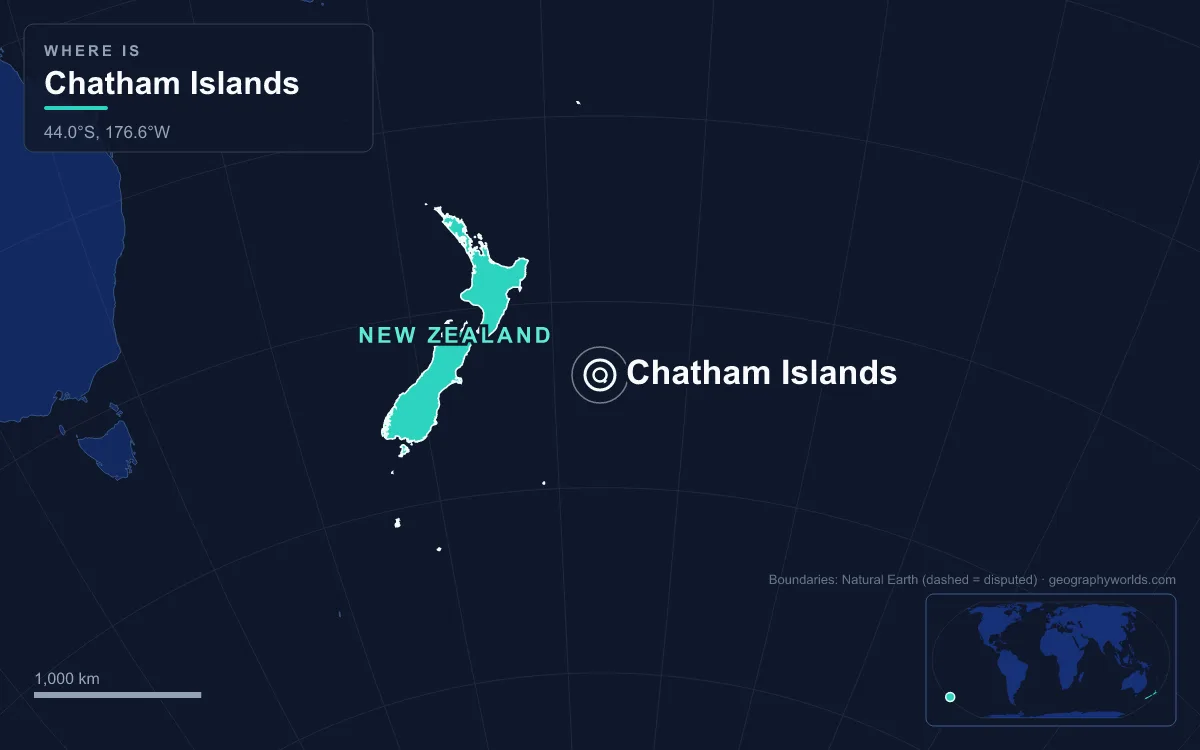
The Chatham Islands are a cluster of about ten islands within a radius of roughly 60 km, centred near 44°S and 176°30′W. Chatham Island is by far the largest, followed by Pitt Island, 65 km², about 20 km to the southeast across Pitt Strait; the two together make up most of the group's 793.87 km² of land. The islands are the only part of the Chatham Rise, a submerged plateau of the largely drowned continent of Zealandia, that breaks the surface, and they emerged only within the last four million years. The nearest point of mainland New Zealand is Cape Turnagain in the North Island, 650 km away. The Forty-Fours, a group of rocks about 50 km east of Chatham Island, hold New Zealand's easternmost point.
That position creates the islands' time puzzle. At 176°30′W the Chathams lie east of the 180th meridian, in what is technically the western hemisphere. By pure longitude they would belong with Samoa or Hawaii on the far side of the International Date Line. Instead, the date line is drawn to the east of the archipelago so that the Chathams share the same calendar day as the rest of New Zealand. The islands are run from New Zealand, supplied from Napier and Timaru and served by flights from Christchurch, Wellington and Auckland, so living a day apart from them would make no sense.
Keeping the date but not quite the hour is the compromise. Local mean solar time at 176°30′W is about UTC−11:46, which, read on the western side of the date line, is equivalent to UTC+12:14. New Zealand's standard meridian is the 180th, giving UTC+12. The Chathams sit about 14 minutes of sun-time east of that, but they chose a clock 45 minutes ahead of Wellington rather than one rounded to the hour or half-hour. Average solar noon therefore falls at about 12:31 on Chatham Standard Time, and at about 1:31 pm in summer.

From New Zealand Mean Time in 1868 to the Standard Time Act 1945
The 45-minute gap is older than almost every other time zone on Earth. On 2 November 1868, New Zealand officially adopted a national standard time, the first country to do so and about fifteen years ahead of any other. New Zealand Mean Time was based on longitude 172°30′E, which made it 11 hours 30 minutes ahead of Greenwich Mean Time. The Chatham Islands were set 45 minutes ahead of that, at GMT+12:15, a figure within about a minute of their actual local solar time.
So, at the start, the Chathams' clock was the more astronomically honest of the two. What changed was the mainland. New Zealand experimented with summer time through the Summer Time Act 1927 and its revisions in 1928 and 1929, which settled on a half-hour shift each summer. During the Second World War, emergency regulations in 1941 advanced the clocks by half an hour for the whole year to save electricity, putting the country 12 hours ahead of GMT. The Standard Time Act 1945 made that change permanent from 1946 and made the 180° meridian the basis of New Zealand time.
The Chathams moved in step. Rather than staying at GMT+12:15, they kept their 45-minute lead over the new standard and so landed on GMT+12:45, where they have been ever since. The Time Act 1974 then redefined New Zealand Standard Time against Coordinated Universal Time as exactly 12 hours ahead of UTC, and the Chatham Islands' offset followed as UTC+12:45. Today New Zealand law divides the country into two standard time zones: New Zealand Standard Time for the main islands and Chatham Standard Time for the archipelago. In military and aviation shorthand, the Chathams are zone "M^", or Mike-Three, while the mainland is plain "M".
The history explains why the Chathams look so odd on a modern map. Their offset was never invented as a quirk; it is the leftover of a sensible 1868 arrangement that survived after the mainland advanced half an hour.
Chatham Daylight Time and the September–April Switch
The Chathams change their clocks on the same days as the rest of New Zealand, so the 45-minute lead never varies. Since September 2007, New Zealand daylight saving has run from the last Sunday in September to the first Sunday in April, a 27-week season that replaced the previous 24 weeks after a government announcement on 30 April 2007. The mainland springs forward at 2:00 am NZST and falls back at 3:00 am NZDT; the Chathams make the same changes at 2:45 am and 3:45 am local time, the same instant in UTC.
In practice that gives the islands four distinct offsets over a year when compared with the rest of the world:
- April to September (southern winter): Chatham Standard Time, UTC+12:45; mainland New Zealand on UTC+12.
- September to April (southern summer): Chatham Daylight Time, UTC+13:45; mainland on UTC+13.
- Against London: the gap swings between 11 hours 45 minutes and 13 hours 45 minutes, because Britain and New Zealand change their clocks in opposite seasons.
- Against Wellington: always exactly 45 minutes ahead.
The summer offset matters for the islands' best-known claim. With clocks at UTC+13:45 between late September and early April, the Chathams are ahead of every inhabited place except Kiribati's Line Islands, which sit on UTC+14 all year. Wikipedia's article on Pitt Island describes its Kahuitara Point as the first populated place on Earth to see the sunrise of each new year, by local time. On 1 January the Chathams are deep in summer, sunrise comes early, and the date line has already put them into the new day.
Chatham Clocks Against Wellington, Tonga and Kiritimati
Placing the Chathams among their Pacific neighbours shows how crowded the far side of the clock has become. Fiji keeps UTC+12 and has not used daylight saving since the 2020–21 season. Tonga uses UTC+13 year round. Samoa moved from UTC−11 to UTC+13 at the end of 29 December 2011, skipping the 30th, and dropped its daylight saving in 2021. Tokelau made the same leap in 2011, also to UTC+13. Kiribati's Line Islands, including Kiritimati, have been on UTC+14 since the change of 31 December 1994.
In the southern winter the picture changes. At UTC+12:45 the Chathams fall behind Tonga, Samoa, Tokelau and Kiribati's Phoenix Islands, all on UTC+13, as well as the Line Islands on UTC+14. Only in summer do they jump almost to the front of the queue. Among the world's three 45-minute offsets, the Chathams are the only one that changes with the seasons: Nepal stays on UTC+5:45 all year, and the unofficial Central Western Time around Eucla in Western Australia keeps UTC+8:45. The reasons behind Nepal's version are set out in our piece on why Nepal is on UTC+5:45.

Flights from Christchurch, Crayfish and Rēkohu’s Morning
For the 620 people who lived on the islands in June 2025, the time zone shows up most clearly in the flight schedule. Visitors usually arrive on Air Chathams, the islands' own airline, headquartered at Te One, which flies twin-turboprop ATR 72–500s to Tuuta Airport from Auckland, Wellington and Christchurch. Planes typically leave the Chathams at about 9:30 am Chathams time and land on the mainland around 11 am New Zealand time, then head back at about 2 pm New Zealand time. A flight of about two and a quarter hours that appears to take an hour and a half on the clocks is the daily reminder of the 45-minute gap.
The economy depends mostly on fishing, especially crayfish, which leaves the islands live by air; Air Chathams keeps a dedicated Saab 340 freighter partly to carry the catch during the crayfish season. Freight comes by sea on the MV Southern Tiare from Napier and Timaru. Mains power on Chatham Island comes from diesel generators and two 225 kW wind turbines, at five to ten times the cost of electricity on the mainland. All of these links run to timetables written in mainland time, so islanders live with two clocks in their heads: Chathams time at home, New Zealand time for anything booked off the island.
The islands' names carry their own layered history. The Moriori, the first people to settle here, probably in the 15th century, called the islands Rēkohu, often translated as "misty sun". The Māori name is Wharekauri. The English name comes from HMS Chatham, whose crew under William Broughton landed on 29 November 1791 and named the main island after John Pitt, 2nd Earl of Chatham, then First Lord of the Admiralty. That date is still marked locally as Chatham Islands anniversary day, observed on the Monday nearest 30 November.
The time zone, finally, is a matter of law rather than local custom. The Chatham Islands Council, set up by the Chatham Islands Council Act 1995, runs the territory much like a unitary authority, but it does not set the clocks; Chatham Standard Time is defined in national legislation alongside New Zealand Standard Time. That gives the islands a status no other small New Zealand community has: a legally separate time zone, 45 minutes of distance from Wellington that has lasted more than 150 years.
The reason that distance can sit east of the 180th meridian without putting the islands into yesterday is the bend in the date line drawn around them, a story explained in full in our guide to how the International Date Line works.