
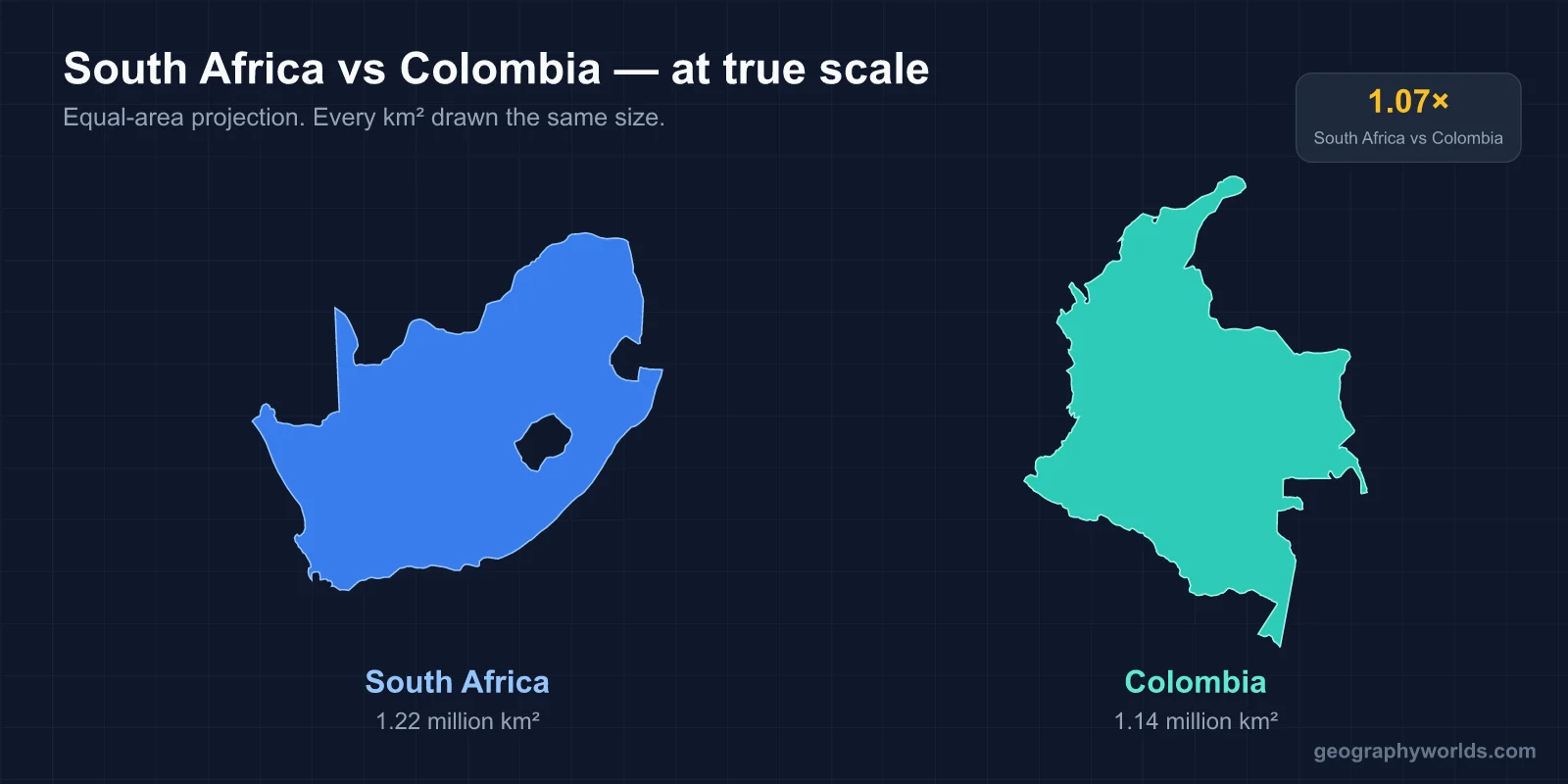
Put side by side, South Africa comes out slightly bigger and more populous, and Colombia richer, higher and far wetter. South Africa covers 1,221,037 km², about 7 percent more than Colombia's 1,141,748 km², and had roughly 63.0 million inhabitants in 2024, compared with Colombia's 52.7 million. Colombia is richer per person: the IMF's 2026 estimates give it a nominal GDP per capita of about US$10,100, against about US$7,500 for South Africa. Colombia has one capital, Bogotá, and one national language, Spanish, spoken by about 99 percent of the population. South Africa splits its capital functions between Pretoria (executive), Cape Town (legislative) and Bloemfontein (judicial). It has twelve official languages, of which Zulu, Xhosa and Afrikaans are the most common first languages, with English dominant in government. The two countries are on different continents, but they are close enough in size, population and income that the headline comparisons are tight. Each answer below comes with figures.
Which Is Bigger, Colombia or South Africa?
South Africa wins by about 79,000 km², a margin roughly the size of Panama. Measured by the land alone, the gap is almost the same. South Africa's land area is 1,220,813 km², and water makes up only about 0.4 percent of its territory, compared with about 2.1 percent in Colombia. On the world list by area, they sit side by side: South Africa is 24th and Colombia 25th.
Their shapes are very different. South Africa is a compact block at the southern tip of Africa, with about 2,800 km of coastline running from the Namibian border on the Atlantic, around the Cape, to Mozambique on the Indian Ocean. Colombia sits at the north-western corner of South America. It has coasts on the Caribbean Sea and the Pacific Ocean, plus the island department of San Andrés, Providencia and Santa Catalina, off the coast of Nicaragua. Colombia borders five countries: Venezuela, Brazil, Peru, Ecuador and Panama. South Africa borders Namibia, Botswana, Zimbabwe, Mozambique and Eswatini, and it completely surrounds Lesotho.
At sea the order flips. South Africa's exclusive economic zone, including the waters around its sub-Antarctic Prince Edward Islands, covers about 1.54 million km² and is larger than its land. Colombia's, at about 808,000 km², is smaller than its land.
Which Has More People, and Do They Live in Bogotá or Johannesburg?
South Africa has about 10 million more people. Its 2022 census counted 62,027,503, and the 2024 estimate was just over 63 million. Colombia's national statistics office projected 52.7 million for 2024. Because the areas are so similar, so are the densities: about 51 people per km² in South Africa and about 46 in Colombia.
The biggest cities differ more than the national totals. Colombia's population is concentrated in the Andean highlands and along the Caribbean coast, and the capital is also the largest city. Bogotá has more than 7 million people. Medellín, the second city, counted 2.4 million at the 2018 census, and Cali and Barranquilla follow. The nine eastern lowland departments cover about 54 percent of Colombia's territory but hold under 6 percent of its people. About 77 percent of Colombians live in urban areas, up from 29 percent in 1938.
South Africa's largest city is not a capital at all. Johannesburg grew out of the Witwatersrand gold rush of 1886 and passed 100,000 people within a decade. The 2022 census counted 4.8 million people in the city and 15.1 million in the wider metropolitan area, making it one of the 100 largest urban areas in the world. Pretoria, the executive capital, is about 56 km to the north-north-east. Cape Town and Durban are the second and third cities. Our guide to South Africa's three capitals explains how the split came about when the Union was formed in 1910.
Language shows the widest gap of all. About 99.2 percent of Colombians speak Spanish. Colombia also uses 65 Amerindian languages, two Creoles, Romani and Colombian Sign Language, and English is official in the San Andrés archipelago. South Africa recognised eleven official spoken languages in its 1996 constitution and added South African Sign Language as the twelfth on 3 May 2023. Zulu is the most common first language (23 percent), followed by Xhosa (16 percent) and Afrikaans (14 percent).
Which Is Richer: Colombian Coffee and Oil or South African Platinum and Gold?
Colombia is richer on every standard measure. In the IMF's April 2026 estimates, Colombia's nominal GDP was about US$540 billion, against about US$480 billion for South Africa. Per person, the figures were US$10,104 against US$7,503. At purchasing power parity, the gap is wider: US$23,576 against US$16,740. Colombia also ranks higher on the UN Human Development Index, at 0.788 (83rd) against 0.741 (106th) for 2023.
The two economies are built on different resources, with one thing in common: both are major coal exporters. South Africa's wealth came from the ground. After diamonds were found near Kimberley and gold on the Witwatersrand in 1886, the country became the world's largest producer of platinum, chromium and manganese, and it was still the 11th-largest gold producer in 2019. Johannesburg hosts Africa's largest stock exchange. Colombia's exports rest on coal and oil, which made up more than 40 percent of exports in 2020. It was the fifth-largest coal exporter in 2018. It is also the world's largest producer of emeralds, one of the five largest coffee producers, and the second-largest flower exporter after the Netherlands.
Both countries are also among the most unequal in the world. South Africa's Gini coefficient of 0.67 is among the highest in the world, a legacy of colonial and apartheid laws that kept the Black majority from land and jobs. About 32 percent of South Africans were unemployed in 2024. Colombia's has been deepened by decades of armed conflict. As of 2012, it had the world's largest internally displaced population, estimated at up to 4.9 million people.
Which Is Higher: the Sierra Nevada de Santa Marta or the Drakensberg?
Colombia, by more than 2,300 metres. Its two highest summits, Pico Cristóbal Colón and Pico Simón Bolívar, are almost equal in height, and Colón is reported at 5,775 m. Both stand in the Sierra Nevada de Santa Marta, a snow-capped massif rising behind the Caribbean coast. It is separate from the Andes, and it is the highest point in South America outside them. The Andes themselves split into three ranges in Colombia. The Cordillera Central has several snow-clad volcanoes above 5,182 m.
South Africa's high ground is the edge of a plateau rather than a separate range. The Great Escarpment rings the interior, and its tallest section is the Drakensberg, along the border with Lesotho. The country's highest point, Mafadi, reaches 3,446 m on that border. Thabana Ntlenyana, the highest summit in southern Africa at 3,482 m, stands just across it in Lesotho.

The capitals follow the same order. Bogotá stands at an average of 2,640 m on the Bogotá savanna, and no urban area on Earth is both higher and more populous. Johannesburg, on the Highveld, is at 1,753 m. Pretoria sits lower still, at about 1,339 m, in a sheltered valley ringed by the Magaliesberg hills. South Africa's inland plateau is high in its own right. Our guide to the Highveld covers the plateau Johannesburg stands on.
Which Is Wetter and Greener: Chocó or the Cape?
Colombia, overwhelmingly. South Africa receives about half the global average rainfall, and the totals increase from west to east. Most of the country gets its rain in summer, and the land dries out towards the semi-desert of the north-west. The Western Cape, around Cape Town, has a Mediterranean climate with winter rain. Colombia's Pacific lowlands are among the rainiest places on Earth. An agricultural farm at Lloró, in Chocó Department, recorded an average of 12,717 mm a year between 1952 and 1989. That is a disputed claim to the world record, which is officially held by Mawsynram in India.
Both countries are on the list of 17 megadiverse nations, but the rankings favour Colombia. It had about 63,000 registered species in 2021. It ranks first in the world for bird and orchid species, and second overall in biodiversity. Its national tree, the Quindío wax palm, can reach 45 m or more, making it the tallest recorded monocot. It grows in the Cocora Valley of the Cordillera Central. See our guide to Colombia's climate for how altitude sorts these zones.

South Africa's strength is concentration. The Cape Floristic Region, near the country's southern tip, is the smallest of the world's six floral kingdoms. It holds more than 9,000 vascular plant species, 69 percent of them found nowhere else, mostly in the fire-adapted shrubland called fynbos.
Which Became a Nation First: Boyacá in 1819 or the Union of 1910?
Colombia, by almost a century. Its independence movement began with the Bogotá junta of 20 July 1810 and was secured at the Battle of Boyacá on 7 August 1819. That same year, Gran Colombia was proclaimed, and it was dissolved in 1831. The country took its present name in 1886 and its current constitution in 1991. South Africa was created on 31 May 1910 as the Union of South Africa, from four British colonies: the Cape, Natal, the Transvaal and the Orange River Colony. It became a republic on 31 May 1961, after a referendum held in 1960, but most Black South Africans could not vote until 1994. Its current constitution dates from 4 February 1997. Football offers one last contrast. Colombia was chosen to host the 1986 FIFA World Cup but withdrew in November 1982, largely for economic reasons. South Africa hosted the tournament in 2010.