
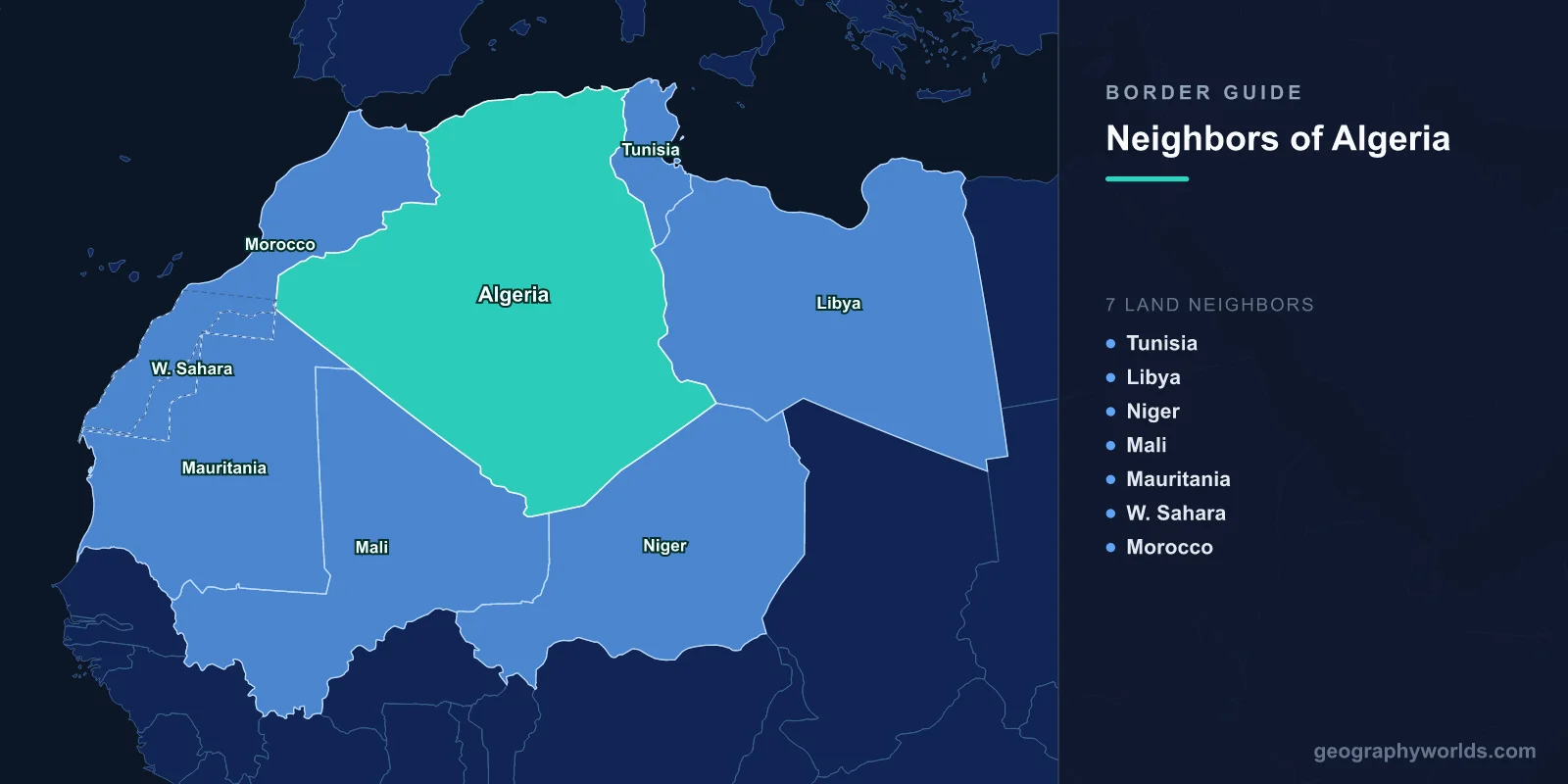
Algeria shares land borders with seven countries: Tunisia and Libya to the east, Niger to the southeast, Mali to the southwest, Mauritania to the west-southwest, Western Sahara to the west, and Morocco to the northwest.
Introduction
Algeria is the largest country in Africa at 2.38 million km², and over 80% of its territory is Saharan desert. Its 6,734 km of borders, the longest total in Africa, cross the Mediterranean Tell Atlas, the Saharan Atlas, and the vast Saharan interior. Algeria's geopolitical rivalry with Morocco over the Western Sahara issue dominates its border politics.

Overview of Algeria's Borders
- Total Land Borders: 6,734 km
- Number of Neighbors: 7 countries
- Longest Border: Morocco (1,559 km)
- Key Feature: Sahara Desert covers 80% of the country
Algeria's borders were drawn during French colonial rule (1830-1962), when France controlled a vast North African empire. The borders with Mali, Niger, and Mauritania cross the deep Sahara, following lines drawn at colonial conferences with no reference to local geography or populations. The Tuareg people, nomadic Saharan inhabitants, are divided among Algeria, Mali, Niger, Libya, and Burkina Faso.
Algeria has the longest total border perimeter in Africa due to its enormous size. However, most of these borders cross uninhabited or very sparsely populated Saharan terrain where border enforcement is minimal. The northern Mediterranean coast, where 90% of Algeria's population lives, has relatively short borders with Morocco and Tunisia.
Eastern Neighbors: Tunisia and Libya
- Tunisia Border: 1,034 km
- Libya Border: 989 km
- Key Feature: Atlas Mountains, Saharan borderlands
Tunisia's 1,034 km border runs from the Mediterranean coast through the Atlas Mountains into the desert. This border is relatively well-managed, with active cross-border trade and tourism. However, militant groups in the mountainous border region (Chaambi Mountains) have posed security threats. Algeria and Tunisia coordinate on counterterrorism operations.
Libya's 989 km border crosses Saharan terrain that has become a major smuggling and migration route since Libya's state collapse in 2011. Weapons, drugs, and migrants flow through this border zone. Algeria has increased military patrols and expressed concern about Libyan instability affecting its security. The In Amenas gas plant attack in 2013 involved militants who crossed from Libya.
Southern Neighbors: Niger and Mali
- Niger Border: 951 km
- Mali Border: 1,359 km
- Key Feature: Sahara Desert, Tuareg territory, Hoggar Mountains
Niger's 951 km border crosses the central Sahara, including the area near the Hoggar Mountains, one of the most spectacular volcanic landscapes in the desert. The border area is extremely remote and sparsely populated, used primarily by Tuareg nomads and trans-Saharan travelers. Algeria has been involved in mediating Niger's political crises.
Mali's 1,359 km border is the most security-sensitive Saharan frontier. Northern Mali's Tuareg rebellions and jihadist groups (AQIM, later JNIM and ISGS) have operated near and across this border. Algeria brokered the 2015 Algiers Accord for Malian peace but has refused direct military intervention. The Tin Zaouatine and Bordj Badji Mokhtar crossing points are key transit hubs.
Western Neighbors: Mauritania, Western Sahara, and Morocco
- Mauritania Border: 460 km
- Western Sahara Border: 41 km
- Morocco Border: 1,559 km
Mauritania's 460 km border crosses the western Sahara. Western Sahara's 41 km border connects to the territory that Algeria supports the Polisario Front in claiming as an independent state (the Sahrawi Arab Democratic Republic). Algeria hosts the Tindouf refugee camps, where approximately 170,000 Sahrawi refugees have lived since Morocco took control of Western Sahara in 1975.
Morocco's 1,559 km border is Algeria's most contentious, closed since 1994. The Morocco-Algeria rivalry is the defining geopolitical fault line of North Africa, centered on the Western Sahara dispute. Morocco severed diplomatic relations in 2021 after accusing Algeria of supporting separatism. Military spending on both sides has increased, making this one of the most tense borders in Africa.
Cross-Border Relations and Strategic Position
- OPEC Member: Major oil and gas exporter
- Western Sahara: Core foreign policy issue
- Sahel Security: Algeria is key actor in Sahara-Sahel security
Algeria's oil and gas wealth (Africa's largest natural gas reserves) gives it significant regional influence. It exports gas to Europe via pipelines through Tunisia and Morocco, making energy transit a cross-border political issue. Algeria has proposed new pipelines to bypass Morocco, reflecting the depth of their rivalry.
Algeria positions itself as a mediator in Saharan and Sahelian conflicts while maintaining a policy of non-intervention. It has hosted peace talks for Mali, Libya, and other regional crises. However, critics argue Algeria uses the Western Sahara issue to keep Morocco contained. The Tindouf refugee camps on its territory are both a humanitarian commitment and a geopolitical tool.
Key Facts
- Algeria borders 7 countries: Tunisia, Libya, Niger, Mali, Mauritania, Western Sahara, and Morocco.
- Algeria is the largest country in Africa at 2.38 million km².
- The Moroccan border at 1,559 km has been closed since 1994.
- Over 80% of Algeria is Saharan desert.
- Algeria hosts approximately 170,000 Sahrawi refugees from Western Sahara.
Fun Facts
- Algeria's land area is roughly the same size as Western Europe.
- The closed border costs Algeria and Morocco an estimated $2-3 billion annually in lost trade.
- The Hoggar Mountains in the central Sahara near the Niger border reach 2,918 m.
- Algeria fought one of the longest and bloodiest independence wars in African history (1954-1962).
Final Thoughts
Algeria's seven borders encircle Africa's largest country, from the Mediterranean coast to the heart of the Sahara. The closed Moroccan border, the security-sensitive Saharan frontiers, and the role of Algerian gas pipelines crossing multiple borders make Algeria a pivotal player in both North African and Sahelian geopolitics.
Test Your Knowledge!
Think you know which countries share borders? Try our geography games!
Play Geography Games →